Mike Ritchie
24 titels in de boekenbase · Vertaler · 2009–2023
Over Mike Ritchie
Mike Ritchie staat met 24 titels in de boekenbase als vertaler. Bekend van de series ‘Essayreeks’ en ‘Kroller-muller reeks’. Het werk valt vooral onder kunst en cultuur (>12 jaar), kleuterboeken en kunst algemeen. Verschenen tussen 2009 en 2023 bij City Thoughts, Stichting en EYE filmmuseum. Over het werk verschenen 2 recensies.
Serie: Topwerken Kröller-Müller Museum →
Isaac Israels
Jeroen Kapelle
Isaac Israels
Jeroen Kapelle
Paperback · 2021
Isaac Israels
Jeroen Kapelle
Isaac Israels
Jeroen Kapelle
Paperback · 2021
Jean Dubuffet. Jardin d’émail
Roos van der Lint
Jean Dubuffet. Jardin d’émail
Roos van der Lint
Paperback · 2020
Serie: Kroller-muller reeks →
Vestibulum 2
Steven ten Thije
Vestibulum 2
Steven ten Thije
Paperback · 2019
De vroege Van Gogh
Auke van der Woud
De vroege Van Gogh
Auke van der Woud
Paperback · 2016
Herman de Vries toevalstekeningen 1970-1975
Lisette Pelsers
Herman de Vries toevalstekeningen 1970-1975
Lisette Pelsers
Hardback · 2015
Serie: Kroller-muller series →
Zwaan krijgt stippen
Sandra Overweg
Zwaan krijgt stippen
Sandra Overweg
Hardback · 2014
Swan gets dots
Sandra Overweg
Swan gets dots
Sandra Overweg
Hardback · 2014
Overige titels
Met verf 4: Paul Drissen. Short Cuts
Rudi Fuchs
Met verf 4: Paul Drissen. Short Cuts
Rudi Fuchs
Paperback · 2023
Vestibulum 4
Auke-Florian Hiemstra
Vestibulum 4
Auke-Florian Hiemstra
Paperback · 2021
MARINUS BOEZEM ALLE SHOWS . ALL SHOWS
Marinus Boezem
MARINUS BOEZEM ALLE SHOWS . ALL SHOWS
Marinus Boezem
Paperback · 2021
MARINUS BOEZEM ALLE SHOWS . ALL SHOWS
Marinus Boezem
MARINUS BOEZEM ALLE SHOWS . ALL SHOWS
Marinus Boezem
Paperback · 2021
Vestibulum 3
Florette Dijkstra
Vestibulum 3
Florette Dijkstra
Paperback · 2019
Cosmogonics
Franck Gribling
Cosmogonics
Franck Gribling
Paperback · 2015
The myth of Artisthood
Camiel van Winkel
Hardback · 2013
Call of the mall
Maaike Lauweart
Call of the mall
Maaike Lauweart
Paperback · 2013
Oskar Fischinger 1900-1967
Jean-Michel Bouhours
Oskar Fischinger 1900-1967
Jean-Michel Bouhours
Paperback · 2012
Tilleke Schwarz
Tilleke Schwarz
Tilleke Schwarz
Tilleke Schwarz
Paperback · 2012
Phantom City
Kim Bouvy
Paperback · 2010

Bob Negryn the flat view
Miriam Windhausen
Paperback · 2009
Darkness is a Place
Hans den Hartog Jager
Paperback · 2009
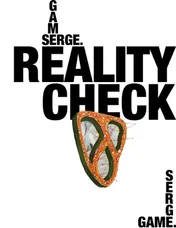
Reality Check. Serge Game
Hans den Hartog Jager
€ 24,50
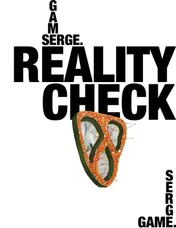
Reality Check. Serge Game
Hans den Hartog Jager
€ 24,50
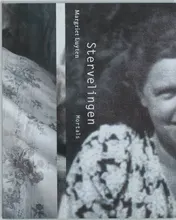
Stervelingen - Mortals
M. Luyten
€ 29,50
Over het werk gezegd
De schilder met de opmerkelijke naam Serge Game (Rotterdam, 1970) is een schepper van een sciencefiction-achtige wereld waarin kleurige 'blobachtige' figuren voorkomen die enigszins aan ruimtewezens doen denken. Game werkt met verschillende soorten verf, waarin de figuren meestal dekkend zijn geschilderd en de achtergrond veelal doorschijnend. In de catalogus zijn veel paginagrote foto's van zijn werk opgenomen, impressies van zijn werkplek en biografische informatie. De kunstcriticus Hans den Hartog Jager probeert het werk wat meer te duiden in een interview, maar het gesprek lijkt niet erg te vlotten ('Is je werk escapistisch?' 'Wat bedoel je daarmee?') Schilders zijn dan ook meestal geen praters, maar doeners. Game exposeerde nog voornamelijk in Nederland, met uitstapjes naar bijv. Berlijn. Voor liefhebbers van hedendaagse schilderkunst.
Biblion · over Reality Check. Serge Game
From 13 December 2009 to 14 March 2010, the Stedelijk Museum Schiedam will organize the exhibition entitled Unisono 21: Serge Game. Totally Together. In the colourful paintings, the artist combines large, expanding, flowing forms and amorphous structures. The large-scale paintings that Game has made in the past four years evoke a world with a type of reality that we seem to know, like the one we can perceive through a microscope. The paintings become accessible through the broad gesture, but also invite the viewer to examine them in much closer detail. A strong spatial effect is created due to the alternating use of mat and glossy paint, large shapes combined with smaller ones, and the contrast of the amorphous background. Serge Game lives and works in Rotterdam. The paintings that Serge Game (Tilburg, 1970) has made in the past four years provoke all kinds of questions. The colourful amorphous structures and substances on the canvas cannot be interpreted straightforwardly. Do they represent objects or forms from our visible reality, or are we looking at painterly exercises in which the artist is investigating the formal possibilities of painting? The titles of the paintings do not provide a solution. Words such as Tweekland, Ronin, Volvo, Dialoog, Looker or Diafragma seem to refer to matters beyond the picture rather than to the representation itself. In his recent work, the method of painting appears to have become more important. The ambience of the paintings is less manifest, less grim, and the emphasis has shifted to the form. Serge Game's paintings are abstract in the sense that they do not directly refer to a visual reality. They seem to represent a different kind of reality, one that occurs beyond our field of vision, at micro-level, too small to be viewed by the naked eye. For his present work, Game himself uses the term organic abstraction. It is a reference to what is depicted but it simultaneously says something about the way Game paints: it not only concerns what has been represented but also primarily how this representation has been created. To Serge Game, the process of painting is at least as important as the ultimate result. First of all he makes drawings that serve as the basis for new pictures. During this drawing process he tries to act as spontaneously and uncontrolled as possible. Paint and brush produce figures that serve as the basis for new images. In this phase, Game exercises a form of automatic drawing. His aim is to allow drawing to be an action in which organic forms arise as unconsciously as possible. These can then be enlarged on canvas and further elaborated. In the paintings, other forms and figures are added, colours and paint structures applied, the spontaneous gesture is exchanged for well-considered decisions. The artist is now seeking a visually logical coherence for the various components of the image, the appropriate tension, a balance in the alignment of forms, colours and material. The work of Serge Game unites divergent pictorial attitudes. The action and the image-related result of the paintings play an equal role. While the sketches are performed primarily as a spontaneous action, the painter makes well-deliberated decisions in the elaboration, to arrive at the definitive image. Game's paintings resemble things we know but, at the same time, are scarcely nameable. The pictures most call to mind undefined comic strip figures and architectonic and organic fabrications. But they do not offer anything to hold on to, to grasp tightly, neither in the image presented nor in the title of the picture.
Stedelijk Museum Schiedam exhibition Unisono 21: Serge Game · over Reality Check. Serge Game