
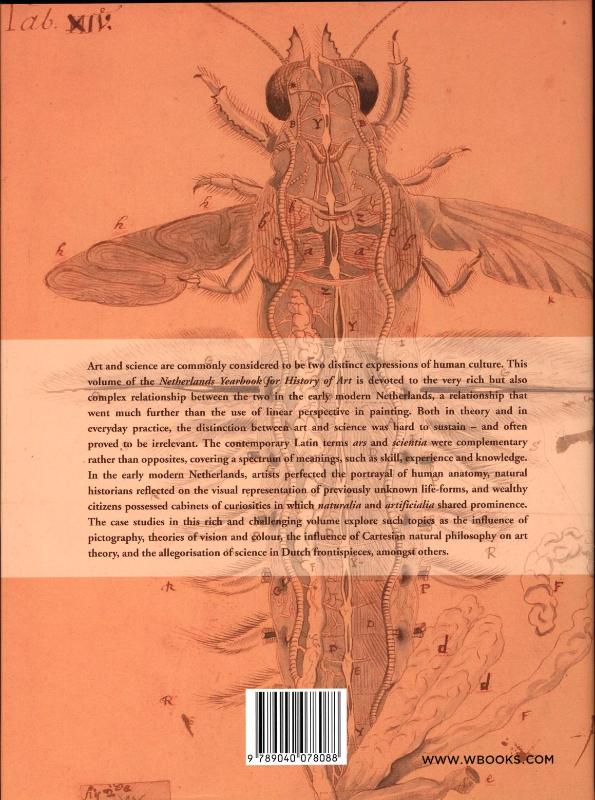
Kunst en wetenschap worden veelal beschouwd als geheel verschillende uitingen van de menselijke cultuur. Deze aflevering van het Nederlands Kunsthistorisch Jaarboek is gewijd aan de uitzonderlijk rijke en complexe verhouding tussen beiden in de vroegmoderne Nederlanden, die veel verder ging dan het gebruik van lijnperspectief in de schilderkunst. Zowel in theorie als in de alledaagse praktijk was de grens tussen kunst en wetenschap nauwelijks te trekken, en deed deze er feitelijk ook weinig toe. Kunstenaars oefenden zich in de weergave van de menselijke anatomie, natuuronderzoekers dachten diepgaand na over de representatie van voorheen onbekende levensvormen, en vermogende burgers legden rariteitenverzamelingen aan, waarin naturalia en artificalia ogenschijnlijk kriskras door elkaar werden tentoongesteld. Themas in Art and science in the early modern Netherlands zijn onder meer de rol van pictografie; uiteenlopende theorieën over licht en kleur; de invloed van nieuwe natuurfilosofische ideeën op de kunsttheorie, en de frontispices van wetenschappelijke boeken.Art and science are commonly considered to be two distinct expressions of human culture. This volume of the Nederlands Kunsthistorisch Jaarboek is devoted to the extremely rich and complex relationship between these two in the early modern Netherlands, a relationship which went much further than the use of a linear perspective in painting. Both in theory and in everyday practice, the distinction between art and science was hard to sustain, and often proved to be not that relevant at all. Artists perfected the portrayal of human anatomy, natural historians reflected on the visual representation of previously unknown forms of life, and wealthy citizens possessed cabinets of curiosities in which naturalia and articificalia shared prominence. Case studies in Art and science in the early modern Netherlands explore the influence of pictography; theories of vision and colour; the influence of Cartesian natural philosophy on art theory, and the the allegorisation of science on Dutch frontispieces.
In het kort
ISBN-13
9789040078088
Uitgever
Verschenen
30 november 2011
Serie
Art and science in the early modern Netherlands / Kunst en wetenschap in de vroegmoderne Nederlanden
Bibliografisch
ISBN-139789040078088
SerieArt and science in the early modern Netherlands / Kunst en wetenschap in de vroegmoderne Nederlanden
Editie1
TaalMeertalig mul
Pagina’s306
GeïllustreerdJa
Uitgave
Vorm & inhoud
ProductvormHardback BB
SamenstellingLos product
Classificatie
NUR (hoofd)Kunstgeschiedenis 654
NUR (alle)654 Kunstgeschiedenis
Medewerkers
Redacteur B01Eric Jorink
Redacteur B01Bart Ramakers
Herkomst
Werk-id (NSTC)500283478
MeldingBevestigd bij publicatie 03
Bijgewerkt6 augustus 2026
Lijkt op dit boek
NSTC 500283478 · CB-relatie 6509637 · Bijgewerkt 6 augustus 2026