
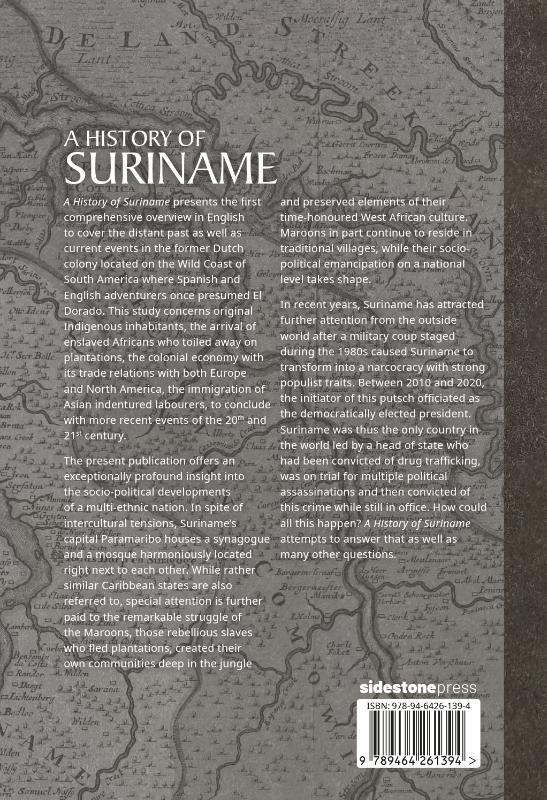
PrefaceChapter 1. Original inhabitants and the first colonisationChapter 2. The Society of Suriname2.1 Introduction2.2 The government of Suriname, a continuous struggle for power2.3 The fight of the cabalistsChapter 3. The white colonial society3.1 Arrival of the first white colonists3.2 Jewish immigration3.3 Social structure3.4 A society without cohesion3.5 Sexual relations of whites with people of colour and Black people3.6 Education3.7 ReligionChapter 4. Slavery4.1 Introduction4.2 Demographic developments4.3 Supervising the enslaved workforce4.4 Slaves in their own world4.5 Free people of colour and free Black peopleChapter 5. Marronage5.1 Introduction5.2 The Boni-Maroon Wars (1765-1778 and 1789-1793)Chapter 6. Inhabitants of the inland6.1 The formation of Maroon societies6.2 Amerindians in the colonial societyChapter 7. Emancipation of the enslavedChapter 8. The economy (1651-1863)Chapter 9. Transforming the colonial society (1863-1942)9.1 Immigration of indentured labourers from Asia9.2 Creoles after emancipation9.3 Tensions within a plural society9.4 The position of Asian populations9.5 Social struggle during the 1930s9.6 Change in assimilation policyChapter 10. Transforming the plantation economyChapter 11. Towards autonomy and independence11.1 World War II11.2 Political mobilisation11.3 Fraternization policy and elite-cartel democracy11.4 Independence and failed nation-building11.5 The Dutch stance on independence11.6 The post-1975 malaiseChapter 12. Economic development (1945-1980)Chapter 13. Military rule (1980-1987)13.1 The 25 February Movement13.2 Dialogue with ‘old’ politicians13.3 Economic developmentsChapter 14. Return to civilian rule14.1 Constitution and elections14.2 War in the Interior14.3 The so-called telephone coup14.4 The Nieuw Front-led government14.5 A more business-like aid relationship and restoring financial stabilityChapter 15. Contours of informal power and narcocracy15.1 The business elite, a divisive force within the Nieuw Front15.2 Old parties in a minority position for the first time15.3 A government of ‘a boss and bosses’15.4 Crisis in relations with the Netherlands15.5 Mass demonstrations against malpractices and corruption15.6 Crisis after malpractice and corruptionChapter 16. Suriname in the 21st century16.1 Introduction16.2 Old parties return to power16.3 Political emancipation of Maroons16.4 Desi Bouterse, President16.5 From sheriff to President16.6 Economy in transitionChapter 17. EpilogueA History of Suriname presents the first comprehensive overview in English to cover the distant past as well as current events in the former Dutch colony located on the Wild Coast of South America where Spanish and English adventurers once presumed El Dorado. This study concerns original Indigenous inhabitants, the arrival of enslaved Africans who toiled away on plantations, the colonial economy with its trade relations with both Europe and North America, the immigration of Asian indentured labourers, to conclude with more recent events of the 20th and 21st century.The present publication offers an exceptionally profound insight into the socio-political developments of a multi-ethnic nation. In spite of intercultural tensions, Suriname’s capital Paramaribo houses a synagogue and a mosque harmoniously located right next to each other. While rather similar Caribbean states are also referred to, special attention is further paid to the remarkable struggle of the Maroons, those rebellious slaves who fled plantations, created their own communities deep in the jungle and preserved elements of their time-honoured West African culture. Maroons in part continue to reside in traditional villages, while their socio-political emancipation on a national level takes shape.In recent years, Suriname has attracted further attention from the outside world after a military coup staged during the 1980s caused Suriname to transform into a narcocracy with strong populist traits. Between 2010 and 2020, the initiator of this putsch officiated as the democratically elected president. Suriname was thus the only country in the world led by a head of state who had been convicted of drug trafficking, was on trial for multiple political assassinations and then convicted of this crime while still in office. How could all this happen? A History of Suriname attempts to answer that as well as many other questions.
In het kort
ISBN-13
9789464261400
Uitgever
Verschenen
9 november 2022
Imprint
Bibliografisch
ISBN-139789464261400
Editie1
TaalEngels eng
Pagina’s480
GeïllustreerdJa
Uitgave
UitgeverSidestone Press
ImprintSidestone Press
CB-relatie-id9180064
Verschenen9 november 2022
StatusOnbekend 00
Vorm & inhoud
ProductvormHardback BB
SamenstellingLos product
Classificatie
NUR (hoofd)Geschiedenis algemeen 680
NUR (alle)680 Geschiedenis algemeen
Medewerkers
Auteur A01Hans Buddingh’
Herkomst
Werk-id (NSTC)501512230
MeldingBevestigd bij publicatie 03
Bijgewerkt6 augustus 2026
Lijkt op dit boek

NSTC 501512230 · CB-relatie 9180064 · Bijgewerkt 6 augustus 2026