
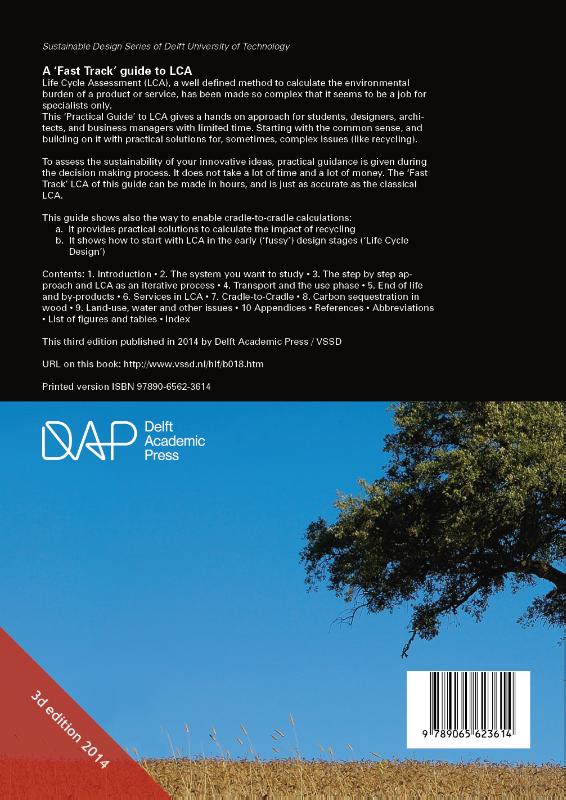
A practical guide to LCA for students designers and business managers cradle-to-grave and cradle-to-cradle
Paperback122 pagina’sEngels
Ook verkrijgbaar als
Life Cycle Assessment (LCA) is a well-defined method to calculate the environmental burden of a product or service. However, LCA has been made (needlessly?) so complex that it seems to be a job for specialists only. The specialists jargon ('functional unit', 'fate analysis', 'midpoints', 'endpoints', 'attributional modelling', etc.) makes it even more impossible for non-specialists to find out what they need to know to make an LCA.The recent LCA manual of the International Reference Life Cycle Data System of the EU is an excellent document for those people who like to become expert. The focus is on all the (theoretical) aspects of LCA: 80% of the text is on how to make an LCI (Life Cycle Inventory) and perform the Life Cycle Interpretation, including data quality checks and formalities on the reporting. However, the vast majority of students, designers, architects and business managers (and their consultants) never make LCI emission lists, nor write extensive reports on the interpretation. Most of them apply LCIs of databases of other parties (like the Ecoinvent database), apply existing single indicator systems (like eco-costs, carbon footprint, CED, BEES, Recipe, etc.), and draw simple conclusions on what seems to be the best solution in terms of environmental burden. Students tend to make LCAs by using computer software. They quickly learn how the input works, regard the calculation as a black box, and watch how the output varies with the input. Basically, they make the LCA by instinct and common sense.However, not all students are equal: some appear to have a much better instinct and common sense than others. Some issues in LCA are too complex to be tackled by common sense only. So these people need a little help and practical guidance.When I realized the abovementioned situation, I decided to write this Practical Guide to LCA, starting with the common sense, and build on it with practical solutions for, sometimes, complex issues (like recycling). The examples are given in eco-costs; however, most of the examples are identical for other single indicators, like BEES, Ecological Scarcity, Ecoindicator 99, Recipe, Carbon Footprint, etc.After two years of intensive use of the First Edition, the Second Edition as issued, with two extra issues: how to define the Functional Unit and the Declared Unit, and how to structure recycling calculations. The Third Edition is based on eco-costs 2012 data.
In het kort
ISBN-13
9789065623614
Uitgever
Verschenen
3 november 2014
Imprint
Bibliografisch
ISBN-139789065623614
Editie4
TaalEngels eng
Pagina’s122
GeïllustreerdJa
Uitgave
UitgeverDelft Academic Press / VSSD
ImprintDelft Academic Press
CB-relatie-id8095824
Verschenen3 november 2014
StatusInactief 08
BeschikbaarheidContact leverancier 99
Adviesprijs (incl. btw)€ 16,00
Vorm & inhoud
ProductvormPaperback BC
SamenstellingLos product
Classificatie
NUR (hoofd)Materiaalkunde 971
NUR (alle)971 Materiaalkunde
Medewerkers
Auteur A01Joost G. Vogtlander
Herkomst
Werk-id (NSTC)500182494
MeldingBevestigd bij publicatie 03
Bijgewerkt6 augustus 2026
Lijkt op dit boek
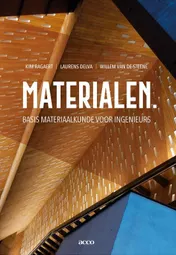
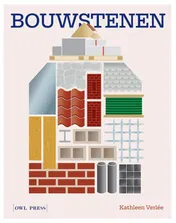
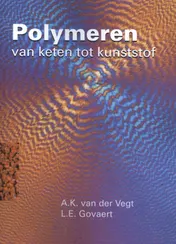
NSTC 500182494 · CB-relatie 8095824 · Bijgewerkt 6 augustus 2026