
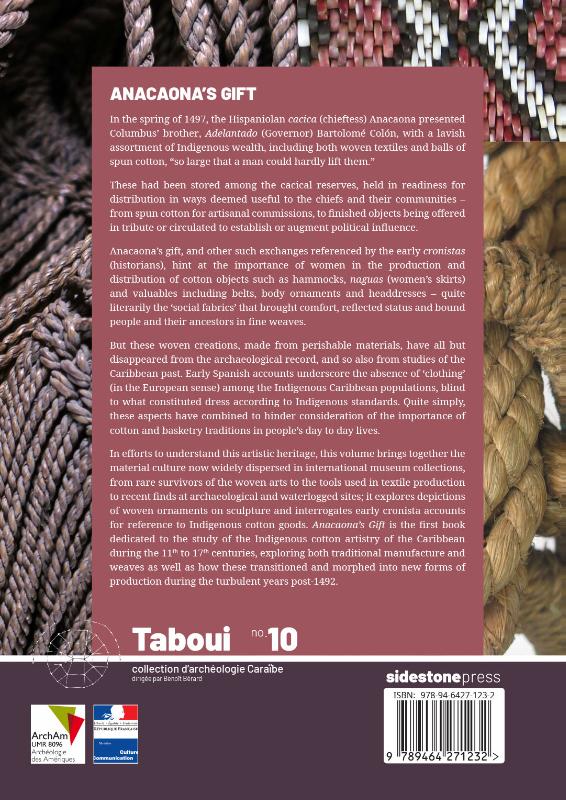
Anacaona’s gift Cotton and the woven arts of the 11th to 17th century Caribbean
Ook verkrijgbaar als
Opening quoteAcknowledgments1. “And the cotton was very well spun”: the woven artistry of the Caribbean1.1 Cotton wealth: power, politics and possession – a brief overview1.1.1 Archaeological evidence for the emergence of pre-Colonial Caribbean social inequality (Greater Antilles)1.1.2 Ethnohistoric sources documenting caciques/cacicas in Greater Antilles1.1.3 Cacicas1.1.4 The role of artistry, exotics and material wealth in the maintenance of the Greater Antillean chiefdom2. “Infinite cotton”: Cotton and fibre materials as resources2.1 The process: cotton and fibre production2.2. The weaving toolkit2.2.1 Spindle whorls2.2.2 Looms3. Woven artefacts and the circulation of cotton wealth in the pre-Colonial period3.1 The domestic sphere3.1.1 Hammocks3.1.2 Nets and fishing lines3.1.3. Basketry3.2 Regalia3.2.1 Belts3.2.2 Naguas3.2.3 Head coverings/ornaments3.2.4 Arm/leg bands3.2.5 Tunics, capes, robes and maos3.3 Cemís, ancestors and precious beings3.3.1 Cotton reliquary3.3.2 Cemí/belt3.3.3 Other cotton ‘beings’4. Through the Spanish lens: Colonial period Indigenous cotton work/production4.1 Native dress; Native wealth4.2 “Clothes maketh the man”: European clothing and status in the early Colonial Caribbean4.3 A different weave: European-style clothes made by Indigenous hands5. ConclusionsReferencesIn the spring of 1497, the Hispaniolan cacica (chieftess) Anacaona presented Columbus’ brother, Adelantado (Governor) Bartolomé Colón, with a lavish assortment of Indigenous wealth, including both woven textiles and balls of spun cotton, “so large that a man could hardly lift them.”These had been stored among the cacical reserves, held in readiness for distribution in ways deemed useful to the chiefs and their communities – from spun cotton for artisanal commissions, to finished objects being offered in tribute or circulated to establish or augment political influence.Anacaona’s gift, and other such exchanges referenced by the early cronistas (historians), hint at the importance of women in the production and distribution of cotton objects such as hammocks, naguas (women’s skirts) and valuables including belts, body ornaments and headdresses – quite literarily the ‘social fabrics’ that brought comfort, reflected status and bound people and their ancestors in fine weaves.But these woven creations, made from perishable materials, have all but disappeared from the archaeological record, and so also from studies of the Caribbean past. Early Spanish accounts underscore the absence of ‘clothing’ (in the European sense) among the Indigenous Caribbean populations, blind to what constituted dress according to Indigenous standards. Quite simply, these aspects have combined to hinder consideration of the importance of cotton and basketry traditions in people’s day to day lives.In efforts to understand this artistic heritage, this volume brings together the material culture now widely dispersed in international museum collections, from rare survivors of the woven arts to the tools used in textile production to recent finds at archaeological and waterlogged sites; it explores depictions of woven ornaments on sculpture and interrogates early cronista accounts for reference to Indigenous cotton goods. Anacaona’s Gift is the first book dedicated to the study of the Indigenous cotton artistry of the Caribbean during the 11th to 17th centuries, exploring both traditional manufacture and weaves as well as how these transitioned and morphed into new forms of production during the turbulent years post-1492.
In het kort
ISBN-13
9789464271249
Uitgever
Verschenen
30 oktober 2025
Serie
Imprint
Bibliografisch
Uitgave
UitgeverSidestone Press
ImprintSidestone Press Academics
CB-relatie-id9180064
Verschenen30 oktober 2025
StatusOnbekend 00
Vorm & inhoud
ProductvormHardback BB
SamenstellingLos product
Classificatie
NUR (hoofd)Archeologie 682
NUR (alle)682 Archeologie
Medewerkers
Auteur A01Joanna Ostapkowicz
Herkomst
Werk-id (NSTC)501626023
MeldingBevestigd bij publicatie 03
Bijgewerkt6 augustus 2026
Lijkt op dit boek
Durrington Walls and Woodhenge: A place for the living
Durrington Walls and Woodhenge: A place for the living
Indigenous Knowledge in Transformation
Indigenous Knowledge in Transformation
Archaeological Approaches to Inequality, Political Organisation, and Social Complexity
Archaeological Approaches to Inequality, Political Organisation, and Social Complexity
Stadterweiterungen und urbane Dynamik im Mittelalter
Stadterweiterungen und urbane Dynamik im Mittelalter
Prehistoric Shore Settlements of the Southwestern Balkans
Prehistoric Shore Settlements of the Southwestern Balkans
NSTC 501626023 · CB-relatie 9180064 · Bijgewerkt 6 augustus 2026