
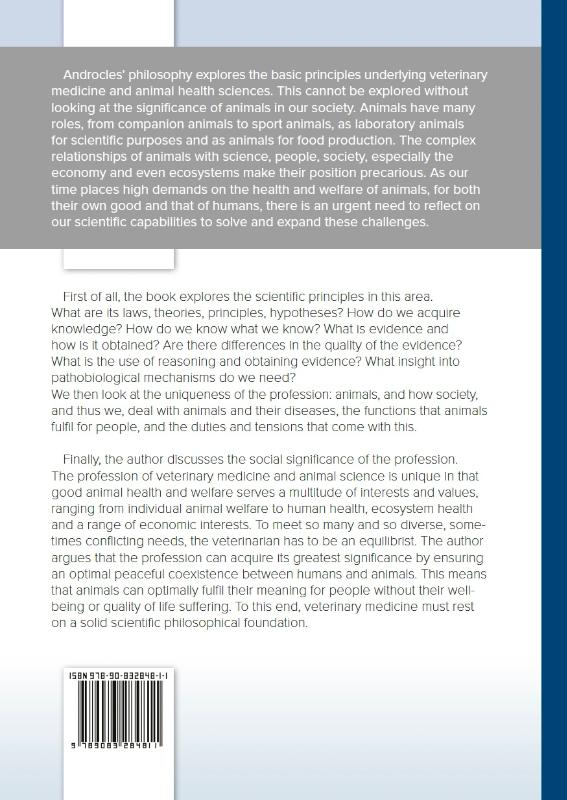
Androcles’ philosophy Principles and dilemmas of veterinary medicine and animal health sciences
Hardback359 pagina’sEngelsLeverbaar
Ook verkrijgbaar als
ContentsAbbreviationsPreface Part A Relation to Science1Do we really need a philosophy of veterinary medicine? 2What to expect of a philosophy of veterinary medicine? 3 Words give meaning4 How do we acquire and value knowledge?5 What is particularly important in veterinary science philosophy? 6Cause and evidence7 Beyond Popper: Imagination and fantasy 8Towards a philosophy of veterinary public health and One Health 9Veterinary medicine and social sciences 10 Does philosophy make veterinary science better? Part B Relation to Animals11Veterinary ethics 12The animal-healing relationship 13 How does society deal with animals? 14 A matter of life and death 15Yuk. Or: Moral disgust of pre-emptive culling 16 The veterinarian and animal rights 17Does the veterinary profession have duties? 18Modifying animals Part C Relation to Man and Society19 The position of animals in society. Or: Are people entitled to keep animals? 20For who and what are we doing it? Or: The purpose of the veterinary profession 21 Is the right and responsible person paying for all this? Or: Shifting costs and benefits and the tragedy of the commons 22 The revenue model of the veterinary health industry. Or: “Who protects you against your veterinarian?” 23Social responsibility for veterinary public health and care for animals: The dilemmas of antibiotic resistance. 24 The role of veterinary medicine in shaping the future of global food systems 25The veterinarian as advocate of animals Epilogue: interests weighed References Illustrations IndexAndrocles’ philosophy explores the basic principles underlying veterinary medicine and animal health sciences. This cannot be explored without looking at the significance of animals in our society. Animals have many roles, from companion animals to sport animals, as laboratory animals for scientific purposes and as animals for food production. The complex relationships of animals with science, people, society, especially the economy and even ecosystems make their position precarious. As our time places high demands on the health and welfare of animals, for both their own good and that of humans, there is an urgent need to reflect on our scientific capabilities to solve and expand these challenges.Finally, the author discusses the social significance of the profession. The profession of veterinary medicine and animal science is unique in that good animal health and welfare serves a multitude of interests and values, ranging from individual animal welfare to human health, ecosystem health and a range of economic interests. To meet so many and so diverse, sometimes conflicting needs, the veterinarian has to be an equilibrist. The author argues that the profession can acquire its greatest significance by ensuring an optimal peaceful coexistence between humans and animals. This means that animals can optimally fulfil their meaning for people without their well-being or quality of life suffering. To this end, veterinary medicine must rest on a solid scientific philosophical foundation.
In het kort
Bibliografisch
ISBN-139789083284804
Editie1
TaalEngels eng
Pagina’s359
GeïllustreerdJa
Uitgave
Vorm & inhoud
ProductvormHardback BB
SamenstellingLos product
Classificatie
Medewerkers
Auteur A01Tjeerd Kimman
Herkomst
Werk-id (NSTC)501518760
MeldingBevestigd bij publicatie 03
Bijgewerkt6 augustus 2026
Trefwoorden
Lijkt op dit boek
Prikkelingen en andere beestachtigheden
De veterinaire keuring van het paard
Doenças em animais de laboratório: rato (Rattus norvegicus)

Hoge nood en andere beestachtigheden

SCHWARZKÜMMELÖL FÜR HUNDE & PFERDE

Waar heeft mijn hond pijn?

Androcles’ philosophy

Bouw, functie en veelvoorkomende ziektes

Waar heeft mijn paard pijn?

De rauwe waarheid over de voeding van je hond
NSTC 501518760 · CB-relatie 6928641 · Bijgewerkt 6 augustus 2026