
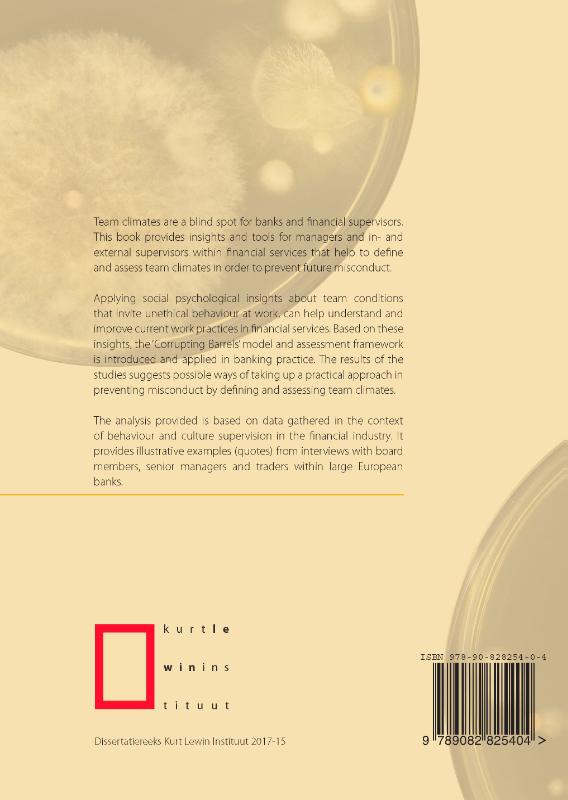
Banking on Team Ethics A team climate perspective on root causes of misconduct in financial services
Paperback180 pagina’sEngels
Ook verkrijgbaar als
IntroductionPart I. Misconduct 1. Misconduct within banking: a current, continuous and serious problem1. A current and continuous problem2. Detrimental consequences 2. Investigating misconduct: conceptualization and context1. Conceptualising misconduct2. Clarifying the context: supervision of behaviour and culture3. Clarifying the context: trading 3. Preventing misconduct: introducing a social psychological perspective1. Causes of misconduct: bad apples versus corrupting barrels2. Responding to misconduct: reactive versus preventivePart II. Banking and financial supervisory practices 4. Introduction Studies 1 and 2: research questions and data sources1. Team climates add a valuable perspective2. Research questions Studies 1 and 23. Data sources Studies 1 and 2 5. Study 1: Current banking practices - teams are the blind spot 1. A bank's litigation report 2. A bank's internal investigation 6. Study 2: Initial financial supervisory requests - little effect 1. Requesting behavioural data 2. Requesting a root cause analysisPart III. Identifying corrupting barrels: social psychological root causes of misconduct 7. Introduction Study 3: research question and data sources 1. Assessing team climates 2. Research questions Study 3 3. Data sources Study 3 8. Theory on team climate facilitating misconduct 1. Ineffective error approaches: denial, empathy and blame & punish 2. Outcome inequality: unequal relationships leading to perceived injustice and envy 3. Dysfunctional moral climates: neglect, inaction and justification 9. Study 3: Identifying team climate: assessing root causes of misconduct 1. Deep dive assessment of two trading teams 2. Corrupting Barrels survey Part IV. Conclusions and practical implications for banks and financial supervisors 10. Conclusions and practical implications 1. Defining team climate: identify root causes of misconduct 2. Improving team climate: mitigate misconduct risk 2.1. Leadership is key 2.2. Improve the 'Corrupting Barrel' team climate characteristics 2.3. Conflicts to resolve 11. Limitations and future research 1. Strengths of this analysis 2. Limitations of this analysis 3. Opportunities for future researchReferencesAppendices Appendix A: Two-pager on the assessment framework as used in this analysis Appendix B: Requested documents for desk research Appendix C: Interview format Appendix D: Observation format Appendix E: Survey Appendix F: Separate survey itemsNederlandse samenvattingCurriculum vitaeBanking on Team Ethics provides social psychological insights and practical tools to assess root causes of unethical behaviour at team level, to help prevent misconduct.Team climates are a blind spot for banks and financial supervisors. This book provides insights and tools for managers and in- and external supervisors within financial services that help to define and assess team climates in order to prevent future misconduct.
Applying social psychological insights about team conditions that invite unethical behaviour at work, can help understand and improve current work practices in financial services. Based on these insights, the 'Corrupting Barrels' model and assessment framework is introduced and applied in banking practice. The results of the studies suggests possible ways of taking up a practical approach in preventing misconduct by defining and assessing team climates.
The analysis provided is based on data gathered in the context of behaviour and culture supervision in the financial industry. It provides illustrative examples (quotes) from interviews with board members, senior managers and traders within large European banks.
Team climates are a blind spot for banks and financial supervisors. This book provides insights and tools for managers and in- and external supervisors within financial services that help to define and assess team climates in order to prevent future misconduct.Applying social psychological insights about team conditions that invite unethical behaviour at work, can help understand and improve current work practices in financial services. Based on these insights, the ‘Corrupting Barrels’ model and assessment framework is introduced and applied in banking practice. The results of the studies suggests possible ways of taking up a practical approach in preventing misconduct by defining and assessing team climates.The analysis provided is based on data gathered in the context of behaviour and culture supervision in the financial industry. It provides illustrative examples (quotes) from interviews with board members, senior managers and traders within large European banks.
Applying social psychological insights about team conditions that invite unethical behaviour at work, can help understand and improve current work practices in financial services. Based on these insights, the 'Corrupting Barrels' model and assessment framework is introduced and applied in banking practice. The results of the studies suggests possible ways of taking up a practical approach in preventing misconduct by defining and assessing team climates.
The analysis provided is based on data gathered in the context of behaviour and culture supervision in the financial industry. It provides illustrative examples (quotes) from interviews with board members, senior managers and traders within large European banks.
Team climates are a blind spot for banks and financial supervisors. This book provides insights and tools for managers and in- and external supervisors within financial services that help to define and assess team climates in order to prevent future misconduct.Applying social psychological insights about team conditions that invite unethical behaviour at work, can help understand and improve current work practices in financial services. Based on these insights, the ‘Corrupting Barrels’ model and assessment framework is introduced and applied in banking practice. The results of the studies suggests possible ways of taking up a practical approach in preventing misconduct by defining and assessing team climates.The analysis provided is based on data gathered in the context of behaviour and culture supervision in the financial industry. It provides illustrative examples (quotes) from interviews with board members, senior managers and traders within large European banks.
In het kort
ISBN-13
9789082825404
Uitgever
Verschenen
29 maart 2018
Imprint
Bibliografisch
ISBN-139789082825404
Editie1
TaalEngels eng
Pagina’s180
GeïllustreerdJa
Uitgave
UitgevervL company
ImprintvL company
CB-relatie-id6190493
Verschenen29 maart 2018
StatusOnbekend 00
BeschikbaarheidContact leverancier 99
Zonder prijsPrijs volgt
Vorm & inhoud
ProductvormPaperback BC
SamenstellingLos product
Classificatie
NUR (hoofd)Algemene sociale wetenschappen 741
NUR (alle)741 Algemene sociale wetenschappen
Medewerkers
Auteur A01Wieke Scholten
Herkomst
Werk-id (NSTC)500182618
MeldingBevestigd bij publicatie 03
Bijgewerkt6 augustus 2026
Trefwoorden
Lijkt op dit boek








NSTC 500182618 · CB-relatie 6190493 · Bijgewerkt 6 augustus 2026