
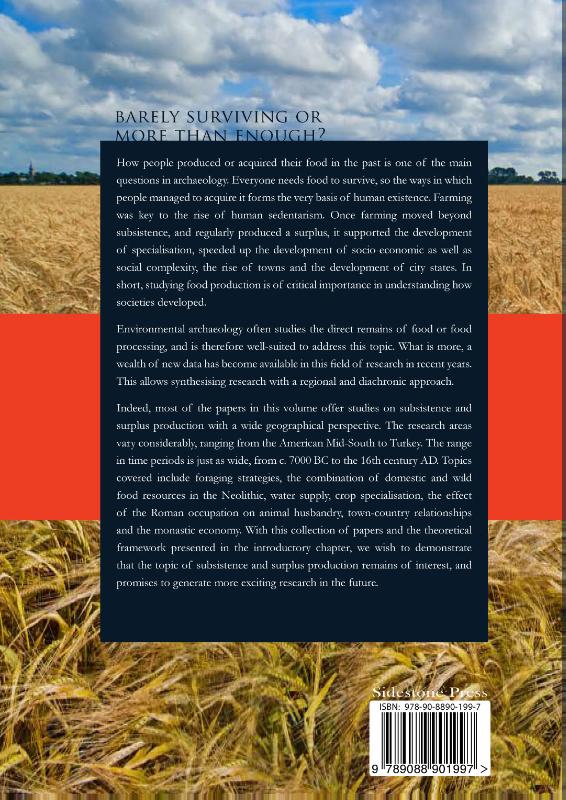
Barely surviving or more than enough? the environmental archaeology of subsistence, specialisation and surplus food production
Paperback300 pagina’sEngels
Ook verkrijgbaar als
How people produced or acquired their food in the past is one of the main questions in archaeology. Everyone needs food to survive, so the ways in which people managed to acquire it forms the very basis of human existence. Farming was key to the rise of human sedentarism. Once farming moved beyond subsistence, and regularly produced a surplus, it supported the development of specialisation, speeded up the development of socio-economic as well as social complexity, the rise of towns and the development of city states. In short, studying food production is of critical importance in understanding how societies developed.
Environmental archaeology often studies the direct remains of food or food processing, and is therefore well-suited to address this topic. What is more, a wealth of new data has become available in this field of research in recent years. This allows synthesising research with a regional and diachronic approach.
Indeed, most of the papers in this volume offer studies on subsistence and surplus production with a wide geographical perspective. The research areas vary considerably, ranging from the American Mid-South to Turkey. The range in time periods is just as wide, from c. 7000 BC to the 16th century AD. Topics covered include foraging strategies, the combination of domestic and wild food resources in the Neolithic, water supply, crop specialisation, the effect of the Roman occupation on animal husbandry, town-country relationships and the monastic economy. With this collection of papers and the theoretical framework presented in the introductory chapter, we wish to demonstrate that the topic of subsistence and surplus production remains of interest, and promises to generate more exciting research in the future.
Contents
Studying subsistence and surplus production - Maaike Groot and Daphne Lentjes
The role of gathering in Middle Archaic social complexity in the Mid-South: a diachronic perspective - Stephen B. Carmody and Kandace D. Hollenbach
Rethinking Neolithic subsistence at the gateway to Europe with new archaeozoological evidence from Istanbul - Canan Çakrlar
Agricultural production between the 6th and the 3rd millennium cal BC in the central part of the Valencia region (Spain) - Guillem Pérez Jordà and Leonor Peña-Chocarro
From subsistence to market exchange: the development of an agricultural economy in 1st-millennium-BC Southeast Italy - Daphne Lentjes
Three systems of agrarian exploitation in the Valencian region of Spain (400-300 BC) - Mª Pilar Iborra Eres and Guillem Pérez Jordà
The well in the settlement: a water source for humans and livestock, studied through insect remains from Southeast Sweden - Magnus Hellqvist
The Late Iron Age-Roman transformation from subsistence to surplus production in animal husbandry in the Central and Western parts of the Netherlands - Joyce van Dijk and Maaike Groot
Tracing changes in animal husbandry in Mallorca (Balearic Islands, Western Mediterranean) from the Iron Age to the Roman Period - Alejandro Valenzuela, Josep Antoni Alcover, Miguel Ángel Cau
Food production and exchanges in the Roman civitas Tungrorum - Fabienne Pigière and Annick Lepot
Entrepreneurs and traditional farmers: the effects of an emerging market in Middle Saxon England - Matilda Holmes
Scant evidence of great surplus: research at the rural Cistercian monastery of Holme Cultram, Northwest England - Don O'Meara
Environmental archaeology often studies the direct remains of food or food processing, and is therefore well-suited to address this topic. What is more, a wealth of new data has become available in this field of research in recent years. This allows synthesising research with a regional and diachronic approach.
Indeed, most of the papers in this volume offer studies on subsistence and surplus production with a wide geographical perspective. The research areas vary considerably, ranging from the American Mid-South to Turkey. The range in time periods is just as wide, from c. 7000 BC to the 16th century AD. Topics covered include foraging strategies, the combination of domestic and wild food resources in the Neolithic, water supply, crop specialisation, the effect of the Roman occupation on animal husbandry, town-country relationships and the monastic economy. With this collection of papers and the theoretical framework presented in the introductory chapter, we wish to demonstrate that the topic of subsistence and surplus production remains of interest, and promises to generate more exciting research in the future.
Contents
Studying subsistence and surplus production - Maaike Groot and Daphne Lentjes
The role of gathering in Middle Archaic social complexity in the Mid-South: a diachronic perspective - Stephen B. Carmody and Kandace D. Hollenbach
Rethinking Neolithic subsistence at the gateway to Europe with new archaeozoological evidence from Istanbul - Canan Çakrlar
Agricultural production between the 6th and the 3rd millennium cal BC in the central part of the Valencia region (Spain) - Guillem Pérez Jordà and Leonor Peña-Chocarro
From subsistence to market exchange: the development of an agricultural economy in 1st-millennium-BC Southeast Italy - Daphne Lentjes
Three systems of agrarian exploitation in the Valencian region of Spain (400-300 BC) - Mª Pilar Iborra Eres and Guillem Pérez Jordà
The well in the settlement: a water source for humans and livestock, studied through insect remains from Southeast Sweden - Magnus Hellqvist
The Late Iron Age-Roman transformation from subsistence to surplus production in animal husbandry in the Central and Western parts of the Netherlands - Joyce van Dijk and Maaike Groot
Tracing changes in animal husbandry in Mallorca (Balearic Islands, Western Mediterranean) from the Iron Age to the Roman Period - Alejandro Valenzuela, Josep Antoni Alcover, Miguel Ángel Cau
Food production and exchanges in the Roman civitas Tungrorum - Fabienne Pigière and Annick Lepot
Entrepreneurs and traditional farmers: the effects of an emerging market in Middle Saxon England - Matilda Holmes
Scant evidence of great surplus: research at the rural Cistercian monastery of Holme Cultram, Northwest England - Don O'Meara
In het kort
Bibliografisch
ISBN-139789088901997
Editie1
TaalEngels eng
Pagina’s300
GeïllustreerdJa
Uitgave
Vorm & inhoud
ProductvormPaperback BC
SamenstellingLos product
Classificatie
NUR (hoofd)Archeologie 682
NUR (alle)682 Archeologie
Medewerkers
Herkomst
Werk-id (NSTC)500370677
MeldingBevestigd bij publicatie 03
Bijgewerkt6 augustus 2026
Lijkt op dit boek
Durrington Walls and Woodhenge: A place for the living
Durrington Walls and Woodhenge: A place for the living
Indigenous Knowledge in Transformation
Indigenous Knowledge in Transformation
Archaeological Approaches to Inequality, Political Organisation, and Social Complexity
Archaeological Approaches to Inequality, Political Organisation, and Social Complexity
Stadterweiterungen und urbane Dynamik im Mittelalter
Stadterweiterungen und urbane Dynamik im Mittelalter
Prehistoric Shore Settlements of the Southwestern Balkans
Prehistoric Shore Settlements of the Southwestern Balkans
NSTC 500370677 · CB-relatie 9180064 · Bijgewerkt 6 augustus 2026