
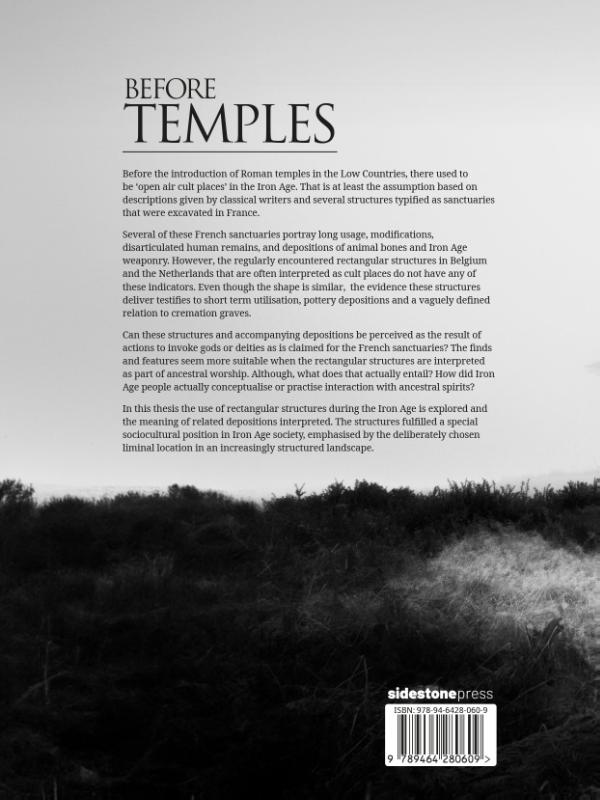
Before Temples Rectangular structures of the Low Countries and their place in the Iron Age belief system
Paperback290 pagina’sEngels
Ook verkrijgbaar als
1 Introduction1.1 Prologue: a semantic problem1.2 The problem of interpreting a rectangular structure1.3 The problem of the ‘ritual’ in a rectangular structure1.4 The problem of the environmental context and date of a rectangular structure1.5 Research questions1.6 Dataset and limitations1.7 Variables1.8 Approach and outline of the study2 The belief system in the Iron Age2.1 Introduction2.2 The soul and the ancestors2.3 Phenomenology and the natural world2.4 The ‘ritual of exchange’2.5 Objects of exchange2.6 Before temples: a place for depositions2.7 Conclusion3 Geographical framework: the ‘archaeotypical’ sanctuary3.1 Introduction3.2 The sanctuaries of Northern France3.3 The rectangular structures of Germany3.4 Shrines, enclosures and causeways in England3.5 Conclusion4 Rectangular structures in the Late Bronze Age – Early Iron Age4.1 Introduction4.2 Rectangular structures in urnfields4.3 Rectangular structures in Early Iron Age settlements4.4 Conclusion: the urnfield as a point of origin5 Rectangular structures in the Middle Iron Age5.1 Introduction5.2 Burial traditions and the treatment of human remains5.3 The 5th century BCE5.4 Rectangular structures and their relation to graves5.5 Discussion on rectangular structures in the Middle Iron Age5.6 Conclusion6 Rectangular structures in the Late Iron Age6.1 Introduction6.2 Transition into the Late Iron Age6.3 Continuation of burial traditions6.4 Rectangular structures and field systems6.5 Diverse use and variable contexts of rectangular structures6.6 Synthesis: the varied use of rectangular structures in the Late Iron Age6.7 Conclusion7 The environment and context of rectangular structures7.1 Introduction7.2 Aalter-Woestijne7.3 Harelbeke and Kortrijk7.4 Oss-Ussen7.5 Diachronic landscape use and the rectangular structure8 The function of a rectangular structure8.1 Introduction8.2 The rectangular structure as a functional earthwork8.3 The rectangular structure as a cemetery demarcation8.4 The rectangular structure as a symbolic boundary8.5 The rectangular structure as a deposition space8.6 The rectangular structure as a liminal place8.7 Epilogue: evaluating Oss-Brabantstraat9 Conclusion9.1 Iron Age beliefs9.2 Warriors and missing persons9.3 A place for communication9.4 Some answers and more questionsBefore the introduction of Roman temples in the Low Countries, there used to be ‘open air cult places’ in the Iron Age. That is at least the assumption based on descriptions given by classical writers and several structures typified as sanctuaries that were excavated in France. Several of these French sanctuaries portray long usage, modifications, disarticulated human remains, and depositions of animal bones and Iron Age weaponry. However, the regularly encountered rectangular structures in Belgium and the Netherlands that are often interpreted as cult places do not have any of these indicators. Even though the shape is similar, the evidence these structures deliver testifies to short term utilisation, pottery depositions and a vaguely defined relation to cremation graves. Can these structures and accompanying depositions be perceived as the result of actions to invoke gods or deities as is claimed for the French sanctuaries? The finds and features seem more suitable when the rectangular structures are interpreted as part of ancestral worship. Although, what does that actually entail? How did Iron Age people actually conceptualise or practise interaction with ancestral spirits? In this thesis the use of rectangular structures during the Iron Age is explored and the meaning of related depositions interpreted. The structures fulfilled a special sociocultural position in Iron Age society, emphasised by the deliberately chosen liminal location in an increasingly structured landscape.
In het kort
ISBN-13
9789464280609
Uitgever
Verschenen
20 december 2023
Bibliografisch
ISBN-139789464280609
Editie1
TaalEngels eng
Pagina’s290
GeïllustreerdJa
Uitgave
Vorm & inhoud
ProductvormPaperback BC
SamenstellingLos product
Classificatie
NUR (hoofd)Archeologie 682
NUR (alle)682 Archeologie
Medewerkers
Auteur A01Roosje de Leeuwe
Herkomst
Werk-id (NSTC)501565603
MeldingBevestigd bij publicatie 03
Bijgewerkt6 augustus 2026
NSTC 501565603 · CB-relatie 9180064 · Bijgewerkt 6 augustus 2026