
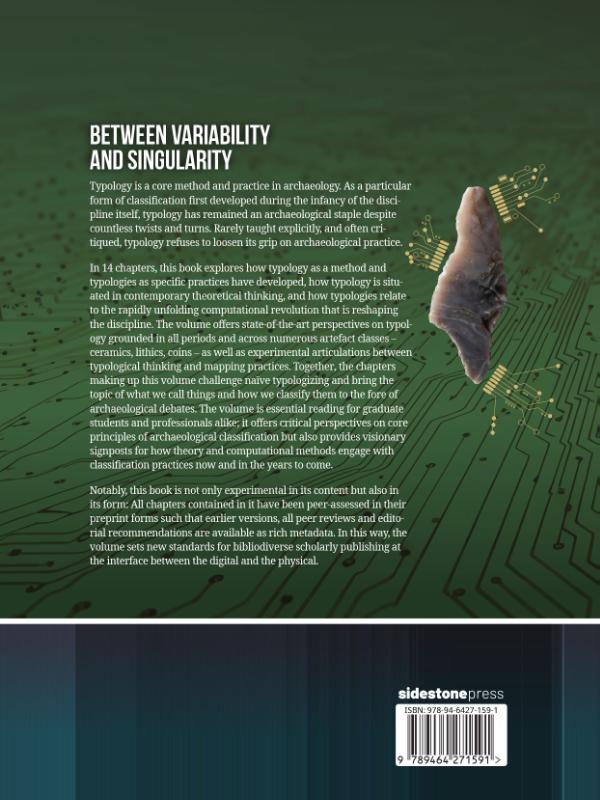
Between variability and singularity Crossing theoretical, qualitative and computer-based approaches to types and typologies in archaeology
Paperback260 pagina’sEngels
PrefaceTypologising archaeological typologies: Motivation, structure and the making of a digitally augmented edited volumeSébastien Plutniak, Shumon T. Hussain & Felix RiedePart I: The epistemology and theory of types and typologiesResearch perspectives and their influence on typologiesEnrico GiannicheddaOn the physics and metaphysics of classification in archaeologyMercedes Okumura & Astolfo G.M. AraujoThe loss of typological innocence: Pluralism in the epistemology and ontology of archaeological typo-praxisShumon T. HussainArchaeology, typology and machine epistemologyGavin LucasPart II: Research legacies, digital infrastructures and computer-based approachesTool types and the establishment of the Late Palaeolithic (Later Stone Age) cultural taxonomic system in the Nile ValleyAlice LeplongeonThe role of heritage databases in typological reification: A case study from the Final Palaeolithic of southern ScandinaviaFelix RiedeFrom paper to byte: An interim report on the digital transformation of two thing editionsFrederic Auth, Katja Rösler, Wenke Domscheit & Kerstin P. HofmannThe density of types and the dignity of the fragment: A website approach to archaeological typologyGiorgio Buccellati & Marilyn Kelly-BuccellatiIT- and machine learning-based methods of classification: The cooperative project ClaReNet (Classification and Representation for Networks)Chrisowalandis Deligio, Caroline von Nicolai, Markus Möller, Katja Rösler, Julia Tietz, Robin Krause, Kerstin P. Hofmann, Karsten Tolle & David Wigg-WolfPart III: New perspectives and themes in type-thinkingWhat is a form? On the classification of archaeological potteryPhilippe BoissinotA return to function as the basis of lithic classificationRadu IovitaSpeaking types into being: Language acts, typological persistence and performing archaeological spacePiraye HacıgüzellerHypercultural types: Archaeological objects in fast timeArtur S.P. RibeiroPostscriptDo we need (more) humble typologies?Shumon T. HussainTypology is a core method and practice in archaeology. As a particular form of classification first developed during the infancy of the discipline itself, typology has remained an archaeological staple despite countless twists and turns. Rarely taught explicitly, and often critiqued, typology refuses to loosen its grip on archaeological practice. In 14 chapters, this book explores how typology as a method and typologies as specific practices have developed, how typology is situated in contemporary theoretical thinking, and how typologies relate to the rapidly unfolding computational revolution that is reshaping the discipline. The volume offers state-of-the-art perspectives on typology grounded in all periods and across numerous artefact classes – ceramics, lithics, coins – as well as experimental articulations between typological thinking and mapping practices. Together, the chapters making up this volume challenge naïve typologizing and bring the topic of what we call things and how we classify them to the fore of archaeological debates. The volume is essential reading for graduate students and professionals alike; it offers critical perspectives on core principles of archaeological classification but also provides visionary signposts for how theory and computational methods engage with classification practices now and in the years to come. Notably, this book is not only experimental in its content but also in its form: All chapters contained in it have been peer-assessed in their preprint forms such that earlier versions, all peer reviews and editorial recommendations are available as rich metadata. In this way, the volume sets new standards for bibliodiverse scholarly publishing at the interface between the digital and the physical.
In het kort
ISBN-13
9789464271591
Uitgever
Verschenen
29 september 2026
Imprint
Bibliografisch
ISBN-139789464271591
Editie1
TaalEngels eng
Pagina’s260
GeïllustreerdJa
Uitgave
UitgeverSidestone Press
ImprintSidestone Press Academics
CB-relatie-id9180064
Verschenen29 september 2026
StatusOnbekend 00
Vorm & inhoud
ProductvormPaperback BC
SamenstellingLos product
Classificatie
NUR (hoofd)Archeologie 682
NUR (alle)682 Archeologie
Medewerkers
Herkomst
Werk-id (NSTC)501660904
MeldingBevestigd bij publicatie 03
Bijgewerkt6 augustus 2026
Lijkt op dit boek
Durrington Walls and Woodhenge: A place for the living
Durrington Walls and Woodhenge: A place for the living
Indigenous Knowledge in Transformation
Indigenous Knowledge in Transformation
Archaeological Approaches to Inequality, Political Organisation, and Social Complexity
Archaeological Approaches to Inequality, Political Organisation, and Social Complexity
Stadterweiterungen und urbane Dynamik im Mittelalter
Stadterweiterungen und urbane Dynamik im Mittelalter
Prehistoric Shore Settlements of the Southwestern Balkans
Prehistoric Shore Settlements of the Southwestern Balkans
NSTC 501660904 · CB-relatie 9180064 · Bijgewerkt 6 augustus 2026