
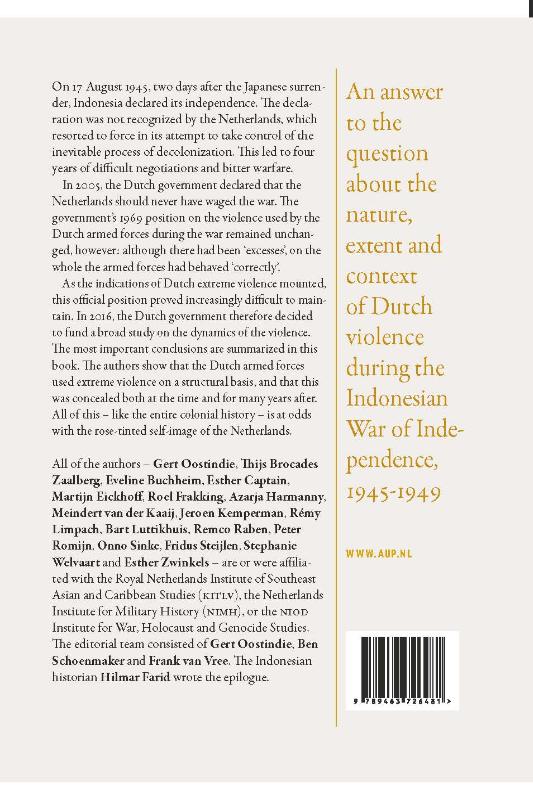
Beyond the Pale Dutch Extreme Violence in the Indonesian War of Independence, 1945-1949
Hardback592 pagina’sEngelsLeverbaar
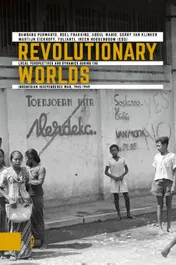
1. Introduction1 Background, guiding principles and methodologyGert Oostindie2 The Netherlands and Indonesia 1945-1949. The political-historical contextGert Oostindie3 The war in Indonesia 1945-1949. The military-historical contextGert Oostindie and Rémy LimpachInterim conclusions2. IntermezzoThe human dimension. The search for stories about the Indonesian War of IndependenceEveline Buchheim, Fridus Steijlen, Stephanie Welvaarti i i. Research results1 ‘Hatred of foreign elements and their “accomplices”’ Extreme violence in the first phase of the Indonesian Revolution (17 August 1945 to 31 March 1946) Esther Captain and Onno Sinke2 Revolutionary worlds. Legitimacy, violence and loyalty during the Indonesian War of IndependenceRoel Frakking and Martijn Eickhoff3 ‘Information costs lives.’ The intelligence war for Indonesia, 1945-1949Rémy Limpach4 The myth of the ‘Dutch Method’. Heavy weapons in the Indonesian War of IndependenceAzarja Harmanny5 The law as a weapon. The actions of the Dutch judiciary during the Indonesian War of IndependenceEsther Zwinkels6 Silence, information and deception in the Indonesian War of IndependenceRemco Raben and Peter Romijn7 Silence as a strategy. International visions of the Indonesian War of IndependenceJeroen Kemperman8 Beyond colonial guilt ranking. Dutch, British and French extreme violence in comparative perspective, 1945-1962Thijs Brocades Zaalberg and Bart Luttikhuis9 A guilty conscience. The painful processing of the Indonesian War of Independence in the NetherlandsGert Oostindie and Meindert van der Kaaij4. Closing remarksConclusions5. EpilogueDealing with the legacies of a violent pastHilmar FaridNotesAbbreviationsFurther readingAcknowledgementsAbout the authorsIndexOn 17 August 1945, two days after the Japanese surrender that also brought an end to the Second World War in Asia, Indonesia declared its independence. The declaration was not recognized by the Netherlands, which resorted to force in its attempt to take control of the inevitable process of decolonization. This led to four years of difficult negotiations and bitter warfare.In 2005, the Dutch government declared that the Netherlands should never have waged the war. The government’s 1969 position on the violence used by the Dutch armed forces during the war remained unchanged, however: although there had been ‘excesses’, on the whole the armed forces had behaved ‘correctly’. As the indications of Dutch extreme violence mounted, this official position proved increasingly difficult to maintain. In 2016, the Dutch government therefore decided to fund a broad study on the dynamics of the violence. The most important conclusions of that research programme are summarized in this book. The authors show that the Dutch armed forces used extreme violence on a structural basis, and that this was concealed both at the time and for many years after the war by the Dutch government and by society more broadly. All of this – like the entire colonial history – is at odds with the rose-tinted self-image of the Netherlands.
In het kort
ISBN-13
9789463726481
Uitgever
Verschenen
18 februari 2022
Serie
Onafhankelijkheid, dekolonisatie, geweld en oorlog in Indonesië 1945-1950
Imprint
Bibliografisch
ISBN-139789463726481
SerieOnafhankelijkheid, dekolonisatie, geweld en oorlog in Indonesië 1945-1950
Editie1
TaalEngels eng
Pagina’s592
GeïllustreerdJa
Uitgave
UitgeverAmsterdam University Press
ImprintAUP Algemeen
CB-relatie-id7400597
Verschenen18 februari 2022
StatusLeverbaar 04
BeschikbaarheidBeschikbaar 20
Adviesprijs (incl. btw)€ 39,95
Vorm & inhoud
ProductvormHardback BB
SamenstellingLos product
Classificatie
NUR (hoofd)Geschiedenis algemeen 680
NUR (alle)680 Geschiedenis algemeen
Herkomst
Werk-id (NSTC)501488896
MeldingBevestigd bij publicatie 03
Bijgewerkt6 augustus 2026
Lijkt op dit boek
NSTC 501488896 · CB-relatie 7400597 · Bijgewerkt 6 augustus 2026