
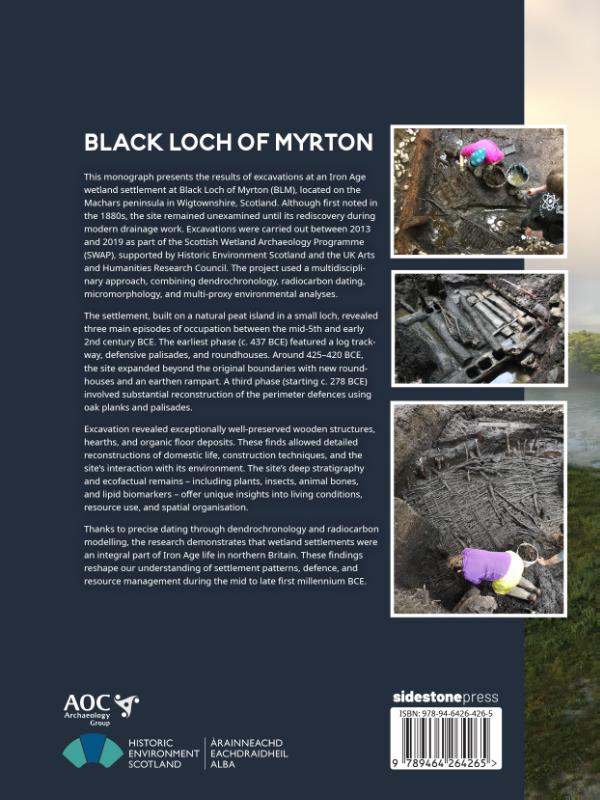
Black Loch of Myrton The life and times of an Iron Age wetland settlement in southwest Scotland
Paperback630 pagina’sEngels
Ook verkrijgbaar als
Chapter 1 IntroductionChapter 2 ChronologyChapter 3 Episode 1Chapter 4 Episode 2Chapter 5 Post-ST2 activityChapter 6 Episode 3Chapter 7 Specialist Reports – DendrochronologyChapter 8 Specialist Reports – Radiocarbon dating and Bayesian chronological modellingChapter 9 Specialist Reports – MicromorphologyChapter 10 Specialist Reports – Faecal steroid biomarkersChapter 11 Specialist Reports – Plant macrofossilsChapter 12 Specialist Reports – Faunal remains and shellfishChapter 13 Specialist Reports – Insect remainsChapter 14 Specialist Reports – Wood use and woodworkingChapter 15 The artefactsChapter 16 Investigations on the crannog in the White Loch of MyrtonChapter 17 The physical environment of the settlementsChapter 18 ReflectionsThis monograph presents the results of excavations at an Iron Age wetland settlement at Black Loch of Myrton (BLM), located on the Machars peninsula in Wigtownshire, Scotland. Although first noted in the 1880s, the site remained unexamined until its rediscovery during modern drainage work. Excavations were carried out between 2013 and 2019 as part of the Scottish Wetland Archaeology Programme (SWAP), supported by Historic Environment Scotland and the UK Arts and Humanities Research Council. The project used a multidisciplinary approach, combining dendrochronology, radiocarbon dating, micromorphology, and multi-proxy environmental analyses. The settlement, built on a natural peat island in a small loch, revealed three main episodes of occupation between the mid-5th and early 2nd century BCE. The earliest phase (c. 437 BCE) featured a log trackway, defensive palisades, and roundhouses. Around 425–420 BCE, the site expanded beyond the original boundaries with new roundhouses and an earthen rampart. A third phase (starting c. 278 BCE) involved substantial reconstruction of the perimeter defences using oak planks and palisades.Excavation revealed exceptionally well-preserved wooden structures, hearths, and organic floor deposits. These finds allowed detailed reconstructions of domestic life, construction techniques, and the site’s interaction with its environment. The site’s deep stratigraphy and ecofactual remains – including plants, insects, animal bones, and lipid biomarkers – offer unique insights into living conditions, resource use, and spatial organisation.Thanks to precise dating through dendrochronology and radiocarbon modelling, the research demonstrates that wetland settlements were an integral part of Iron Age life in northern Britain. These findings reshape our understanding of settlement patterns, defence, and resource management during the mid to late first millennium BCE.
In het kort
ISBN-13
9789464264265
Uitgever
Verschenen
19 maart 2026
Imprint
Bibliografisch
ISBN-139789464264265
Editie1
TaalEngels eng
Pagina’s630
GeïllustreerdJa
Uitgave
UitgeverSidestone Press
ImprintSidestone Press
CB-relatie-id9180064
Verschenen19 maart 2026
StatusOnbekend 00
Vorm & inhoud
ProductvormPaperback BC
SamenstellingLos product
Classificatie
NUR (hoofd)Archeologie 682
NUR (alle)682 Archeologie
Medewerkers
Auteur A01Anne Crone
Auteur A01Graeme Cavers
Herkomst
Werk-id (NSTC)501635066
MeldingBevestigd bij publicatie 03
Bijgewerkt6 augustus 2026
Lijkt op dit boek
Durrington Walls and Woodhenge: A place for the living
Durrington Walls and Woodhenge: A place for the living
Indigenous Knowledge in Transformation
Indigenous Knowledge in Transformation
Archaeological Approaches to Inequality, Political Organisation, and Social Complexity
Archaeological Approaches to Inequality, Political Organisation, and Social Complexity
Stadterweiterungen und urbane Dynamik im Mittelalter
Stadterweiterungen und urbane Dynamik im Mittelalter
Prehistoric Shore Settlements of the Southwestern Balkans
Prehistoric Shore Settlements of the Southwestern Balkans
NSTC 501635066 · CB-relatie 9180064 · Bijgewerkt 6 augustus 2026