
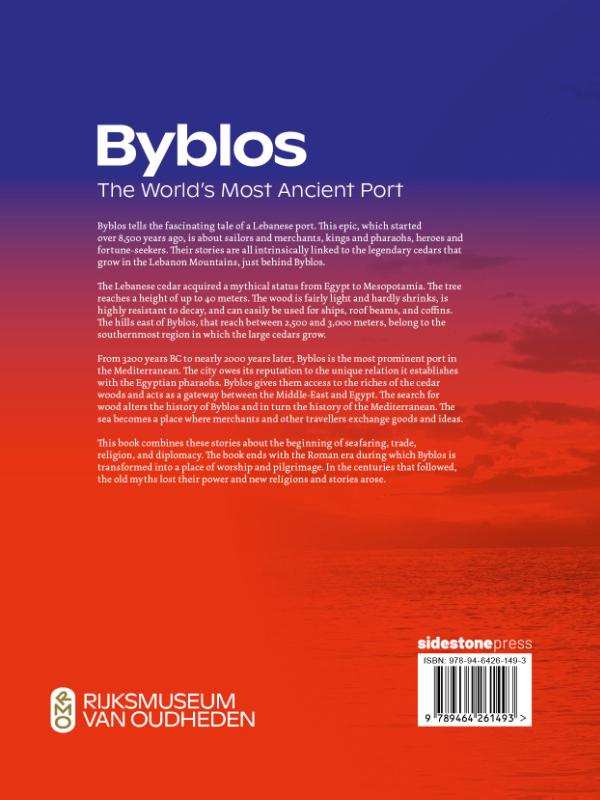
Byblos: The World’s Most Ancient Port
Paperback152 pagina’sEngels
Ook verkrijgbaar als
Foreword Sarkis El Khoury & Wim WeijlandIntroduction Finding Our Bearings, and a PuzzleChapter 1 The BeginningChapter 2 The ‘Byblos Ships’ Set SailChapter 3 Byblos Becomes a CityChapter 4 Byblos and EgyptChapter 5 Byblos and MesopotamiaChapter 6 The Lady of Byblos and Her CountryChapter 7 Prosperity and DiplomacyChapter 8 The King and the EliteChapter 9 Archaeology of a Forgotten ReligionChapter 10 Between two SuperpowersChapter 11 Bronze and IronChapter 12 The First EmpiresChapter 13 A New, Old CityEpilogue The World’s Most Ancient PortTimeline of ByblosFind Out MoreSources and AcknowledgementsLenders to the ExhibitionPhoto CreditsByblos tells the fascinating tale of a Lebanese port. This epic, which started over 8,500 years ago, is about sailors and merchants, kings and pharaohs, heroes and fortune-seekers. Their stories are all intrinsically linked to the legendary cedars that grow in the Lebanon Mountains, just behind Byblos. The Lebanese cedar acquired a mythical status from Egypt to Mesopotamia. The tree reaches a height of up to 40 meters. The wood is fairly light and hardly shrinks, is highly resistant to decay, and can easily be used for ships, roof beams, and coffins. The hills east of Byblos, that reach between 2,500 and 3,000 meters, belong to the southernmost region in which the large cedars grow. From 3200 years BC to nearly 2000 years later, Byblos is the most prominent port in the Mediterranean. The city owes its reputation to the unique relation it establishes with the Egyptian pharaohs. Byblos gives them access to the riches of the cedar woods and acts as a gateway between the Middle-East and Egypt. The search for wood alters the history of Byblos and in turn the history of the Mediterranean. The sea becomes a place where merchants and other travellers exchange goods and ideas.This book combines these stories about the beginning of seafaring, trade, religion, and diplomacy. The book ends with the Roman era during which Byblos is transformed into a place of worship and pilgrimage. In the centuries that followed, the old myths lost their power and new religions and stories arose.David Kertai is curator of the Ancient Near East at the National Museum of Antiquities in Leiden. He studied architecture, ancient history, and archaeology and worked as a researcher and lecturer at University College London, New York University and the Freie Universität Berlin. Since 2005 he has been active as an archaeologist in Iraq, Syria, and Turkey.Jona Lendering is a historian, journalist, and lecturer. He created the website Livius.org and maintains a daily blog on ancient history, MainzerBeobachter.com (in Dutch). He is also the author of several books, including Edge of Empire. Rome’s Frontier on the Lower Rhine.
In het kort
ISBN-13
9789464261493
Uitgever
Verschenen
6 oktober 2022
Imprint
Bibliografisch
ISBN-139789464261493
Editie1
TaalEngels eng
Pagina’s152
GeïllustreerdJa
Uitgave
UitgeverSidestone Press
ImprintSidestone Press
CB-relatie-id9180064
Verschenen6 oktober 2022
StatusOnbekend 00
Vorm & inhoud
ProductvormPaperback BC
SamenstellingLos product
Classificatie
NUR (hoofd)Archeologie 682
NUR (alle)682 Archeologie
Medewerkers
Auteur A01David Kertai
Auteur A01Jona Lendering
Herkomst
Werk-id (NSTC)501517363
MeldingBevestigd bij publicatie 03
Bijgewerkt6 augustus 2026
Lijkt op dit boek

NSTC 501517363 · CB-relatie 9180064 · Bijgewerkt 6 augustus 2026