
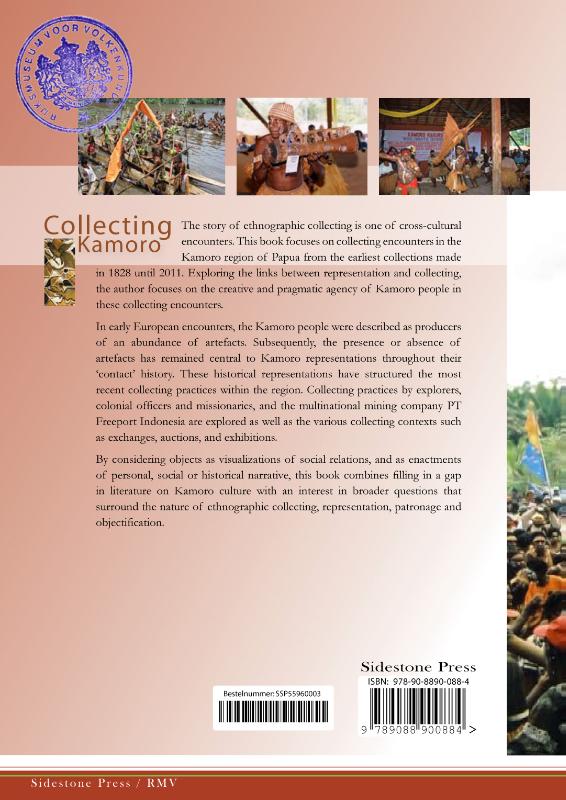
Collecting Kamoro objects, encounters and representation on the southwest coast of Papua
Ook verkrijgbaar als
The story of ethnographic collecting is one of cross-cultural encounters. This book focuses on collecting encounters in the Kamoro region of Papua from the earliest collections made in 1828 until 2011. Exploring the links between representation and collecting, the author focuses on the creative and pragmatic agency of Kamoro people in these collecting encounters.
In early European encounters, the Kamoro people were described as producers of an abundance of artefacts. Subsequently, the presence or absence of artefacts has remained central to Kamoro representations throughout their 'contact' history. These historical representations have structured the most recent collecting practices within the region. Collecting by explorers, colonial officers and missionaries, and the multi-national mining company PT Freeport Indonesia are explored as well as various collecting contexts such as exchanges, auctions, and exhibitions.
By considering objects as visualizations of social relations, and as enactments of personal, social or historical narrative, this book combines filling a gap in the literature on Kamoro culture with an interest in broader questions that surround the nature of ethnographic collecting, representation, patronage and objectification.
Published in co-operation with the Dutch National Museum of Ethnology, Leiden
Mededelingen van het Rijksmuseum voor Volkenkunde 40
In early European encounters, the Kamoro people were described as producers of an abundance of artefacts. Subsequently, the presence or absence of artefacts has remained central to Kamoro representations throughout their 'contact' history. These historical representations have structured the most recent collecting practices within the region. Collecting by explorers, colonial officers and missionaries, and the multi-national mining company PT Freeport Indonesia are explored as well as various collecting contexts such as exchanges, auctions, and exhibitions.
By considering objects as visualizations of social relations, and as enactments of personal, social or historical narrative, this book combines filling a gap in the literature on Kamoro culture with an interest in broader questions that surround the nature of ethnographic collecting, representation, patronage and objectification.
Published in co-operation with the Dutch National Museum of Ethnology, Leiden
Mededelingen van het Rijksmuseum voor Volkenkunde 40
In het kort
ISBN-13
9789088900884
Uitgever
Verschenen
18 mei 2012
Bibliografisch
ISBN-139789088900884
SerieMededelingen Rijksmuseum Volkenkunde — deel 40
Editie1
TaalEngels eng
Pagina’s240
GeïllustreerdJa
Uitgave
Vorm & inhoud
ProductvormPaperback BC
SamenstellingLos product
Classificatie
NUR (hoofd)Culturele antropologie 761
NUR (alle)761 Culturele antropologie
Medewerkers
Auteur A01Karen Jacobs
Herkomst
Werk-id (NSTC)500187001
MeldingBevestigd bij publicatie 03
Bijgewerkt6 augustus 2026
Lijkt op dit boek




NSTC 500187001 · CB-relatie 9180064 · Bijgewerkt 6 augustus 2026