
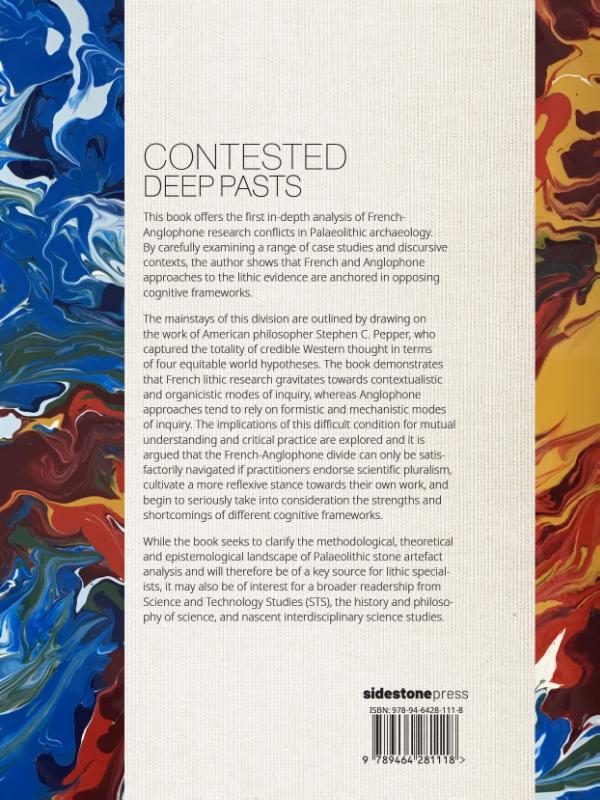
Contested Deep Pasts Negotiating the French-Anglophone Divide in Pleistocene Lithic Studies
Hardback380 pagina’sEngels
Ook verkrijgbaar als
AcknowledgementsAuthor’s prefaceForeword by Raymond CorbeyTerminology, definitions and key conceptsIntroductionChapter 1: The clash between French and Anglophone lithic research in Palaeolithic archaeology1.1 The problem of lithic knowledge1.2 The French-Anglophone divide1.3 Critical practice beyond partisanshipChapter 2: Pepper’s four world hypotheses as a new framework to examine the French-Anglophone divide2.1 Why Pepper?2.2 The landscape of Western thought2.3 Root metaphor theory2.4 Four distinct ways of marshalling evidence2.5 Affinities and trade-offs between world hypotheses2.6 The problem of knowledge corroboration2.7 Finding utility in world hypothesesChapter 3: The French-Anglophone divide and the analytic-synthetic polarity of world theories3.1 Pepper applied: a new hypothesis3.2 The structure of the French-Anglophone divide reconsideredChapter 4: Analyticity unpacked – Anglophone approaches between formism and mechanism4.1 Tropes of formism in Anglophone practice4.2 Tropes of mechanism in Anglophone practiceChapter 5: Syntheticity unpacked – French approaches between contextualism and organicism5.1 Tropes of contextualism in French practice5.2 Tropes of organicism in French practiceChapter 6: Conceptual equivocality, pluralism and critical practice at the French-Anglophone boundary6.1 A review of main findings and arguments6.2 Towards a new understanding of time-honoured problems6.3 The epistemological status of the divide6.4 A call for pluralism in lithic research6.5 The art of criticism6.6 Future perspectives: exploiting the world hypotheses interfaceEpilogueFAQBibliographyElectronic AppendixThis book offers the first in-depth analysis of French-Anglophone research conflicts in Palaeolithic archaeology. By carefully examining a range of case studies and discursive contexts, the author shows that French and Anglophone approaches to the lithic evidence are anchored in opposing cognitive frameworks. The mainstays of this division are outlined by drawing on the work of American philosopher Stephen C. Pepper, who captured the totality of credible Western thought in terms of four equitable world hypotheses. The book demonstrates that French lithic research gravitates towards contextualistic and organicistic modes of inquiry, whereas Anglophone approaches tend to rely on formistic and mechanistic modes of inquiry. The implications of this difficult condition for mutual understanding and critical practice are explored and it is argued that the French-Anglophone divide can only be satisfactorily navigated if practitioners endorse scientific pluralism, cultivate a more reflexive stance towards their own work, and begin to seriously take into consideration the strengths and shortcomings of different cognitive frameworks. While the book seeks to clarify the methodological, theoretical and epistemological landscape of Palaeolithic stone artefact analysis and will therefore be of a key source for lithic specialists, it may also be of interest for a broader readership from Science and Technology Studies (STS), the history and philosophy of science, and nascent interdisciplinary science studies.
In het kort
ISBN-13
9789464281125
Uitgever
Verschenen
16 december 2025
Bibliografisch
ISBN-139789464281125
Editie1
TaalEngels eng
Pagina’s380
GeïllustreerdJa
Uitgave
Vorm & inhoud
ProductvormHardback BB
SamenstellingLos product
Classificatie
NUR (hoofd)Archeologie 682
NUR (alle)682 Archeologie
Medewerkers
Auteur A01Shumon Hussain
Herkomst
Werk-id (NSTC)501633695
MeldingBevestigd bij publicatie 03
Bijgewerkt6 augustus 2026
NSTC 501633695 · CB-relatie 9180064 · Bijgewerkt 6 augustus 2026