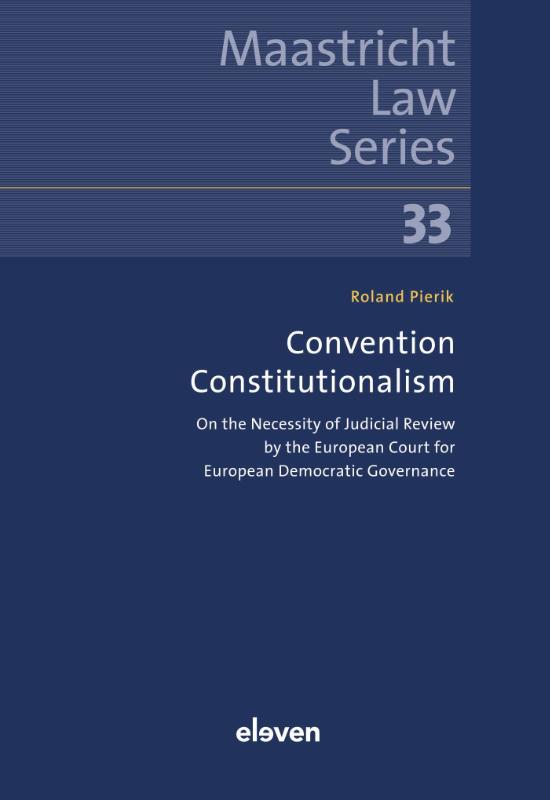
Convention Constitutionalism On the Necessity of Judicial Review by the European Court for European Democratic Governance
Ook verkrijgbaar als
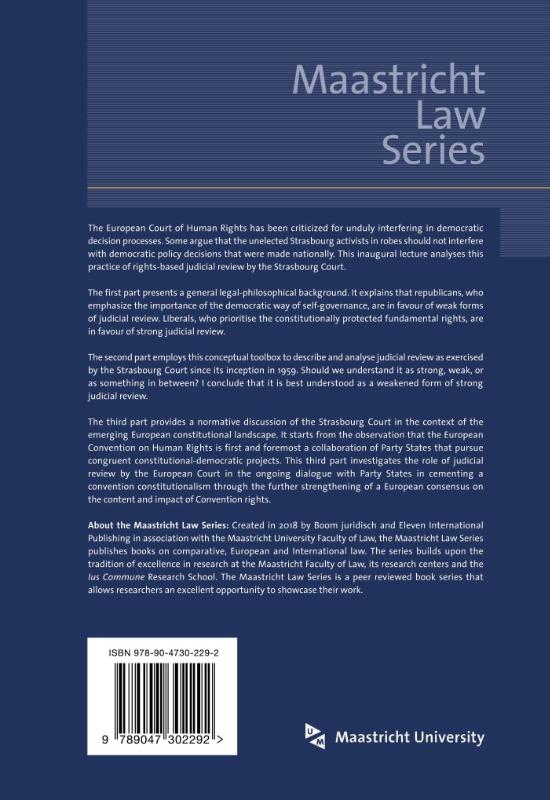
1 Introduction; 2 Legal-Philosophical Background; 3 Between State Power and Competence Creep; 4 The way Forward. Should the European Court Exercise Weak or Strong Judicial Review?; 5 Convention Constitutionalism; 6 Conclusion; 7 Embedment in the Law Faculty; 8 Some Words of ThanksThe European Court of Human Rights has been criticized for unduly interfering in democratic decision processes. Some argue that the unelected Strasbourg activists in robes should not interfere with democratic policy decisions that were made nationally. This inaugural lecture analyses this practice of rights-based judicial review by the Strasbourg Court. The first part presents a general legal-philosophical background. It explains that republicans, who emphasize the importance of the democratic way of self-governance, are in favour of weak forms of judicial review. Liberals, who prioritise the constitutionally protected fundamental rights, are in favour of strong judicial review. The second part employs this conceptual toolbox to describe and analyse judicial review as exercised by the Strasbourg Court since its inception in 1959. Should we understand it as strong, weak, or as something in between? I conclude that it is best understood as a weakened form of strong judicial review. The third part provides a normative discussion of the Strasbourg Court in the context of the emerging European constitutional landscape. It starts from the observation that the European Convention on Human Rights is first and foremost a collaboration of Party States that pursue congruent constitutional-democratic projects. This third part investigates the role of judicial review by the European Court in the ongoing dialogue with Party States in cementing a convention constitutionalism through the further strengthening of a European consensus on the content and impact of Convention rights. About the Maastricht Law Series: Created in 2018 by Boom juridisch and Eleven International Publishing in association with the Maastricht University Faculty of Law, the Maastricht Law Series publishes books on comparative, European and International law. The series builds upon the tradition of excellence in research at the Maastricht Faculty of Law, its research centers and the Ius Commune Research School. The Maastricht Law Series is a peer reviewed book series that allows researchers an excellent opportunity to showcase their work.
In het kort
ISBN-13
9789047302292
Uitgever
Verschenen
24 juni 2024
Bibliografisch
ISBN-139789047302292
SerieMaastricht Law Series — deel 33
Editie1
TaalEngels eng
Pagina’s30
GeïllustreerdNee
Uitgave
UitgeverKoninklijke Boom uitgevers PW
CB-relatie-id7500275
Verschenen24 juni 2024
StatusOnbekend 00
BeschikbaarheidContact leverancier 99
Zonder prijsPrijs volgt
Vorm & inhoud
ProductvormPaperback BC
SamenstellingLos product
Classificatie
NUR (hoofd)Recht algemeen 820
NUR (alle)820 Recht algemeen
Trefwoordeneuropean convention · court · strasbourg · judicial review · fundamental rights · philosophy of law · human rights · philosophy · state
Medewerkers
Auteur A01R. Pierik
Herkomst
Werk-id (NSTC)501585257
MeldingUpdate 04
Laatste CB-bericht7794
Bijgewerkt7 augustus 2026
Trefwoorden
Lijkt op dit boek

Grondwet

Niet zonder ons

Veerkrachtig milieurecht?
De integriteitsprocedure in de wetenschap

Manuel de l'ordre public

Informatie beheren en archiveren: selecteren en digitaal depot
Codex overheidsopdrachten

Welzijn in de bibliotheek. Gids voor zorgzame en veerkrachtige bibliotheken

Manuel de la discipline des services de police

Handboek tucht bij de politiediensten
NSTC 501585257 · CB-relatie 7500275 · Laatste CB-bericht 7794 · Bijgewerkt 7 augustus 2026