
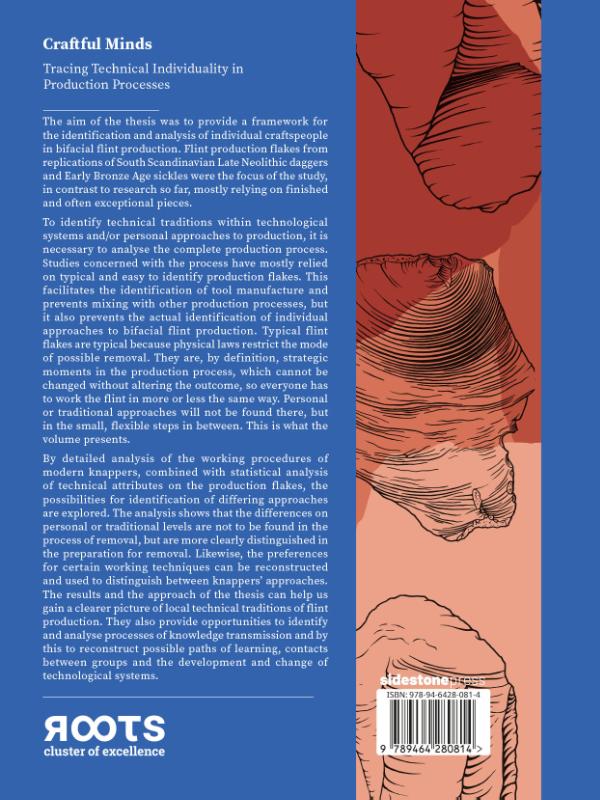
Craftful Minds Tracing Technical Individuality in Production Processes
Ook verkrijgbaar als
ContentsPreface of the series editorsAcknowledgementsAbstractChapter 1: IntroductionChapter 2: A short history of research2.1 Development of flint technology research in general2.2 Research on Late Neolithic bifacial toolsChapter 3: Theory, method and terminology3.1 Theory3.1.1 Technique and technology3.1.2 Transmission of knowledge3.2 Method3.2.1 Experiments in archaeology3.2.2 The recording system3.2.3 Implementation of statistics in the analysisChapter 4: Production sequences in action4.1 Ideal production sequence4.2 Individual working procedures4.2.1 Greg Nunn4.2.2 Andreas Benke4.2.3 Peter Wiking4.3 Observed differences from documentation4.4 Observed differences on knapping products4.5 ConclusionChapter 5: Statistical analysis5.1 The inventories5.2 The raw material5.3 Reconstructing production stages5.4 Technical differences in production5.4.1 Preparation before the strike5.4.2 Tracing differences in the application of techniques5.5 Summarising the analyses5.6 Simulating archaeological assemblages5.6.1 Single-knapper features5.6.2 Single-knapper against pure mixed features5.6.3 Single-knapper against ‘messy’ mixed features5.6.4 Mixed features5.7 Summing up the resultsChapter 6: Summary and perspective of resultsChapter 7: Summary in German /Deutsche Zusammenfassung7.1 Einleitung7.2 Forschungsgeschichte7.2.1 Generelle Entwicklung von Forschung zur Flinttechnologie7.2.2 Forschung zu spätneolithischen bifaziellen Geräten7.3 Theorie, Methode und Terminologie7.3.1 Theoretischer Hintergrund7.3.2 Methodischer Hintergrund7.4 Produktionssequenzen in Aktion7.4.1 Die Ideale Produktionssequenz7.4.2 Unterschiede in den individuellen Produktionssequenzen7.4.3 Beobachtete Unterschiede an Abschlagsprodukten7.5 Statistische Analyse der Daten7.5.1 Die Inventare7.5.2 Das Rohmaterial7.5.3 Rekonstruktion von Produktionsphasen7.5.4 Technische Unterschiede während der Produktion7.6 Zusammenfassung und Perspektive der ResultateReferencesAppendixGlossaryThe aim of the thesis was to provide a framework for the identification and analysis of individual craftspeople in bifacial flint production. Flint production flakes from replications of South Scandinavian Late Neolithic daggers and Early Bronze Age sickles were the focus of the study, in contrast to research so far, mostly relying on finished and often exceptional pieces.To identify technical traditions within technological systems and/or personal approaches to production, it is necessary to analyse the complete production process. Studies concerned with the process have mostly relied on typical and easy to identify production flakes. This facilitates the identification of tool manufacture and prevents mixing with other production processes, but it also prevents the actual identification of individual approaches to bifacial flint production. Typical flint flakes are typical because physical laws restrict the mode of possible removal. They are, by definition, strategic moments in the production process, which cannot be changed without altering the outcome, so everyone has to work the flint in more or less the same way. Personal or traditional approaches will not be found there, but in the small, flexible steps in between. This is what the volume presents.By detailed analysis of the working procedures of modern knappers, combined with statistical analysis of technical attributes on the production flakes, the possibilities for identification of differing approaches are explored. The analysis shows that the differences on personal or traditional levels are not to be found in the process of removal, but are more clearly distinguished in the preparation for removal. Likewise, the preferences for certain working techniques can be reconstructed and used to distinguish between knappers’ approaches. The results and the approach of the thesis can help us gain a clearer picture of local technical traditions of flint production. They also provide opportunities to identify and analyse processes of knowledge transmission and by this to reconstruct possible paths of learning, contacts between groups and the development and change of technological systems.
In het kort
ISBN-13
9789464280821
Uitgever
Verschenen
12 december 2024
Serie
Bibliografisch
Uitgave
Vorm & inhoud
ProductvormHardback BB
SamenstellingLos product
Classificatie
NUR (hoofd)Archeologie 682
NUR (alle)682 Archeologie
Medewerkers
Auteur A01Moiken Hinrichs
Herkomst
Werk-id (NSTC)501594386
MeldingBevestigd bij publicatie 03
Bijgewerkt6 augustus 2026
Lijkt op dit boek
The Handle Core Concept
Flintknapping from the Lateglacial to the Early Holocene
Prehension and hafting traces on flint tools

Living with Flint
Quarries and mines in social context

Serial Learners

Heligoland Flint in Prehistoric Europe

Artefact Biographies from Mesolithic and Neolithic Europe and Beyond
Hidden dimensions
The Lower to Middle Palaeolithic Transition in Northwestern Europe
NSTC 501594386 · CB-relatie 9180064 · Bijgewerkt 6 augustus 2026