
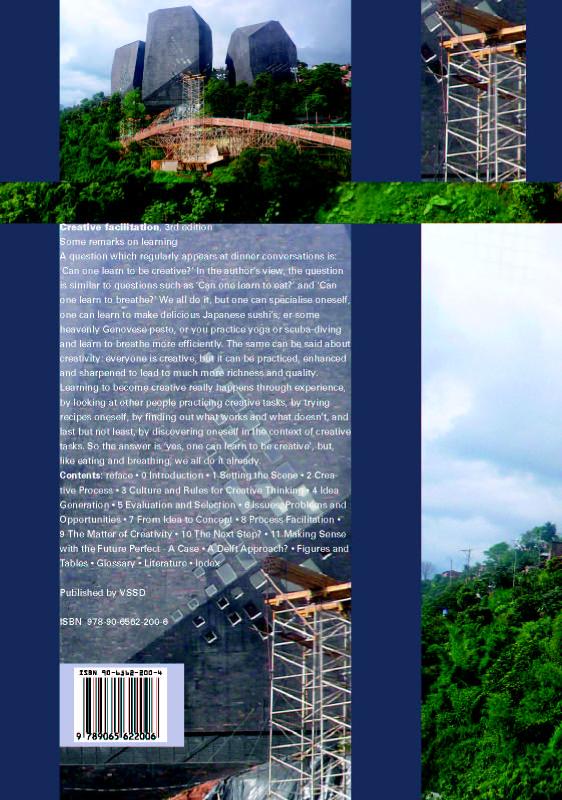
Creative facilitation, 3rd edition
A question which regularly appears at dinner conversations is: Can one learn to be creative? In the authors view, the question is similar to questions such as Can one learn to eat? and Can one learn to breathe? We all do it, but one can specialise oneself, one can learn to make delicious Japanese sushis, or some heavenly Genovese pesto, or you practice yoga or scuba-diving and learn to breathe more efficiently. The same can be said about creativity: everyone is creative, but it can be practiced, enhanced and sharpened to lead to much more richness and quality.
Learning to become creative really happens through experience, by looking at other people practicing creative tasks, by trying recipes oneself, by finding out what works and what doesnt, and last but not least, by discovering oneself in the context of creative tasks. So the answer is yes, one can learn to be creative, but, like eating and breathing, we all do it already.
Contents: reface 0 Introduction 1 Setting the Scene 2 Creative Process 3 Culture and Rules for Creative Thinking 4 Idea Generation 5 Evaluation and Selection 6 Issues, Problems and Opportunities 7 From Idea to Concept 8 Process Facilitation 9 The Matter of Creativity 10 The Next Step? 11 Making Sense with the Future Perfect - A Case A Delft Approach? Figures and Tables Glossary Literature Index
URL on this book: http://www.vssd.nl/hlf/b005.htm
A question which regularly appears at dinner conversations is: Can one learn to be creative? In the authors view, the question is similar to questions such as Can one learn to eat? and Can one learn to breathe? We all do it, but one can specialise oneself, one can learn to make delicious Japanese sushis, or some heavenly Genovese pesto, or you practice yoga or scuba-diving and learn to breathe more efficiently. The same can be said about creativity: everyone is creative, but it can be practiced, enhanced and sharpened to lead to much more richness and quality.
Learning to become creative really happens through experience, by looking at other people practicing creative tasks, by trying recipes oneself, by finding out what works and what doesnt, and last but not least, by discovering oneself in the context of creative tasks. So the answer is yes, one can learn to be creative, but, like eating and breathing, we all do it already.
Contents: reface 0 Introduction 1 Setting the Scene 2 Creative Process 3 Culture and Rules for Creative Thinking 4 Idea Generation 5 Evaluation and Selection 6 Issues, Problems and Opportunities 7 From Idea to Concept 8 Process Facilitation 9 The Matter of Creativity 10 The Next Step? 11 Making Sense with the Future Perfect - A Case A Delft Approach? Figures and Tables Glossary Literature Index
URL on this book: http://www.vssd.nl/hlf/b005.htm
In het kort
ISBN-13
9789065622006
Uitgever
Verschenen
1 september 2009
Bibliografisch
ISBN-139789065622006
Editie3
TaalEngels eng
Pagina’s204
GeïllustreerdJa
Uitgave
UitgeverDelft Academic Press / VSSD
CB-relatie-id8095824
Verschenen1 september 2009
StatusInactief 08
BeschikbaarheidContact leverancier 99
Adviesprijs (incl. btw)€ 24,00
Vorm & inhoud
ProductvormPaperback BC
SamenstellingPakket (meerdelig)
Classificatie
NUR (hoofd)Industrieel ontwerpen 964
NUR (alle)964 Industrieel ontwerpen
Medewerkers
Auteur A01M. Tassoul
Herkomst
Werk-id (NSTC)500196715
MeldingBevestigd bij publicatie 03
Bijgewerkt6 augustus 2026
Lijkt op dit boek
NSTC 500196715 · CB-relatie 8095824 · Bijgewerkt 6 augustus 2026