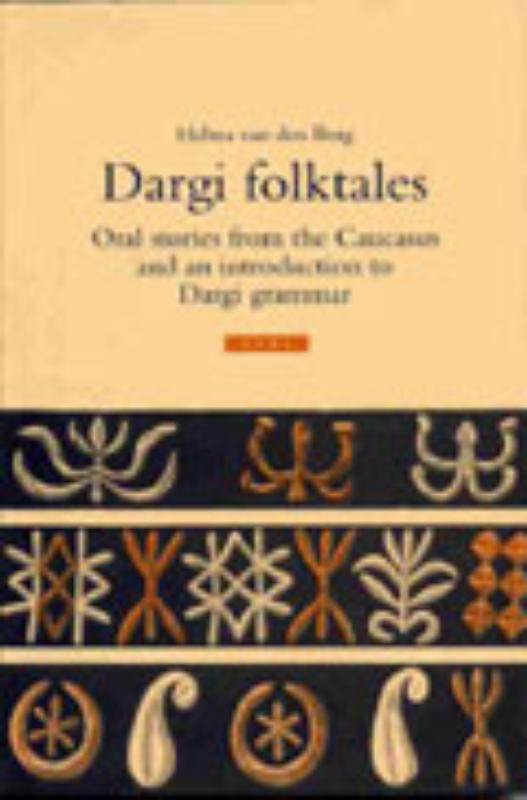
Dargi folktales oral stories from the Caucasus with an introduction to Dargi grammar
Dargi folktalesis a collection of some thirty tales and anecdotes from the East Caucasus.
The texts were gathered during the early 1950s and 60s by Daghestanian scholars and represent traditional oral stories. As Daghestan borders the Arab and Anatolian world, we come across features common to the oral traditions of those areas, like the figure of Mullah Nasredin. Even now, oral stories remain a vivid part of Daghestanian literary life and serve as the basis for newly written works.
At the same time, the book presents the first grammatical sketch of Standard Dargi available to the Western linguistic public in a language other than Russian. This sketch is based on the texts which are given in the original orthography, a transliteration, interlinear glosses and a English translation. A Dargi-English glossary completes the volume. Dargi morphosyntax is typical for the Daghestanian branch of the East Caucasian language family. It has a rich suffixation on nouns and verbs, a large case inventory, ergative/absolutive case-marking, widespread use of non- finite subordination and a fairly consistent head-final word order.
(In English, 324 pp., incl. lex. and bibl.)
In het kort
ISBN-13
9789057890666
Uitgever
Verschenen
1 juli 2001
Bibliografisch
ISBN-139789057890666
SerieCNWS publications — deel 106
Editie1
TaalNederlands dut
Pagina’s324
GeïllustreerdNee
Uitgave
UitgeverCnws Publicaties
CB-relatie-id8767404
Verschenen1 juli 2001
StatusOnbekend 00
BeschikbaarheidContact leverancier 99
Zonder prijsPrijs volgt
Vorm & inhoud
ProductvormPaperback BC
SamenstellingLos product
Classificatie
Medewerkers
Auteur A01Helma van den Berg
Herkomst
Werk-id (NSTC)500309555
MeldingBevestigd bij publicatie 03
Bijgewerkt6 augustus 2026
Lijkt op dit boek
NSTC 500309555 · CB-relatie 8767404 · Bijgewerkt 6 augustus 2026