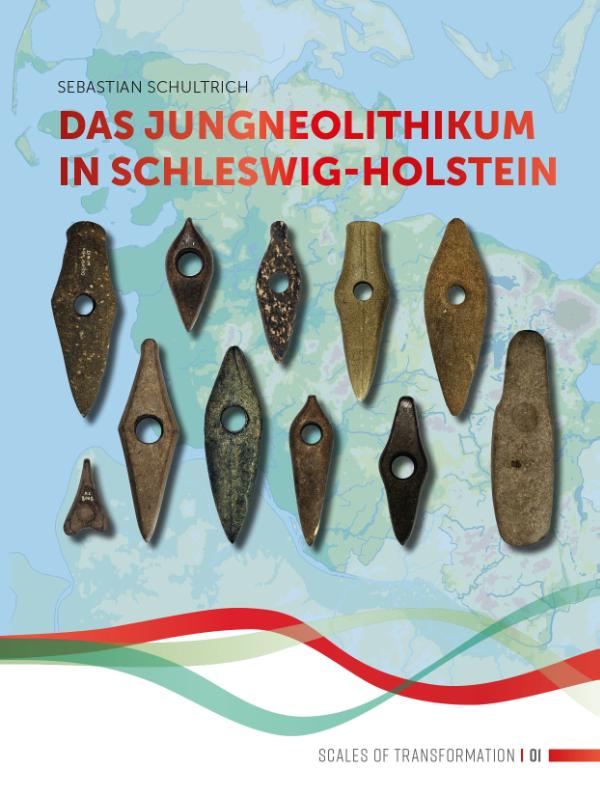

Das Jungneolithikum in Schleswig-Holstein
Ook verkrijgbaar als
Das Buch bietet eine detaillierte Darstellung des Jüngeren Neolithikums (ca. 2850 - 2250 v.Chr.) in Schleswig-Holstein (SH). Neben der Vorlage aller bisher bekannter Funde und Befunde der Einzelgrabkultur wird ein besonderer Fokus auf deren Hammeräxte gelegt. Sie sind das meist vorkommende Artefakt und bieten in ihren Kontexten eine Möglichkeit, soziale Praktiken des Jungneolithikums zu analysieren.
Grundsätzlich nimmt die Variationsbreite der Hammeräxte mit der Zeit zu, was - ähnlich wie bei den Flintdolchen - als ein Hinweis auf komplexer werdende soziale Beziehungen gewertet wird. Viele Hammeräxte wurden fragmentiert deponiert. Zahlreiche Argumente werden angeführt, warum dies intentionell und rituell geschah. Wir haben es mit einer neuen Deponierungspraxis zu tun, die in dieser Form aus dem Mittelneolithikum nicht bekannt war. Zusätzlich können Unterschiede in Deponierungspraktiken zwischen dem westlichen und östlichen Holstein festgestellt werden, die als eine strukturell unterschiedliche soziale Orientierung der beteiligten Gruppen interpretiert werden.
English abstract
This book offers a comprehensive study of the Younger Neolithic period ([YN], c. 2850 - 2250 BC) of Schleswig-Holstein (SH). Apart from presenting all currently known artefacts and contexts of that period in detail, a particular focus was placed on the examination of YN battle axes. They appear to be the most common artefact that is preserved from the YN, and they are very well suited for investigating social phenomena. These artefacts furthermore changed diachronically.
While battle axes of the early stage are shaped more or less equally elaborately, late specimens exhibit significant morphological variation and difference, as some specimens were shaped very elaborately whereas others were quite simple. The same difference has been observed for the subsequently used flint daggers. It is suggested that this difference reflects the emergence of a more stratified society.
Many battle axes appear to have been deposited as broken pieces. As the ratio of cutting edges to butt ends is unequal (2:1) both in SH and in a wider region and as many pieces have "decorations" (Applikationen, pars pro toto shaft holes), battle axes are regarded as intentionally deposited. Accordingly, a large proportion of single finds are regarded as intentional depositions.
Another focus was set on examining the transition to the YN. It is argued that many aspects that are said to characterize the YN are rooted in the preceding Middle Neolithic. A novelty is that social role becomes marked in funerary contexts. Thus, the transformation to the YN marks a certain point where already initiated societal changes become visible for first time. The examination of certain attributes revealed furthermore that there are differences between western and eastern SH which are not determined by chronological changes only. Rather, general differences appear between western and eastern regions, an in a wider geographical as well as temporal frame, which might be linked to different social orientations - either collectively or individually acting groups.
Grundsätzlich nimmt die Variationsbreite der Hammeräxte mit der Zeit zu, was - ähnlich wie bei den Flintdolchen - als ein Hinweis auf komplexer werdende soziale Beziehungen gewertet wird. Viele Hammeräxte wurden fragmentiert deponiert. Zahlreiche Argumente werden angeführt, warum dies intentionell und rituell geschah. Wir haben es mit einer neuen Deponierungspraxis zu tun, die in dieser Form aus dem Mittelneolithikum nicht bekannt war. Zusätzlich können Unterschiede in Deponierungspraktiken zwischen dem westlichen und östlichen Holstein festgestellt werden, die als eine strukturell unterschiedliche soziale Orientierung der beteiligten Gruppen interpretiert werden.
English abstract
This book offers a comprehensive study of the Younger Neolithic period ([YN], c. 2850 - 2250 BC) of Schleswig-Holstein (SH). Apart from presenting all currently known artefacts and contexts of that period in detail, a particular focus was placed on the examination of YN battle axes. They appear to be the most common artefact that is preserved from the YN, and they are very well suited for investigating social phenomena. These artefacts furthermore changed diachronically.
While battle axes of the early stage are shaped more or less equally elaborately, late specimens exhibit significant morphological variation and difference, as some specimens were shaped very elaborately whereas others were quite simple. The same difference has been observed for the subsequently used flint daggers. It is suggested that this difference reflects the emergence of a more stratified society.
Many battle axes appear to have been deposited as broken pieces. As the ratio of cutting edges to butt ends is unequal (2:1) both in SH and in a wider region and as many pieces have "decorations" (Applikationen, pars pro toto shaft holes), battle axes are regarded as intentionally deposited. Accordingly, a large proportion of single finds are regarded as intentional depositions.
Another focus was set on examining the transition to the YN. It is argued that many aspects that are said to characterize the YN are rooted in the preceding Middle Neolithic. A novelty is that social role becomes marked in funerary contexts. Thus, the transformation to the YN marks a certain point where already initiated societal changes become visible for first time. The examination of certain attributes revealed furthermore that there are differences between western and eastern SH which are not determined by chronological changes only. Rather, general differences appear between western and eastern regions, an in a wider geographical as well as temporal frame, which might be linked to different social orientations - either collectively or individually acting groups.
In het kort
ISBN-13
9789088907425
Uitgever
Verschenen
24 december 2018
Imprint
Bibliografisch
ISBN-139789088907425
SerieScales of Transformation — deel 1
Editie1
TaalDuits ger
Pagina’s280
GeïllustreerdJa
Uitgave
UitgeverSidestone Press
ImprintSidestone Press
CB-relatie-id9180064
Verschenen24 december 2018
StatusOnbekend 00
Vorm & inhoud
ProductvormPaperback BC
SamenstellingLos product
Classificatie
NUR (hoofd)Archeologie 682
NUR (alle)682 Archeologie
Medewerkers
Auteur A01Sebastian Schultrich
Herkomst
Werk-id (NSTC)500183656
MeldingBevestigd bij publicatie 03
Bijgewerkt6 augustus 2026
Lijkt op dit boek
Durrington Walls and Woodhenge: A place for the living
Durrington Walls and Woodhenge: A place for the living
Indigenous Knowledge in Transformation
Indigenous Knowledge in Transformation
Archaeological Approaches to Inequality, Political Organisation, and Social Complexity
Archaeological Approaches to Inequality, Political Organisation, and Social Complexity
Stadterweiterungen und urbane Dynamik im Mittelalter
Stadterweiterungen und urbane Dynamik im Mittelalter
Prehistoric Shore Settlements of the Southwestern Balkans
Prehistoric Shore Settlements of the Southwestern Balkans
NSTC 500183656 · CB-relatie 9180064 · Bijgewerkt 6 augustus 2026