
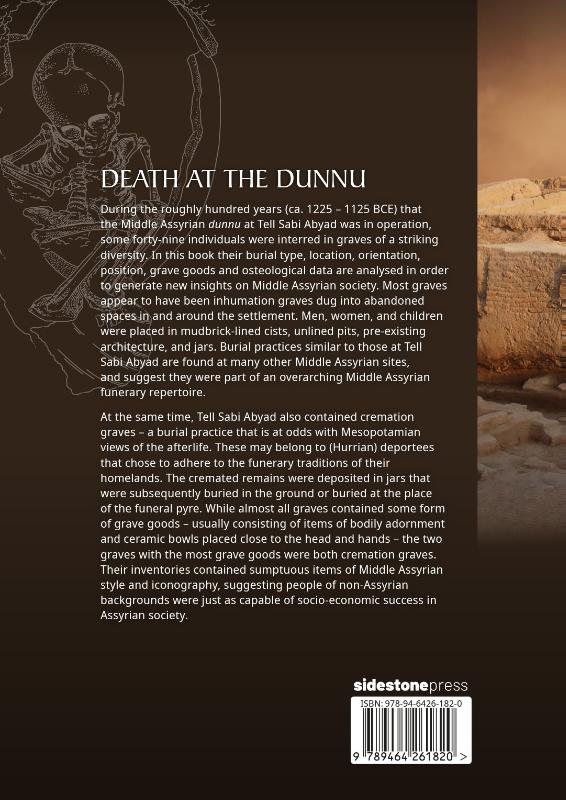
Death at the Dunnu Investigating Funerary Variety at Middle Assyrian Tell Sabi Abyad, Syria
Hardback200 pagina’sEngels
Ook verkrijgbaar als
1. Introduction2. Data and Methodology3. Theorizing Death4. The Middle Assyrian State: Culture-Historic Frameworks5. Introducing Tell Sabi Abyad6. The Graves of Sabi Abyad7. Burial in the Middle Assyrian Empire8. Concluding Death at the DunnuBibliographyFigures, Tables, and AppendicesBurial CatalogueDuring the roughly hundred years (ca. 1225 – 1125 BCE) that the Middle Assyrian dunnu at Tell Sabi Abyad was in operation, some forty-nine individuals were interred in graves of a striking diversity. In this book their burial type, location, orientation, position, grave goods and osteological data are analysed in order to generate new insights on Middle Assyrian society. Most graves appear to have been inhumation graves dug into abandoned spaces in and around the settlement. Men, women, and children were placed in mudbrick-lined cists, unlined pits, pre-existing architecture, and jars. Burial practices similar to those at Tell Sabi Abyad are found at many other Middle Assyrian sites, and suggest they were part of an overarching Middle Assyrian funerary repertoire.At the same time, Tell Sabi Abyad also contained cremation graves – a burial practice that is at odds with Mesopotamian views of the afterlife. These may belong to (Hurrian) deportees that chose to adhere to the funerary traditions of their homelands. The cremated remains were deposited in jars that were subsequently buried in the ground or buried at the place of the funeral pyre. While almost all graves contained some form of grave goods – usually consisting of items of bodily adornment and ceramic bowls placed close to the head and hands – the two graves with the most grave goods were both cremation graves. Their inventories contained sumptuous items of Middle Assyrian style and iconography, suggesting people of non-Assyrian backgrounds were just as capable of socio-economic success in Assyrian society.
In het kort
ISBN-13
9789464261837
Uitgever
Verschenen
7 september 2023
Imprint
Bibliografisch
ISBN-139789464261837
Editie1
TaalEngels eng
Pagina’s200
GeïllustreerdJa
Uitgave
UitgeverSidestone Press
ImprintSidestone Press
CB-relatie-id9180064
Verschenen7 september 2023
StatusOnbekend 00
Vorm & inhoud
ProductvormHardback BB
SamenstellingLos product
Classificatie
NUR (hoofd)Archeologie 682
NUR (alle)682 Archeologie
Medewerkers
Auteur A01Keshia Akkermans
Herkomst
Werk-id (NSTC)501546833
MeldingBevestigd bij publicatie 03
Bijgewerkt6 augustus 2026
Lijkt op dit boek
Cremation in the Early Middle Ages
The Archaeology of the ‘Margins’
Breaking and making the ancestors
Death in Times of Change
Style and Society in the Prehistory of West Asia
Elite Mobility and Funerary Practices in Early Iron Age Europe
Identity, Power and Group Formation in Archaic Macedonia (600-400 BC)
Before Temples
Cyprus and Ugarit
Making a Neolithic non-megalithic monument
NSTC 501546833 · CB-relatie 9180064 · Bijgewerkt 6 augustus 2026