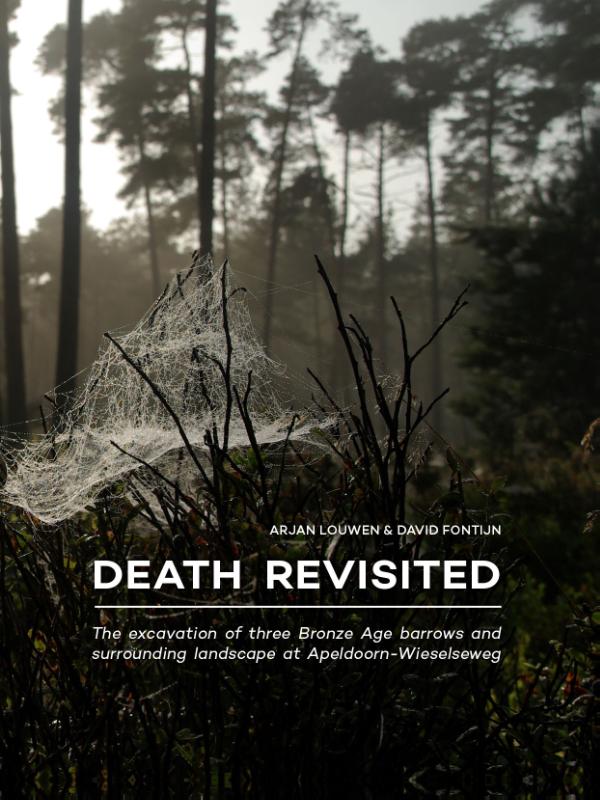
Death revisited The excavation of three Bronze Age barrows and surrounding landscape at Apeldoorn-Wieselseweg
David Fontijn bewerker
Hardback200 pagina’sEngels
This book presents a group of small and inconspicuous barrows that were recently discovered in the forest of Apeldoorn, the Netherlands. They are part of an extensive barrow landscape of which little was yet known. Fieldwork carried out in and around them yielded a wealth of new data. It was discovered that even the most inconspicuous and heavily damaged mound of this group still contained many special features.
This special place was anchored around a site that probably had a particular significance in the Late Neolithic, and where special rituals were carried out during the Bronze Age, resulting in the construction of an enigmatic row of pits - rituals the likes of which have not previously been attested around barrows in the Netherlands, but which are known elsewhere in Europe. The dead were buried at locations that were probably only later covered by monuments. During the Bronze Age (between the 18th and 15th centuries BC) the mounds of this small barrow group were used as collective graves for what was probably perceived as one specific 'community of ancestors'.
The burial practices in the mounds show strong similarities and it is argued that these barrows were each other's successors, representing the funeral history of people who wished to unite their forebears in death as one unproblematic whole without distinctions. The fieldwork showed that even small-scale, partial excavations of a seemingly minor barrow group can inform us on the significance of the extensive barrow landscapes they are part of - a knowledge that can help us to understand the prehistoric legacy of the Netherlands and to protect it for the future as heritage.
Contents:
1. Introduction
David Fontijn, Arjan Louwen
2. Research plan and methodology
Cristian van der Linde, Arjan Louwen
3. Physical geography and site formation processes
Arjan Louwen
4. Archaeological and historical context
Arjan Louwen
5. Results landscape related research
Arjan Louwen, Cristian van der Linde, Marieke Doorenbosch, Hans Huisman
6. The surroundings of the four barrows of Monument 145
Arjan Louwen, David Fontijn & Cristian van der Linde
7. Mound 1
Arjan Louwen, Quentin Bourgeois & David Fontijn
8. Mound 2
Arjan Louwen, David Fontijn, Cristian van der Linde, Maurits Pruysen, Liesbeth Smits & Erica van Hees
9. Mound 3
Arjan Louwen, David Fontijn, Cristian van der Linde, Patrick Valentijn, Liesbeth Smits & Erica van Hees
10. The surroundings of the barrow group of Apeldoorn-Wieselseweg
Arjan Louwen, David Fontijn & Cristian van der Linde
11. The barrow landscape of Apeldoorn-Wieselseweg in context
David Fontijn & Arjan Louwen
Appendix 1. Summary of the analysis of the cremated remains of Apeldoorn - Wieselseweg
Liesbeth Smits
In het kort
ISBN-13
9789088905810
Uitgever
Verschenen
15 oktober 2018
Imprint
Bibliografisch
ISBN-139789088905810
Editie1
TaalEngels eng
Pagina’s200
GeïllustreerdJa
Uitgave
UitgeverSidestone Press
ImprintSidestone Press
CB-relatie-id9180064
Verschenen15 oktober 2018
StatusOnbekend 00
Vorm & inhoud
ProductvormHardback BB
SamenstellingLos product
Classificatie
NUR (hoofd)Archeologie 682
NUR (alle)682 Archeologie
Medewerkers
Bewerker B05Arjan Louwen
Bewerker B05David Fontijn
Herkomst
Werk-id (NSTC)500347455
MeldingBevestigd bij publicatie 03
Bijgewerkt6 augustus 2026
Lijkt op dit boek
Landscapes in Motion
Landscapes in Motion
Durrington Walls and Woodhenge: A place for the living
Durrington Walls and Woodhenge: A place for the living
Indigenous Knowledge in Transformation
Indigenous Knowledge in Transformation
Archaeological Approaches to Inequality, Political Organisation, and Social Complexity
Archaeological Approaches to Inequality, Political Organisation, and Social Complexity
Stadterweiterungen und urbane Dynamik im Mittelalter
Stadterweiterungen und urbane Dynamik im Mittelalter
NSTC 500347455 · CB-relatie 9180064 · Bijgewerkt 6 augustus 2026