
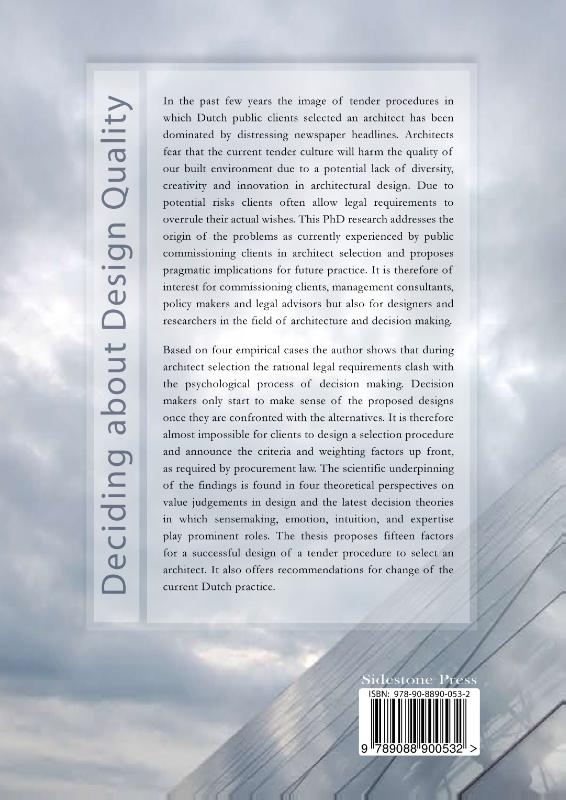
Deciding about Design Quality value judgements and decision making in the selection of architects by public clients under European tendering regulations
Paperback250 pagina’sEngels
Ook verkrijgbaar als
In the past few years the image of tender procedures in which Dutch public clients selected an architect has been dominated by distressing newspaper headlines. Architects fear that the current tender culture will harm the quality of our built environment due to a potential lack of diversity, creativity and innovation in architectural design. Clients often allow legal requirements to overrule their actual wishes. The current practice of architect selection by European public clients has its roots in three distinct systems: 1) tendering for services and works, 2) the selective search to identify a suitable architect or design team, and 3) the architectural competition. It is these diverse roots of the selection process that appear to cause conflicts between the legal rationality of procurement and the psychological rationality of public decision making. This PhD research addresses the origin of these problems as currently experienced by public commissioning clients in architect selection and proposes pragmatic implications for future practice. It is therefore of interest for commissioning clients, management consultants, policy makers and legal advisors but also for designers and researchers in the field of architecture and decision making.
Based on four empirical cases the author shows that during architect selection the rational legal requirements clash with the psychological process of decision making. Decision makers only start to make sense of the proposed designs once they are confronted with the alternatives. It is therefore almost impossible for clients to design a selection procedure and announce the criteria and weighing factors up front, as required by procurement law. The scientific underpinning of the findings is found in four theoretical perspectives on value judgements in design and the latest decision theories in which emotion, intuition, and expertise play prominent roles. In the conclusions five sensemaking processes are distinguished and several underlying situational characteristics are identified that influence the selection process, such as complexity, uncertainty and decision support. The thesis proposes fifteen factors for a successful design of a tender procedure to select an architect. It also offers recommendations for change of the current Dutch practice.
Based on four empirical cases the author shows that during architect selection the rational legal requirements clash with the psychological process of decision making. Decision makers only start to make sense of the proposed designs once they are confronted with the alternatives. It is therefore almost impossible for clients to design a selection procedure and announce the criteria and weighing factors up front, as required by procurement law. The scientific underpinning of the findings is found in four theoretical perspectives on value judgements in design and the latest decision theories in which emotion, intuition, and expertise play prominent roles. In the conclusions five sensemaking processes are distinguished and several underlying situational characteristics are identified that influence the selection process, such as complexity, uncertainty and decision support. The thesis proposes fifteen factors for a successful design of a tender procedure to select an architect. It also offers recommendations for change of the current Dutch practice.
In het kort
Bibliografisch
ISBN-139789088900532
Editie1
TaalEngels eng
Pagina’s250
GeïllustreerdJa
Uitgave
Vorm & inhoud
ProductvormPaperback BC
SamenstellingLos product
Classificatie
NUR (hoofd)Bouwkunde 955
NUR (alle)955 Bouwkunde
Medewerkers
Auteur A01L. Volker
Herkomst
Werk-id (NSTC)500187042
MeldingBevestigd bij publicatie 03
Bijgewerkt6 augustus 2026
Lijkt op dit boek


NSTC 500187042 · CB-relatie 9180064 · Bijgewerkt 6 augustus 2026