
Designing Interdisciplinary Education A Practical Handbook for University Teachers
Ook verkrijgbaar als
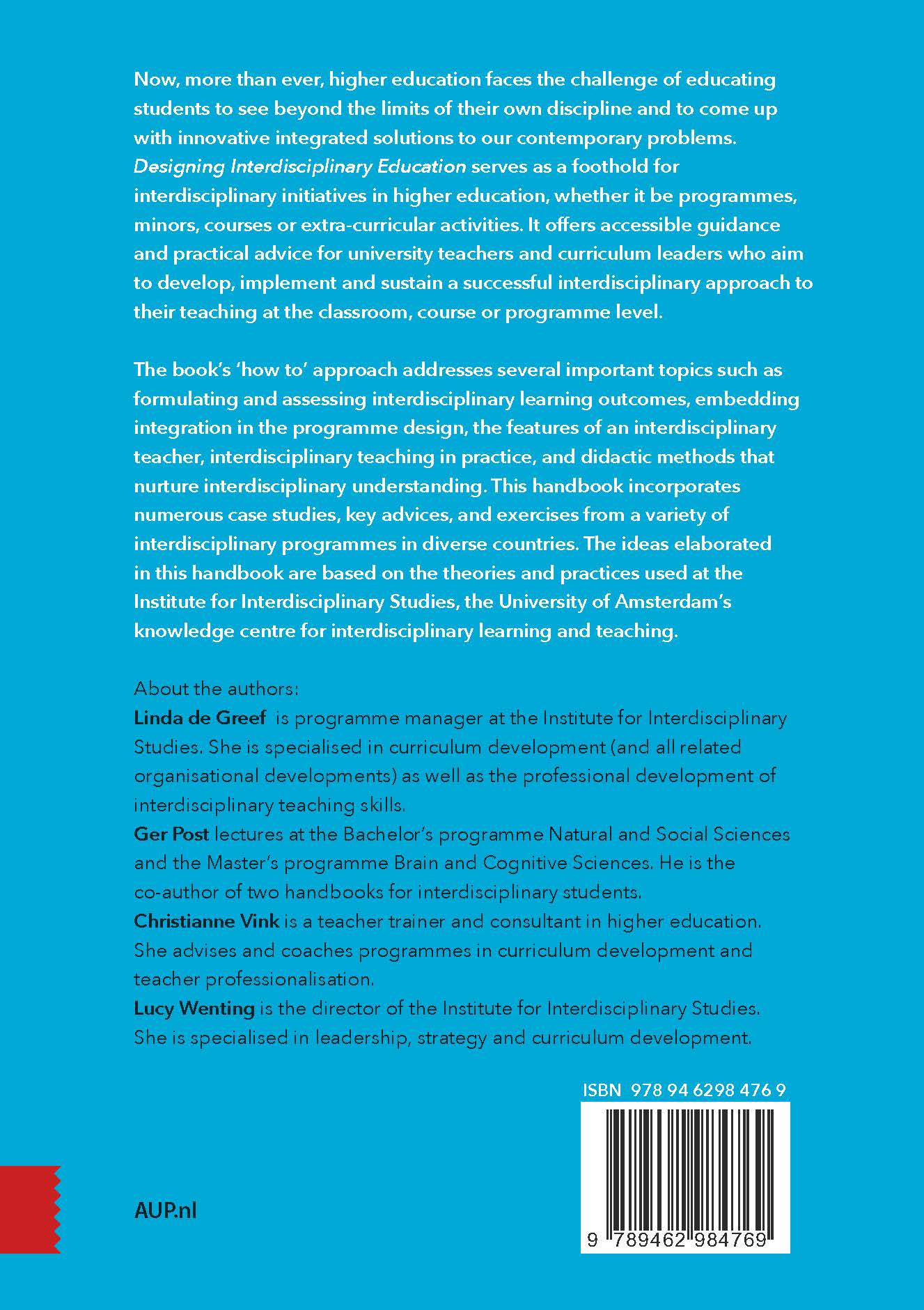
Acknowledgements 1 Introduction 1.1 Moving towards more complexity 1.2 Why interdisciplinary education? 1.3 Why this handbook 1.4 An overview of the content 2 An overview of the development stages 2.1 Starting with an interdisciplinary development team 2.2 Stages in programme development 2.3 Putting the theory into practice 3 Unravelling interdisciplinary understanding 283.1 The definition of interdisciplinarity 3.2 Embedding integration in education 3.3 Unravelling interdisciplinary understanding 4 Developing the raw sketch 4.1 Drafting the vision 4.2 Expressing thevision 4.3 Engaging stakeholders in the visioning process 4.4 Communicating the vision 5 Formulating interdisciplinary learning outcomes 5.1 Intended learning outcomes at the programme level 5.2 Intended learning outcomes at the course level 5.3 Creating learning pathways within a programme 5.4 Translating intended learning outcomes into learning activities 6 Embedding integration in the programme design 6.1 Four curriculum models 6.2 Deciding on a curriculum format 6.3 Working towards an interdisciplinary programme 7 Hiring and engaging faculty 7.1 Features of an interdisciplinary teacher 7.2 Recruiting, engaging and connecting faculty 7.3 Overcome hurdles in the interdisciplinary teaching team 8 Exploring the teaching philosophy and didactic methods 8.1 Assumptions of teaching and understanding 8.2 Formulating a shared teaching philosophy 8.3 Didactic methods that nurture interdisciplinary understanding 9 Assessment of interdisciplinary learning outcomes 9.1 Valid assessment of interdisciplinary learning outcomes 9.2 Make interdisciplinary assessment work 9.3 Developing a programme-wide assessment strategy 10 Interdisciplinary teaching in practice 10.1 Important prerequisites for interdisciplinary classes 10.2 The teacher as coach 10.3 Teaching reflective functioning 10.4 Enhancing collaboration skills 10.5 Teaching critical thinking 10.6 Teaching an integrative interdisciplinary capstone course 11 Programme assessment and adjustment 11.1 Formal and informal assessment 11.2 An evaluation approach 11.3 Accreditation of interdisciplinary programmes 11.4 Sustaining interdisciplinary programmes Appendices Index case studies Index activities Index key advices References ColophonInterdisciplinary education has been identified by many educational organisations in Europe and the United States as important for what lies ahead, and it has become a buzzword in some debates about educating for the future. Now, more than ever, higher education is challenged to educate students to see beyond the limits of their own discipline and to come up with innovative integrated solutions for our global challenges. But how do you define interdisciplinarity? How do you measure whether a student has integrated different insights? How do you challenge students to step across disciplinary borders?'Designing interdisciplinary education' offers guidance and practical advice for university teachers who want to successfully develop, implement and sustain an interdisciplinary approach to their teaching.
In het kort
ISBN-13
9789048571246
Uitgever
Verschenen
17 januari 2025
Imprint
Bibliografisch
ISBN-139789048571246
Editie1
TaalEngels eng
Pagina’s144
GeïllustreerdJa
Uitgave
UitgeverAmsterdam University Press
ImprintAmsterdam University Press
CB-relatie-id7400597
Verschenen17 januari 2025
StatusAangekondigd 02
BeschikbaarheidContact leverancier 99
Adviesprijs (incl. btw)€ 14,99
Vorm & inhoud
ProductvormE-book ED
VormdetailE101 EPUB
SamenstellingLos product
EPUB-versie2
Beveiliging e-bookGeen 00
Classificatie
Medewerkers
Herkomst
Werk-id (NSTC)500068292
MeldingBevestigd bij publicatie 03
Bijgewerkt6 augustus 2026
NSTC 500068292 · CB-relatie 7400597 · Bijgewerkt 6 augustus 2026