
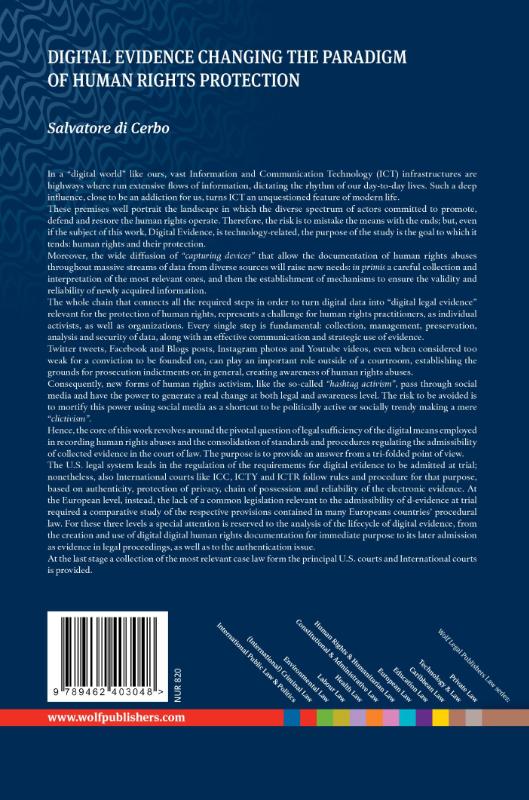
Digital evidence changing the paradigm of human rights protection
Paperback286 pagina’sEngels
In a "digital world" like ours, vast Information and Communication Technology (ICT)
infrastructures are highways where run extensive flows of information, dictating the
rhythm of our day-to-day lives. Such a deep influence, close to be an addiction for us, turns
ICT an unquestioned feature of modern life.
These premises well portrait the landscape in which the diverse spectrum of actors
committed to promote, defend and restore the human rights operate. Therefore, the risk is
to mistake the means with the ends; but, even if the subject of this work, Digital Evidence,
is technology-related, the purpose of the study is the goal to which it tends: human rights
and their protection.
Moreover, the wide diffusion of "capturing devices" that allow the documentation of human
rights abuses throughout massive streams of data from diverse sources will raise new
needs: in primis a careful collection and interpretation of the most relevant ones, and then
the establishment of mechanisms to ensure the validity and reliability of newly acquired
information.
The whole chain that connects all the required steps in order to turn digital data into
"digital legal evidence" relevant for the protection of human rights, represents a challenge
for human rights practitioners, as individual activists, as well as organizations. Every single
step is fundamental: collection, management, preservation, analysis and security of data,
along with an effective communication and strategic use of evidence.
Twitter tweets, Facebook and Blogs posts, Instagram photos and Youtube videos, even
when considered too weak for a conviction to be founded on, can play an important
role outside of a courtroom, establishing the grounds for prosecution indictments or, in
general, creating awareness of human rights abuses.
Consequently, new forms of human rights activism, like the so-called "hashtag activism",
pass through social media and have the power to generate a real change at both legal and
awareness level. The risk to be avoided is to mortify this power using social media as a
shortcut to be politically active or socially trendy making a mere "clictivism".
Hence, the core of this work revolves around the pivotal question of legal sufficiency of
the digital means employed in recording human rights abuses and the consolidation of
standards and procedures regulating the admissibility of collected evidence in the court of
law. The purpose is to provide an answer from a tri-folded point of view.
The U.S. legal system leads in the regulation of the requirements for digital evidence to be
admitted at trial; nonetheless, also International courts like ICC, ICTY and ICTR follow
rules and procedure for that purpose, based on authenticity, protection of privacy, chain
of possession and reliability of the electronic evidence. At the European level, instead, the
lack of a common legislation relevant to the admissibility of d-evidence at trial required a
comparative study of the respective provisions contained in many Europeans countries'
procedural law. For these three levels a special attention is reserved to the analysis
of the lifecycle of digital evidence, from the creation and use of digital digital human
rights documentation for immediate purpose to its later admission as evidence in legal
proceedings, as well as to the authentication issue.
At the last stage a collection of the most relevant case law form the principal U.S. courts
and International courts is provided.
infrastructures are highways where run extensive flows of information, dictating the
rhythm of our day-to-day lives. Such a deep influence, close to be an addiction for us, turns
ICT an unquestioned feature of modern life.
These premises well portrait the landscape in which the diverse spectrum of actors
committed to promote, defend and restore the human rights operate. Therefore, the risk is
to mistake the means with the ends; but, even if the subject of this work, Digital Evidence,
is technology-related, the purpose of the study is the goal to which it tends: human rights
and their protection.
Moreover, the wide diffusion of "capturing devices" that allow the documentation of human
rights abuses throughout massive streams of data from diverse sources will raise new
needs: in primis a careful collection and interpretation of the most relevant ones, and then
the establishment of mechanisms to ensure the validity and reliability of newly acquired
information.
The whole chain that connects all the required steps in order to turn digital data into
"digital legal evidence" relevant for the protection of human rights, represents a challenge
for human rights practitioners, as individual activists, as well as organizations. Every single
step is fundamental: collection, management, preservation, analysis and security of data,
along with an effective communication and strategic use of evidence.
Twitter tweets, Facebook and Blogs posts, Instagram photos and Youtube videos, even
when considered too weak for a conviction to be founded on, can play an important
role outside of a courtroom, establishing the grounds for prosecution indictments or, in
general, creating awareness of human rights abuses.
Consequently, new forms of human rights activism, like the so-called "hashtag activism",
pass through social media and have the power to generate a real change at both legal and
awareness level. The risk to be avoided is to mortify this power using social media as a
shortcut to be politically active or socially trendy making a mere "clictivism".
Hence, the core of this work revolves around the pivotal question of legal sufficiency of
the digital means employed in recording human rights abuses and the consolidation of
standards and procedures regulating the admissibility of collected evidence in the court of
law. The purpose is to provide an answer from a tri-folded point of view.
The U.S. legal system leads in the regulation of the requirements for digital evidence to be
admitted at trial; nonetheless, also International courts like ICC, ICTY and ICTR follow
rules and procedure for that purpose, based on authenticity, protection of privacy, chain
of possession and reliability of the electronic evidence. At the European level, instead, the
lack of a common legislation relevant to the admissibility of d-evidence at trial required a
comparative study of the respective provisions contained in many Europeans countries'
procedural law. For these three levels a special attention is reserved to the analysis
of the lifecycle of digital evidence, from the creation and use of digital digital human
rights documentation for immediate purpose to its later admission as evidence in legal
proceedings, as well as to the authentication issue.
At the last stage a collection of the most relevant case law form the principal U.S. courts
and International courts is provided.
In het kort
ISBN-13
9789462403048
Uitgever
Verschenen
20 april 2016
Imprint
Bibliografisch
ISBN-139789462403048
Editie1
TaalEngels eng
Pagina’s286
GeïllustreerdNee
Uitgave
UitgeverWolf Legal Publishers
ImprintWolf legal publishers
CB-relatie-id8037459
Verschenen20 april 2016
StatusOnbekend 00
Vorm & inhoud
ProductvormPaperback BC
SamenstellingLos product
Classificatie
NUR (hoofd)Recht algemeen 820
NUR (alle)820 Recht algemeen
Medewerkers
Auteur A01Salvatore di Cerbo
Herkomst
Werk-id (NSTC)500412266
MeldingBevestigd bij publicatie 03
Bijgewerkt6 augustus 2026
Lijkt op dit boek

Grondwet

Niet zonder ons

Veerkrachtig milieurecht?

Manuel de l'ordre public

Informatie beheren en archiveren: selecteren en digitaal depot

Codex overheidsopdrachten

Welzijn in de bibliotheek. Gids voor zorgzame en veerkrachtige bibliotheken

Manuel de la discipline des services de police

Handboek tucht bij de politiediensten

Wegwijs overheidsopdrachten
NSTC 500412266 · CB-relatie 8037459 · Bijgewerkt 6 augustus 2026