
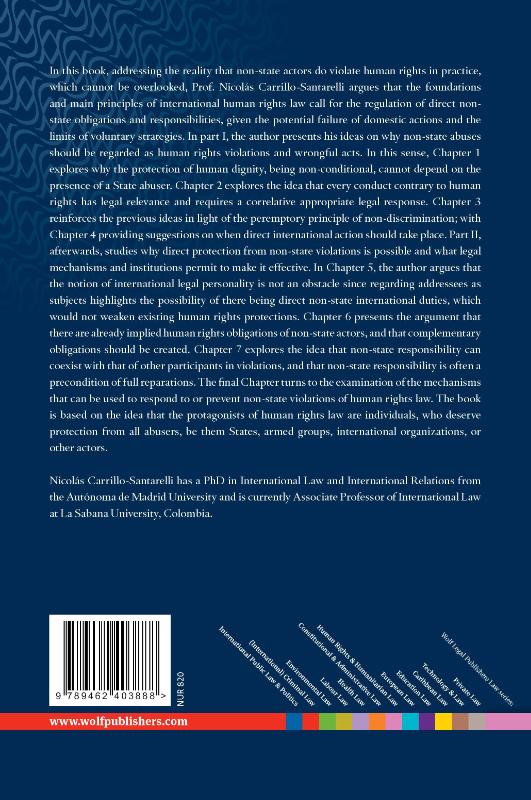
Direct international human rights obligations of non-state actors a legal and ethical necessity
PaperbackEngels
Table of ContentsFOREWORD1PREFACE3INTRODUCTION5PART I. THE NECESSITY OF PROTECTING HUMAN DIGNITY FROM NON-STATE VIOLATIONS27INTRODUCTION29CHAPTER 1. THE DEMAND OF HUMAN DIGNITY TOPROTECT FROM ALL ABUSES311.1.The legal implications of the protection of human dignity in terms of protection from non-state threats401.2.Alternative proposals for human rights foundations and protection fromnon-state threats681.3.The political and legal implications of protecting human dignity fromnon-state violations: are restrictions of rights admissible?801.4.The legitimation of non-state actors that promote and defend humandignity from non-state abuses95CHAPTER 2. THE DEMAND OF PROTECTION FROMNON-STATE ABUSES BY HUMAN RIGHTS PRINCIPLES1072.1.The protection of peremptory human rights1072.2.Legal principles related to the protection of human dignity and theireffects concerning protection from non-state violations1152.3.Material human rights breaches as negative facts that are legally relevantunder human rights law1182.4.The reinforcement of the protection of human dignity from non-stateabuses by soft law and principles of equity and good faith154CHAPTER 3. EQUALITY AND THE NON-DISCRIMINATIONOF VICTIMS OF NON-STATE VIOLATIONS1633.1.Manifestations of equality and non-discrimination and their effectstowards protection from non-state actors1643.2.The equality of all victims and its incompatibility with State-centered protection paradigms184CHAPTER 4. FEATURES AND OPERATION OF A MULTI- LEVEL AND MULTI-ACTOR FRAMEWORK OF PROTECTIONOF HUMAN RIGHTS FROM NON-STATE ABUSES193 PART II. THE INTERNATIONAL LEGAL POSSIBILITIES OF PROTECTING INDIVIDUALS FROM NON-STATE ABUSES225CHAPTER 5. CONDITIONS AND SOURCES OF INTERNATIONAL HUMAN RIGHTS OBLIGATIONS AND OTHER LEGAL CAPACITIES OF NON-STATE ACTORS2275.1.The legal personality or subjectivity of non-state actors: a condition ofnon-state obligations?2285.2.Substantive conditions for the creation of non-state human rights dutiesand legal burdens2525.3.The search of effective and adequate legal responses to non-state threats2655.4.The normative creation of human rights-related legal capacities ofnon-state actors2705.5.Rebutting objections to the regulation of direct non-state human rightsduties and legal burdens284CHAPTER 6. THE TYPES OF DIRECT HUMAN RIGHTS OBLIGATIONS OF NON-STATE ACTORS2956.1.General and implied human rights obligations of non-state entities2966.2.Possible express international human rights obligations of non-state actors321CHAPTER 7. NON-STATE RESPONSIBILITY AND THE FULL REPARATIONS OF VICTIMS3397.1.Principles on the responsibility of non-state actors participating in human rights abuses3417.2.The necessity of non-state participation in reparations for the fullprotection of victims362CHAPTER 8. STRATEGIES AND MECHANISMS THAT CAN SERVE TO PROMOTE AND PROTECT HUMAN RIGHTS FROMNON-STATE ABUSES3778.1.Types of mechanisms that can be used to protect human dignity fromnon-state abuses3788.2.Features of mechanisms for the promotion and protection of humanrights in relation to non-state threats390CONCLUSIONS399BIBLIOGRAPHY415In this book, addressing the reality that non-state actors do violate human rights in practice, which cannot be overlooked, Prof. Nicolás Carrillo-Santarelli argues that the foundations and main principles of international human rights law call for the regulation of direct nonstate obligations and responsibilities, given the potential failure of domestic actions and the limits of voluntary strategies. In part I, the author presents his ideas on why non-state abuses should be regarded as human rights violations and wrongful acts. In this sense, Chapter 1 explores why the protection of human dignity, being non-conditional, cannot depend on the presence of a State abuser. Chapter 2 explores the idea that every conduct contrary to human rights has legal relevance and requires a correlative appropriate legal response. Chapter 3 reinforces the previous ideas in light of the peremptory principle of non-discrimination; with Chapter 4 providing suggestions on when direct international action should take place. Part II, afterwards, studies why direct protection from non-state violations is possible and what legal mechanisms and institutions permit to make it effective. In Chapter 5, the author argues that the notion of international legal personality is not an obstacle since regarding addressees as subjects highlights the possibility of there being direct non-state international duties, which would not weaken existing human rights protections. Chapter 6 presents the argument that there are already implied human rights obligations of non-state actors, and that complementary obligations should be created. Chapter 7 explores the idea that non-state responsibility can coexist with that of other participants in violations, and that non-state responsibility is often a precondition of full reparations. The fi nal Chapter turns to the examination of the mechanisms that can be used to respond to or prevent non-state violations of human rights law. The book is based on the idea that the protagonists of human rights law are individuals, who deserve protection from all abusers, be them States, armed groups, international organizations, or other actors.
Nicolás Carrillo-Santarelli has a PhD in International Law and International Relations from the Autónoma de Madrid University and is currently Associate Professor of International Law at La Sabana University, Colombia.
Nicolás Carrillo-Santarelli has a PhD in International Law and International Relations from the Autónoma de Madrid University and is currently Associate Professor of International Law at La Sabana University, Colombia.
In het kort
ISBN-13
9789462403888
Uitgever
Verschenen
1 april 2017
Imprint
Bibliografisch
ISBN-139789462403888
Editie1
TaalEngels eng
GeïllustreerdNee
Uitgave
UitgeverWolf Legal Publishers
ImprintWolf legal publishers
CB-relatie-id8037459
Verschenen1 april 2017
StatusOnbekend 00
Vorm & inhoud
ProductvormPaperback BC
SamenstellingLos product
Classificatie
NUR (hoofd)Recht algemeen 820
NUR (alle)820 Recht algemeen
Medewerkers
Auteur A01Nicolás Carrillo-Santarelli
Herkomst
Werk-id (NSTC)500395063
MeldingBevestigd bij publicatie 03
Bijgewerkt6 augustus 2026
Lijkt op dit boek
Human rights obligations of armed non-state actors in non-international armed conflicts
Remedies for Human Rights Violations by the European Union
Foreign direct liability and beyond
Corruption and human rights
From policies against poverty to the human right not to be poor
The future of individuals in international law
Corporate Religious Freedom and the Rights of Others
Discrimination and the Foundation of Justice
Reparation for victims of collateral damage
Women and Minority Rights Law in Africa: Reimagining Equality and Addressing Discrimination
NSTC 500395063 · CB-relatie 8037459 · Bijgewerkt 6 augustus 2026