
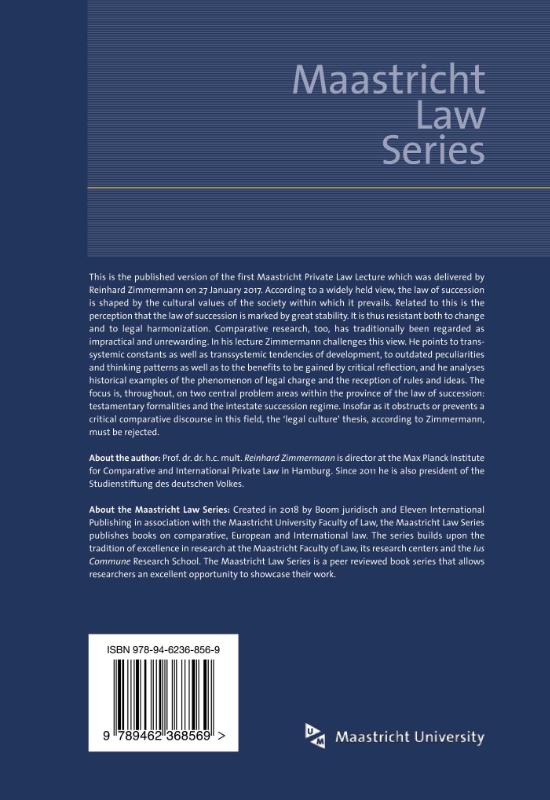
Does the Law of Succession Reflect Cultural Differences?
Ook verkrijgbaar als
This is the published version of the first Maastricht Private Law Lecture which was delivered by Reinhard Zimmermann on 27 January 2017. According to a widely held view, the law of succession is shaped by the cultural values of the society within which it prevails. Related to this is the perception that the law of succession is marked by great stability. It is thus resistant both to change and to legal harmonization. Comparative research, too, has traditionally been regarded as impractical and unrewarding. In his lecture Zimmermann challenges this view. He points to transsystemic constants as well as transsystemic tendencies of development, to outdated peculiarities and thinking patterns as well as to the benefits to be gained by critical reflection, and he analyses historical examples of the phenomenon of legal charge and the reception of rules and ideas. The focus is, throughout, on two central problem areas within the province of the law of succession: testamentary formalities and the intestate succession regime. Insofar as it obstructs or prevents a critical comparative discourse in this field, the 'legal culture' thesis, according to Zimmermann, must be rejected.
In het kort
ISBN-13
9789462368569
Uitgever
Verschenen
15 mei 2018
Bibliografisch
Uitgave
UitgeverKoninklijke Boom uitgevers PW
CB-relatie-id7500275
Verschenen15 mei 2018
StatusOnbekend 00
BeschikbaarheidContact leverancier 99
Adviesprijs (incl. btw)€ 21,00
Vorm & inhoud
ProductvormPaperback BC
SamenstellingLos product
Classificatie
NUR (hoofd)Internationaal (publiek)recht 828
NUR (alle)828 Internationaal (publiek)recht
Medewerkers
Auteur A01Reinhard Zimmermann
Herkomst
Werk-id (NSTC)500127954
MeldingUpdate 04
Laatste CB-bericht7794
Bijgewerkt7 augustus 2026
Lijkt op dit boek
Re- De- Co-dification?
Facilitating Cross-Border Real Estate Transactions in Europe
The possibility of a European judicial culture
Comparative Perspectives on Law and Language

Cross-border claims to cultural objects
Explaining legal transplants
Judicial decision making in civil law
Judicial decision making in civil law
Five Uneasy Pieces
Rethinking Choice of Law in Cross-Border Sales
NSTC 500127954 · CB-relatie 7500275 · Laatste CB-bericht 7794 · Bijgewerkt 7 augustus 2026