
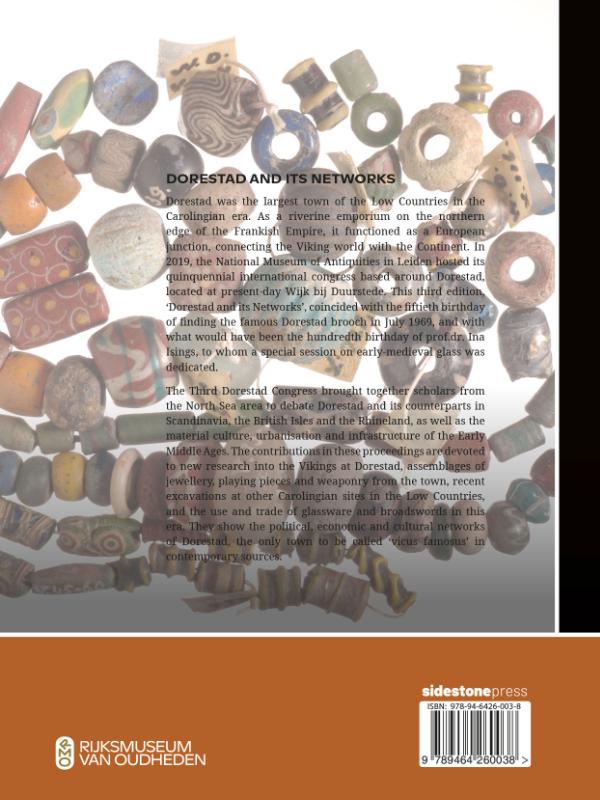
Dorestad and its Networks Communities, Contact and Conflict in Early Medieval Europe
Hanneke Kik bewerker
Dorestad was the largest town of the Low Countries in the Carolingian era. As a riverine emporium on the northern edge of the Frankish Empire, it functioned as a European junction, connecting the Viking world with the Continent. In 2019, the National Museum of Antiquities in Leiden hosted its quinquennial international congress based around Dorestad, located at present-day Wijk bij Duurstede. This third edition, ‘Dorestad and its Networks’, coincided with the fiftieth birthday of finding the famous Dorestad brooch in July 1969, and with what would have been the hundredth birthday of prof.dr. Ina Isings, to whom a special session on early-medieval glass was dedicated.The Third Dorestad Congress brought together scholars from the North Sea area to debate Dorestad and its counterparts in Scandinavia, the British Isles and the Rhineland, as well as the material culture, urbanisation and infrastructure of the Early Middle Ages. The contributions in these proceedings are devoted to new research into the Vikings at Dorestad, assemblages of jewellery, playing pieces and weaponry from the town, recent excavations at other Carolingian sites in the Low Countries, and the use and trade of glassware and broadswords in this era. They show the political, economic and cultural networks of Dorestad, the only town to be called ‘vicus famosus’ in contemporary sources.Contents:Dorestad and its Networks: An IntroductionAnnemarieke WillemsenVikings and Luxury at DorestadViking Dorestad: A Haven for Hydrarchy?Christian CooijmansVikings beyond Dorestad: Rethinking some metal finds in, around and after the emporiumNelleke IJssennagger – van der PluijmTrading Games? Playing with/without the Vikings in DorestadMark A. HallA new gold ring from Dorestad?Channa Cohen Stuart & Annemarieke WillemsenBeads from DorestadMette LangbroekMixed Emotions: The swords from DorestadAnnemarieke WillemsenThe Medieval NetherlandsA Carolingian coin hoard from Wirdum (Friesland, the Netherlands) and the Dorestad mintSimon CouplandTimber! Opening up the landscape of Carolingian LeiderdorpMenno DijkstraCharlemagne’s palace at Nijmegen: Some thoughts on the economic implications of itinerant kingshipArjan den BravenBeyond the planned/unplanned dichotomy: The development of the town plan of Utrecht until c.1560Marcel IJsselstijnCommerce and ConflictProduction of early medieval glass in Cologne and its export via DorestadMichael Dodt, Andreas Kronz & Klaus SimonGlass vessels from the early medieval emporium at IpswichRose BroadleyNon-funerary sword depositions in Carolingian EuropeDušan MaczekForm follows function: Reconstructing the use of Viking age swordsIngo Petri
In het kort
ISBN-13
9789464260045
Uitgever
Verschenen
15 mei 2020
Serie
Imprint
Bibliografisch
Uitgave
UitgeverSidestone Press
ImprintSidestone Press
CB-relatie-id9180064
Verschenen15 mei 2020
StatusOnbekend 00
Vorm & inhoud
ProductvormHardback BB
SamenstellingLos product
Classificatie
NUR (hoofd)Archeologie 682
NUR (alle)682 Archeologie
Medewerkers
Bewerker B05Annemarieke Willemsen
Bewerker B05Hanneke Kik
Herkomst
Werk-id (NSTC)500846760
MeldingBevestigd bij publicatie 03
Bijgewerkt6 augustus 2026
Lijkt op dit boek
Durrington Walls and Woodhenge: A place for the living
Durrington Walls and Woodhenge: A place for the living
Indigenous Knowledge in Transformation
Indigenous Knowledge in Transformation
Archaeological Approaches to Inequality, Political Organisation, and Social Complexity
Archaeological Approaches to Inequality, Political Organisation, and Social Complexity
Stadterweiterungen und urbane Dynamik im Mittelalter
Stadterweiterungen und urbane Dynamik im Mittelalter
Prehistoric Shore Settlements of the Southwestern Balkans
Prehistoric Shore Settlements of the Southwestern Balkans
NSTC 500846760 · CB-relatie 9180064 · Bijgewerkt 6 augustus 2026