
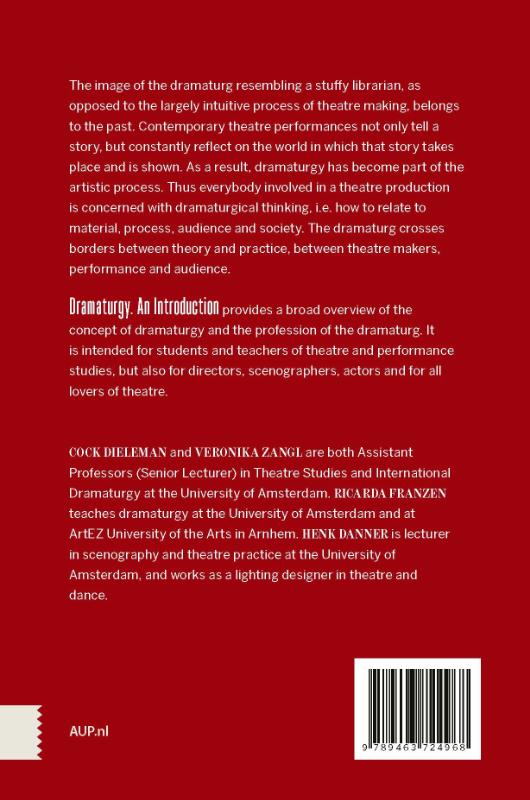
Dramaturgy An Introduction
Paperback206 pagina’sEngelsLeverbaar
Ook verkrijgbaar als
Introduction
1. What is dramaturgy?
1.1 Dramaturgy with and without a dramaturg
1.2 The roots of today’s dramaturgy: From Poetics to postdramatic theatre
1.3 Theatre as a process of transformation
1.4 Dramaturgy in the Netherlands and Flanders
1.5 Perspectives on dramaturgy
1.6 Dramaturgy and theatre research
1.7 Dramaturgy within and across disciplines, styles, and genres
2. Material
2.1 Text as material
2.2 Aristotle: Language as medium of imitation (mimesis)
2.3 Theatre landscape until the eighteenth century
2.4 Absolute drama
2.5 Concepts of drama analysis
Primary text / Secondary text
Story & plot
Dramatic characters
Monologue
Re-definitions of processes of meaning production
2.6 Brecht: Epic theatre
2.7 Metatheatricality
2.8 Theatre of the Absurd
2.9 Textual montage techniques
Accumulation as a principle of montage
Juxtaposition as a principle of montage
Dissipation as a principle of montage
2.10 Material and materiality
2.11 Theatre as a means of exploration
3. Process: From material to performance
3.1 The material and the envisioned performance
3.2 Translational processes in theatre
Context – location
Context – time
Translation for accessibility
Starting point: The source
Relevance and inspiration
Research and interpretation
3.3 Visual aspects of dramaturgy
Scenography
The space and the audience
Writing the space
Light
The visual experience
3.4 Auditory aspects of dramaturgy
Voice
A few historical examples of voice in theatre
Beyond meaning
Accents, dialect, play with language, and sound of voice
4. Audience
4.1 The first spectator
4.2 The position and the role of the audience in the performance: the spectator as/is dramaturg
The dramaturg as intermediary between performance and audience
4.3 Audience reach
4.4 Theatre and politics: The heritage of Brecht and Boal
4.5 The auditorium and the stage
Site-specific and immersive theatre
4.6 Youth in/and theatre
Dutch Theatre for Young Audiences
Theatre education for children and youngsters
The last spectator
Epilogue
Glossary
Notes
Illustration acknowledgements
Bibliography
Index
The image of the dramaturg resembling a stuffy librarian, as opposed to the largely intuitive process of theatre making, belongs to the past. Contemporary theatre performances not only tell a story, but constantly reflect on the world in which that story takes place and is shown. As a result, dramaturgy has become part of the artistic process. Thus everybody involved in a theatre production is concerned with dramaturgical thinking, i.e. how to relate to material, process, audience and society. The dramaturg crosses borders between theory and practice, between theatre makers, performance and audience.
'Dramaturgy. An Introduction' provides a broad overview of the concept of dramaturgy and the profession of the dramaturg. It is intended for students and teachers of theatre and performance studies, but also for directors, scenographers, actors and for all lovers of theatre.
1. What is dramaturgy?
1.1 Dramaturgy with and without a dramaturg
1.2 The roots of today’s dramaturgy: From Poetics to postdramatic theatre
1.3 Theatre as a process of transformation
1.4 Dramaturgy in the Netherlands and Flanders
1.5 Perspectives on dramaturgy
1.6 Dramaturgy and theatre research
1.7 Dramaturgy within and across disciplines, styles, and genres
2. Material
2.1 Text as material
2.2 Aristotle: Language as medium of imitation (mimesis)
2.3 Theatre landscape until the eighteenth century
2.4 Absolute drama
2.5 Concepts of drama analysis
Primary text / Secondary text
Story & plot
Dramatic characters
Monologue
Re-definitions of processes of meaning production
2.6 Brecht: Epic theatre
2.7 Metatheatricality
2.8 Theatre of the Absurd
2.9 Textual montage techniques
Accumulation as a principle of montage
Juxtaposition as a principle of montage
Dissipation as a principle of montage
2.10 Material and materiality
2.11 Theatre as a means of exploration
3. Process: From material to performance
3.1 The material and the envisioned performance
3.2 Translational processes in theatre
Context – location
Context – time
Translation for accessibility
Starting point: The source
Relevance and inspiration
Research and interpretation
3.3 Visual aspects of dramaturgy
Scenography
The space and the audience
Writing the space
Light
The visual experience
3.4 Auditory aspects of dramaturgy
Voice
A few historical examples of voice in theatre
Beyond meaning
Accents, dialect, play with language, and sound of voice
4. Audience
4.1 The first spectator
4.2 The position and the role of the audience in the performance: the spectator as/is dramaturg
The dramaturg as intermediary between performance and audience
4.3 Audience reach
4.4 Theatre and politics: The heritage of Brecht and Boal
4.5 The auditorium and the stage
Site-specific and immersive theatre
4.6 Youth in/and theatre
Dutch Theatre for Young Audiences
Theatre education for children and youngsters
The last spectator
Epilogue
Glossary
Notes
Illustration acknowledgements
Bibliography
Index
The image of the dramaturg resembling a stuffy librarian, as opposed to the largely intuitive process of theatre making, belongs to the past. Contemporary theatre performances not only tell a story, but constantly reflect on the world in which that story takes place and is shown. As a result, dramaturgy has become part of the artistic process. Thus everybody involved in a theatre production is concerned with dramaturgical thinking, i.e. how to relate to material, process, audience and society. The dramaturg crosses borders between theory and practice, between theatre makers, performance and audience.
'Dramaturgy. An Introduction' provides a broad overview of the concept of dramaturgy and the profession of the dramaturg. It is intended for students and teachers of theatre and performance studies, but also for directors, scenographers, actors and for all lovers of theatre.
In het kort
ISBN-13
9789463724968
Uitgever
Verschenen
20 augustus 2021
Imprint
Bibliografisch
ISBN-139789463724968
Editie1
TaalEngels eng
Pagina’s206
GeïllustreerdNee
Uitgave
UitgeverAmsterdam University Press
ImprintAmsterdam University Press
CB-relatie-id7400597
Verschenen20 augustus 2021
StatusLeverbaar 04
BeschikbaarheidBeschikbaar 20
Adviesprijs (incl. btw)€ 29,99
Vorm & inhoud
ProductvormPaperback BC
SamenstellingLos product
Classificatie
NUR (hoofd)Theatertheorie en -techniek 677
NUR (alle)677 Theatertheorie en -techniek
Medewerkers
Herkomst
Werk-id (NSTC)501461038
MeldingBevestigd bij publicatie 03
Bijgewerkt6 augustus 2026
Lijkt op dit boek
NSTC 501461038 · CB-relatie 7400597 · Bijgewerkt 6 augustus 2026