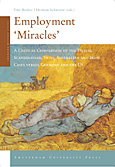
Employment Miracles a critical comparison of the Dutch, Scandinavian, Swiss, Australian and Irish cases versus Germany and the US
H. Schwartz red.
Ook verkrijgbaar als
Table of Contents - 6[-]Preface - 10[-]1 Introduction:Miracles,Mirages and Markets - 12[-] Introduction - 12[-] Luck, pluck and stuck in the employment miracles - 17[-] Globalisation and the miracles - 20[-] A specific (corporatist) variety of capitalism? - 26[-] What the chapters say - 35[-]2 The Dutch Model:Magic in a Flat Landscape? - 40[-] Introduction - 40[-] Labour market performance - 43[-] Economic performance - 46[-] Social outcomes - 49[-] Policies, the model and the results - 53[-] Conclusion: luck, pluck or stuck? - 59[-]3 Employment and Unemployment in Denmark and Sweden:Success or Failure for the Universal Welfare Model? - 66[-] Introduction - 66[-] Employment and unemployment: what happened? - 67[-] Unemployment and employment policies - 73[-] Policies and outcome - Is there a link? - 78[-] Conclusions - 81[-]4 The Evolution of the Finnish Model in the 1990s : From Depression to High-Tech Boom - 88[-] Introduction - 88[-] The background of the Finnish miracle: the economic crisis of the 1990s - 90[-] Political response to the crisis - 94[-] The recovery and the Finnish 'miracle' - 95[-] Structural issues:welfare state and labour market institutions - 104[-] The Nordic welfare state: Good to economic growth? - 105[-] Labour market institutions and corporatism - 106[-] Conclusion - 108[-]5 The Swiss Miracle:Low growth and high employment - 112[-] Introduction - 112[-] Corporatism in a fragmented polity - 112[-] A coordinated market economy? - 115[-] Recent developments - 116[-] Economic and labour market development - 118[-] Disentangling the Swiss 'miracle' - 122[-] An expanding welfare system - 128[-] Conclusion - 131[-]6 Recasting the Story of Ireland's Miracle:Policy,Politics or Profit? - 134[-] The constituents of economic growth and development - 135[-] Possible explanations - 138[-] The costs: sustainability? - 146[-] The significance of the Irish case - 153[-]7 The Australian Miracle:Luck,Pluck or Being Stuck Down Under? - 158[-] Introduction - 158[-] Exports and the current account balance - 166[-] Employment and collective bargaining - 172[-] Fiscal balance - 179[-] Conclusion - 182[-]8 Last Year's Model? Reflections on the American Model of Employment Growth - 184[-] Introduction - 184[-] An American success story 185 - 186[-] The American model - 190[-] Limits to the liberal market economy model - 196[-] Conclusion - 203[-]9 The German Contrast.On Bad Comparisons,Special Circumstances,Luck and Policies That Turned Out to Be Wrong - 206[-] 'Germany isn't working' - 206[-] The German economy in comparison - 209[-] A bad employment record because of labour market and welfare rigidities? - 212[-] Accidental circumstances: housing bubble versus unification - 218[-] On strong German regions - 224[-] Prospects and possible lessons from the 'model cases' - 228[-]10 Conclusion:The Importance of Lucky Circumstances,and Still the Liberal-Social Democratic Divide - 232[-] In sum - 232[-] Recent developments and prospects - 234[-] What is to be learned? - 240[-] 'Competitive Corporatism'? - 242[-] Still the liberal-social democratic divide - 245[-]Contributors - 280[-]Index - 284[-]Bibliography - 250Was de 'miraculeuze' ontwikkeling van de werkgelegenheid in de jaren '90 en net na de eeuwwisseling in onder andere Australië, Nederland en Denemarken inderdaad een wonder, of lag hieraan een uitgekiende strategie ten grondslag? Meestal wordt de oorzaak gezocht in het economisch beleid en de loonmatiging zoals vastgelegd in cao's, die een toenemende export en een afnemende werkloosheid tot gevolg zouden hebben gehad. Dit vijfde deel in de serie "http://www.aup.nl/do.php?a=show_visitor_booklist&b=series&series=29">Changing Welfare States laat zien dat toevallige omstandigheden minstens zo belangrijk zijn voor de banengroei als een weloverwogen beleid. Opvallend is vooral de invloed van een sterke huizenmarkt op de economische groei en werkgelegenheid. Loonmatiging, vaak beschouwd als doorslaggevende factor, maakt daarentegen weinig verschil. Hetzelfde geldt voor neoliberale stokpaardjes als het snijden in de uitkeringen en flexibilisering van de arbeidsmarkt om een sterke concurrentiepositie te behouden. Becker en Schwartz laten zien dat de meeste van de onderzochte landen, vooral Scandinavische, door de handhaving van een genereus sociaal bestel een reëel alternatief bieden voor de dominante liberale weg naar werkgelegenheidsgroei. Deze titel kunt u inzien in Google Books - http://books.google.com/books?vid=ISBN9789053567555. Deze titel is onderdeel van de OAPEN Library - http://www.oapen.org.Was de 'miraculeuze' ontwikkeling van de werkgelegenheid in de jaren '90 en net na de eeuwwisseling in onder andere Australië, Nederland en Denemarken inderdaad een wonder, of lag hieraan een uitgekiende strategie ten grondslag? Meestal wordt de oorzaak gezocht in het economisch beleid en de loonmatiging zoals vastgelegd in cao's, die een toenemend
In het kort
ISBN-13
9789053567555
Uitgever
Verschenen
16 juni 2006
Bibliografisch
ISBN-139789053567555
SerieChanging Welfare States — deel 5
Editie1
TaalEngels eng
Pagina’s145
GeïllustreerdJa
Uitgave
UitgeverAmsterdam University Press
CB-relatie-id7400597
Verschenen16 juni 2006
StatusInactief 08
BeschikbaarheidContact leverancier 99
Adviesprijs (incl. btw)€ 41,99
Vorm & inhoud
ProductvormPaperback BC
SamenstellingLos product
Classificatie
NUR (hoofd)Politicologie 754
NUR (alle)754 Politicologie
Medewerkers
Redacteur B01U. Becker
Redacteur B01H. Schwartz
Herkomst
Werk-id (NSTC)500293527
MeldingBevestigd bij publicatie 03
Bijgewerkt6 augustus 2026
Lijkt op dit boek

Wim Kok, een leven op eigen kracht. Deel II
Gelaagd land

Oorlog in transitie

Oorlog in transitie

Het jaar dat wij antifascisten werden

De magie van de achterkamertjes

La révolution des communes

Het recht op islamofobie

Het recht op islamofobie

Filosofische fluisteraars, theologische techbro's, politieke rattenvangers
NSTC 500293527 · CB-relatie 7400597 · Bijgewerkt 6 augustus 2026