
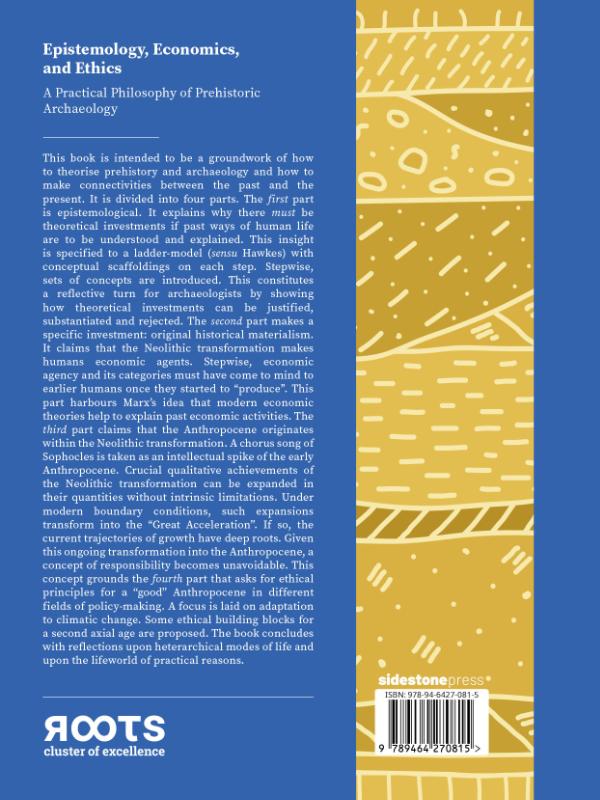
Epistemology, Economics, and Ethics A Practical Philosophy of Prehistoric Archaeology
Ook verkrijgbaar als
Preface of the series editorsPreface of the authorIntroduction: What the book is all aboutPart 1: Epistemology: Scaffolding on a ladder1.1 Ethics, reflection, and transcendental pragmatics1.2 History and archaeology1.3 Basic suppositions and distinctions1.4 The universal, the particular, and the individual1.5 The concept of transformation1.6 A brief history of theory formation in prehistoric archaeology (PA)1.7 Understanding, explaining, and the role of reasons1.8 The practical interest in history1.9 Antinomies and resolutions1.10 Theoretical investments1.11 Scaffolding on a ladder, stepwise1.12 Results of the analysis: Sets of conceptsPart 2: Historical materialism reloaded: The transformative emergence of economic life2.1 Historical materialism reloaded2.2 Claim2.3 Investing economic theories2.4 On Marxian legacies in contemporary historical materialism2.5 Explaining the thesis in detail2.6 Household economics and the domestic mode of production2.7 Anatomy of economic transformation2.8 Result: Emergence of economic life and the “thin” AnthropocenePart 3: Origins of the Anthropocene in the Neolithic3.1 Introduction and outline3.2 Challenges of the Anthropocene3.3 Sophocles: The chorus song in the “Antigone”3.4 The eclipse of qualities into quantities3.5 Preliminary resultsPart 4: Prehistoric archaeology and contemporary ethics: Prospects for a “good” Anthropocene4.1 Diagnosis4.2 Program and claim4.3 Normative investments4.4 Universalism and particularism4.5 Ethical framework4.6 Why and how a second axial age should be different4.7 “Greening” the Anthropocene with the help of prehistoric archaeology (PA)4.8 On degrowth theories4.9 Outline of the method: Historical laboratories and “do-it-yourself” strategies4.10 Ways ahead4.11 Results and outlooks: System and lifeworldReferencesAbbreviationsThis book is intended to be a groundwork of how to theorise prehistory and archaeology and how to make connectivities between the past and the present. It is divided into four parts. The first part is epistemological. It explains why there must be theoretical investments if past ways of human life are to be understood and explained. This insight is specified to a ladder-model (sensu Hawkes) with conceptual scaffoldings on each step. Stepwise, sets of concepts are introduced. This constitutes a reflective turn for archaeologists by showing how theoretical investments can be justified, substantiated and rejected. The second part makes a specific investment: original historical materialism. It claims that the Neolithic transformation makes humans economic agents. Stepwise, economic agency and its categories must have come to mind to earlier humans once they started to “produce”. This part harbours Marx’s idea that modern economic theories help to explain archaic economic activities. The third part claims that the Anthropocene originates within the Neolithic transformation. A chorus song of Sophocles is taken as an intellectual spike of the early Anthropocene. Crucial qualitative achievements of the Neolithic transformation can be expanded in their quantities without intrinsic limitations. Under modern boundary conditions, such expansions transform into the “Great Acceleration”. If so, the current trajectories of growth have deep roots. Given this ongoing transformation into the Anthropocene, a concept of responsibility becomes unavoidable. This concept grounds the fourth part that asks for ethical principles for a “good” Anthropocene in different fields of policy-making. A focus is laid on adaptation to climatic change. Some ethical building blocks for a second axial age are proposed. The book concludes with reflections upon heterarchical modes of life and upon the lifeworld of practical reasons.
In het kort
ISBN-13
9789464270822
Uitgever
Verschenen
29 december 2023
Serie
Imprint
Bibliografisch
Uitgave
UitgeverSidestone Press
ImprintSidestone Press Academics
CB-relatie-id9180064
Verschenen29 december 2023
StatusOnbekend 00
Vorm & inhoud
ProductvormHardback BB
SamenstellingLos product
Classificatie
NUR (hoofd)Archeologie 682
NUR (alle)682 Archeologie
Medewerkers
Auteur A01Konrad Ott
Herkomst
Werk-id (NSTC)501573745
MeldingBevestigd bij publicatie 03
Bijgewerkt6 augustus 2026
Lijkt op dit boek
Discourses on Modernity
Archaeological Approaches to Inequality, Political Organisation, and Social Complexity
Beyond heterogeneities
Environmental humanities: a rethinking of landscape archaeology?
Population dynamics and land-use patterns in the southwestern Baltic region during the Neolithic and the Bronze Age
Quarries and mines in social context
Connectivity Matters!
Shaping Cultural Landscapes
Resources in Premodern Societies
Indigenous Knowledge in Transformation
NSTC 501573745 · CB-relatie 9180064 · Bijgewerkt 6 augustus 2026