
Evolution of burial practices within Neolithic cist graves Tracking funerary customs in the Western Alpine region (4800–3800 BCE)
Ook verkrijgbaar als
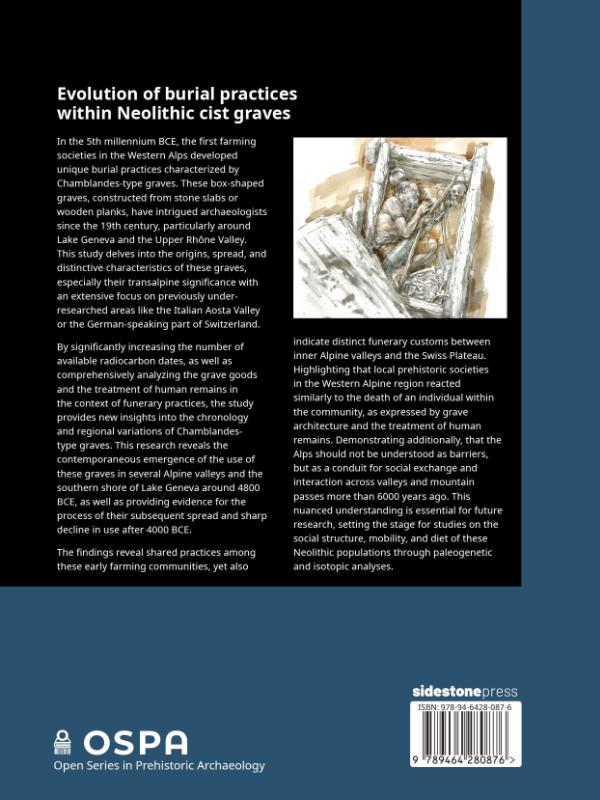
Foreword(Albert Hafner, Marie Besse)1. Introduction1.1. Opening remarks1.2. Research aims2. Background2.1. Research of Western Alpine Neolithic cist graves2.1.1. Defining Chamblandes-type graves2.1.2. History of research2.1.3. State of the research2.2. Archaeological context in the research area2.2.1. Mesolithic and Early Neolithic burials in the Western Alpine region2.2.2. Settling the landscape and intra-Alpine mobility2.2.3. Pottery styles in the Western Alpine region (4500–3800 BCE)2.3. Concepts of burial archaeology2.3.1. Terminology regarding burial practices2.3.2. Rituals, grave goods, and gender3. Methods3.1. Research area and geographical zones3.2. Evaluation and choice of sites3.3. Assessment approaches3.3.1. Radiocarbon dating3.3.2. Evaluation of burial practices3.3.3. Evaluation of grave goods4. Evaluated sites4.1. Aosta Valley4.1.1. Quart, Vollein4.1.2. Villeneuve, Champ Rotard4.1.3. Montjovet, Fiusey4.1.4 Outlined sites4.2. Tarentaise Valley4.2.1. Aime, Le Replat4.2.2. Bourg-Saint-Maurice, Le Châtelard4.2.3. Outlined site4.3. Upper Rhône Valley4.3.1. Saint-Léonard, Les-Bâtiments4.3.2. Sion, Place et Rue des Remparts4.3.3. Outlined sites4.4. Lake Geneva, southern shore4.4.1. Thonon-les-Bains, Genevray4.4.2. Outlined site4.5. Lake Geneva, northern shore4.5.1. Corseaux-sur-Vevey, En-Seyton4.5.2. Outlined sites4.6. Swiss Plateau4.6.1. Lenzburg, Goffersberg4.6.2. Däniken, Studenweid4.6.3. Outlined sites4.7. Peripheral sites4.7.1. Niederried, Ursisbalm4.7.2. Chiomonte, La Maddalena4.7.3. Montagnieu, Grotte-du-Souhait5. Radiocarbon dates of Western Alpine cist graves5.1. Available radiocarbon data5.2. Sampling strategy5.3. Bone sample treatment5.4. Results6. Burial practices within Western Alpine cist graves6.1. Spatial organisation of grave sites6.2. Treatment of human remains7. Grave goods within Western Alpine cist graves7.1. Reported grave goods within the assessed sites7.2. Origin of raw material7.2.1. Flint7.2.2. Jet7.2.3. Seashells7.3. Typological evaluation7.3.1. Pottery7.3.2. Selected axe types7.3.3. Selected limestone beads/buttons7.3.4. Shell bracelet (and imitations)7.3.5. Boar-tusk pectoral8. Discussion of results8.1. Chronology and spread of Western Alpine cist graves8.1.1. Discussion of radiocarbon results8.1.2. Aspects potentially affecting the radiocarbon dates8.1.3. Modelling the emergence and spread of Neolithic cist graves8.2. Evolution of burial practices within Western Alpine cist graves8.3. Regionality and chronology of grave goods9. Interpretative approach of Chamblandes-type cist graves9.1. Proposing distinct funerary customs9.2. Chamblandes-type cist graves beyond the Western Alps?9.2.1. Group Finale Ligure9.2.2. Group Massif Central9.2.3. Neolithic burial types of northwestern Italy and south-central France9.2.4. Scope of the Chamblandes-type cist graves9.3. Social considerations9.3.1. Ramifications of funerary customs9.3.2. Emergence of necropolises and megalithic elements9.3.3. Who built Chamblandes-type cist graves?10. SynthesisAcknowledgementsReferencesIn the 5th millennium BCE, the first farming societies in the Western Alps developed unique burial practices characterized by Chamblandes-type graves. These box-shaped graves, constructed from stone slabs or wooden planks, have intrigued archaeologists since the 19th century, particularly around Lake Geneva and the Upper Rhône Valley. This study delves into the origins, spread, and distinctive characteristics of these graves, especially their transalpine significance with an extensive focus on previously under-researched areas like the Italian Aosta Valley or the German-speaking part of Switzerland.By significantly increasing the number of available radiocarbon dates, as well as comprehensively analyzing the grave goods and the treatment of human remains in the context of funerary practices, the study provides new insights into the chronology and regional variations of Chamblandes-type graves. This research reveals the contemporaneous emergence of the use of these graves in several Alpine valleys and the southern shore of Lake Geneva around 4800 BCE, as well as providing evidence for the process of their subsequent spread and sharp decline in use after 4000 BCE.The findings reveal shared practices among these early farming communities, yet also indicate distinct funerary customs between inner Alpine valleys and the Swiss Plateau. Highlighting that local prehistoric societies in the Western Alpine region reacted similarly to the death of an individual within the community, as expressed by grave architecture and the treatment of human remains. Demonstrating additionally, that the Alps should not be understood as barriers, but as a conduit for social exchange and interaction across valleys and mountain passes more than 6000 years ago. This nuanced understanding is essential for future research, setting the stage for studies on the social structure, mobility, and diet of these Neolithic populations through paleogenetic and isotopic analyses.
In het kort
ISBN-13
9789464280883
Uitgever
Verschenen
21 maart 2025
Bibliografisch
ISBN-139789464280883
SerieOpen Series in Prehistoric Archaeology — deel 6
Editie1
TaalEngels eng
Pagina’s260
GeïllustreerdJa
Uitgave
Vorm & inhoud
ProductvormHardback BB
SamenstellingLos product
Classificatie
NUR (hoofd)Archeologie 682
NUR (alle)682 Archeologie
Medewerkers
Auteur A01Noah Steuri
Herkomst
Werk-id (NSTC)501602712
MeldingBevestigd bij publicatie 03
Bijgewerkt6 augustus 2026
NSTC 501602712 · CB-relatie 9180064 · Bijgewerkt 6 augustus 2026