
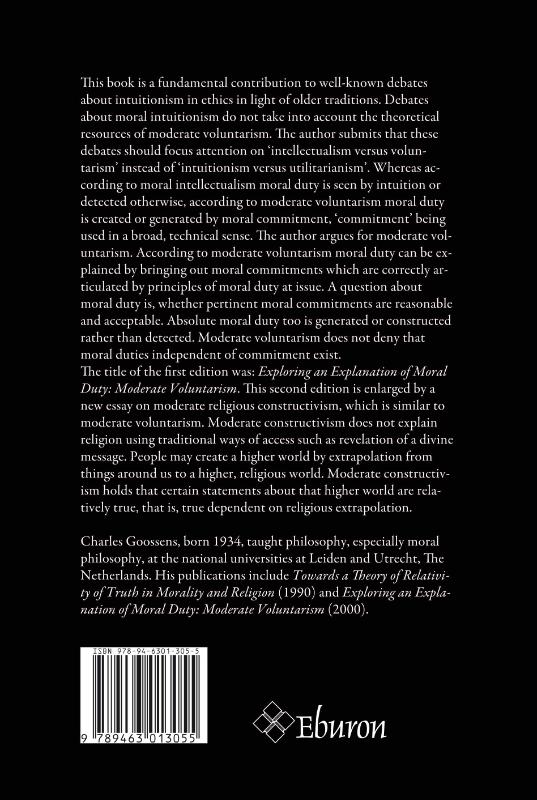
Exploring a Theory of Morality and Religion: Moderate Constructivism
Paperback120 pagina’sEngels
This book is a fundamental contribution to well-known debates about intuitionism in ethics in light of older traditions. Debates about moral intuitionism do not take into account the theoretical resources of moderate voluntarism. The author submits that these debates should focus attention on ‘intellectualism versus voluntarism’ instead of ‘intuitionism versus utilitarianism’. Whereas according to moral intellectualism moral duty is seen by intuition or detected otherwise, according to moderate voluntarism moral duty is created or generated by moral commitment, ‘commitment’ being used in a broad, technical sense. The author argues for moderate voluntarism. According to moderate voluntarism moral duty can be explained by bringing out moral commitments which are correctly articulated by principles of moral duty at issue. A question about moral duty is, whether pertinent moral commitments are reasonable and acceptable. Absolute moral duty too is generated or constructed rather than detected. Moderate voluntarism does not deny that moral duties independent of commitment exist.The title of the first edition was: "Exploring an Explanation of Moral Duty: Moderate Voluntarism." This second edition is enlarged by a new essay on moderate religious constructivism, which is similar to moderate voluntarism. Moderate constructivism does not explain religion using traditional ways of access such as revelation of a divine message. People may create a higher world by extrapolation from things around us to a higher, religious world. Moderate constructivism holds that certain statements about that higher world are relatively true, that is, true dependent on religious extrapolation.Charles Goossens, born 1934, taught philosophy, especially moral philosophy, at the national universities at Leiden and Utrecht, The Netherlands. His publications include "Towards a Theory of Relativity of Truth in Morality and Religion" (1990) and "Exploring an Explanation of Moral Duty: Moderate Voluntarism" (2000).
In het kort
ISBN-13
9789463013055
Uitgever
Verschenen
25 september 2020
Imprint
Bibliografisch
ISBN-139789463013055
Editie1
TaalEngels eng
Pagina’s120
GeïllustreerdNee
Uitgave
UitgeverEburon Uitgeverij B.V.
ImprintEburon
CB-relatie-id7804140
Verschenen25 september 2020
StatusInactief 08
BeschikbaarheidContact leverancier 99
Adviesprijs (incl. btw)€ 23,00
Vorm & inhoud
ProductvormPaperback BC
SamenstellingLos product
Classificatie
NUR (hoofd)Filosofie algemeen 730
NUR (alle)730 Filosofie algemeen
Medewerkers
Auteur A01Charles Goossens
Herkomst
Werk-id (NSTC)500838173
MeldingBevestigd bij publicatie 03
Bijgewerkt6 augustus 2026
Lijkt op dit boek






NSTC 500838173 · CB-relatie 7804140 · Bijgewerkt 6 augustus 2026