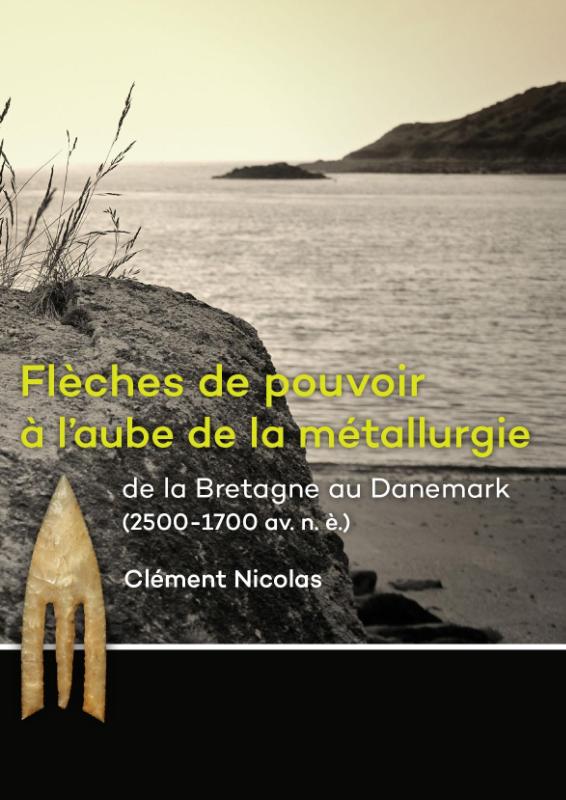
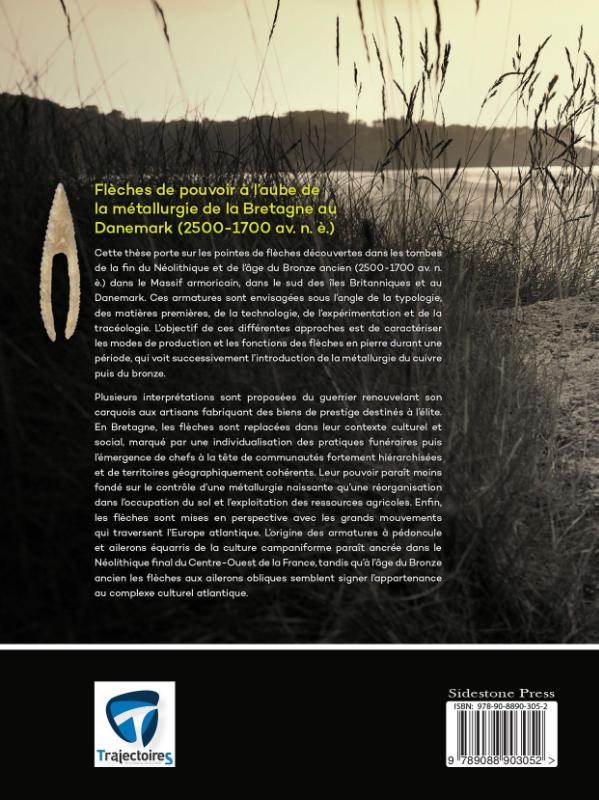
Flèches de pouvoir à l’aube de la métallurgie de la Bretagne au Danemark (2500-1700 av. n. è.)
Paperback570 pagina’sFrans
Ook verkrijgbaar als
Cette thèse porte sur les pointes de flèches découvertes dans les tombes de la fin du Néolithique et de l'âge du Bronze ancien (2500-1700 av. n. è.) dans le Massif armoricain, dans le sud des îles Britanniques et au Danemark. Ces armatures sont envisagées sous l'angle de la typologie, des matières premières, de la technologie, de l'expérimentation et de la tracéologie. L'objectif de ces différentes approches est de caractériser les modes de production et les fonctions des flèches en pierre durant une période, qui voit successivement l'introduction de la métallurgie du cuivre puis du bronze.
Plusieurs interprétations sont proposées du guerrier renouvelant son carquois aux artisans fabriquant des biens de prestige destinés à l'élite. En Bretagne, les flèches sont replacées dans leur contexte culturel et social, marqué par une individualisation des pratiques funéraires puis l'émergence de chefs à la tête de communautés fortement hiérarchisées et de territoires géographiquement cohérents. Leur pouvoir paraît moins fondé sur le contrôle d'une métallurgie naissante qu'une réorganisation dans l'occupation du sol et l'exploitation des ressources agricoles. Enfin, les flèches sont mises en perspective avec les grands mouvements qui traversent l'Europe atlantique. L'origine des armatures à pédoncule et ailerons équarris de la culture campaniforme paraît ancrée dans le Néolithique final du Centre-Ouest de la France, tandis qu'à l'âge du Bronze ancien les flèches aux ailerons obliques semblent signer l'appartenance au complexe culturel atlantique.
English abstract
This thesis focusses on the arrowheads found in graves of Late Neolithic and Early Bronze Age date (2500-1700 BC) in the Armorican massif, the southern British Isles and Denmark. These artefacts are examined from the angle of typology, raw materials, technology, experimentation and use-wear. The aim of these different approaches is to characterize the modes of production and the functions of stone arrowheads during a period which successively sees the introduction of copper then bronze metallurgy.
Several interpretations are proposed, from warriors renewing their quivers to craftsmen manufacturing prestige goods for the elite. In Brittany, the arrows are set in their cultural and social context, marked by an individualization of funerary practices and then by the emergence of chiefs at the head of strongly hierarchical communities with geographically coherent territories. Power seems founded on reorganization of land-use and exploitation of agricultural resources, rather than on control of incipient metallurgy. Lastly, arrows are placed in the broader perspective of major trends affecting Atlantic Europe. The origin of the squared-off barbed and tanged arrowheads of the Bell Beaker culture seems anchored in the Final Neolithic of west-central France, while in the Early Bronze Age the arrowheads with oblique barbs seem to indicate an attachment to the Atlantic cultural complex.
In het kort
ISBN-13
9789088903052
Uitgever
Verschenen
1 januari 2016
Bibliografisch
ISBN-139789088903052
Editie1
TaalFrans fre
Pagina’s570
GeïllustreerdJa
Uitgave
Vorm & inhoud
ProductvormPaperback BC
SamenstellingLos product
Classificatie
NUR (hoofd)Archeologie 682
NUR (alle)682 Archeologie
Medewerkers
Auteur A01Clément Nicolas
Herkomst
Werk-id (NSTC)500175819
MeldingBevestigd bij publicatie 03
Bijgewerkt6 augustus 2026
Lijkt op dit boek

Durrington Walls and Woodhenge: A place for the living

Durrington Walls and Woodhenge: A place for the living
Indigenous Knowledge in Transformation
Indigenous Knowledge in Transformation

Archaeological Approaches to Inequality, Political Organisation, and Social Complexity

Archaeological Approaches to Inequality, Political Organisation, and Social Complexity
Stadterweiterungen und urbane Dynamik im Mittelalter
Stadterweiterungen und urbane Dynamik im Mittelalter
Prehistoric Shore Settlements of the Southwestern Balkans
Prehistoric Shore Settlements of the Southwestern Balkans
NSTC 500175819 · CB-relatie 9180064 · Bijgewerkt 6 augustus 2026