
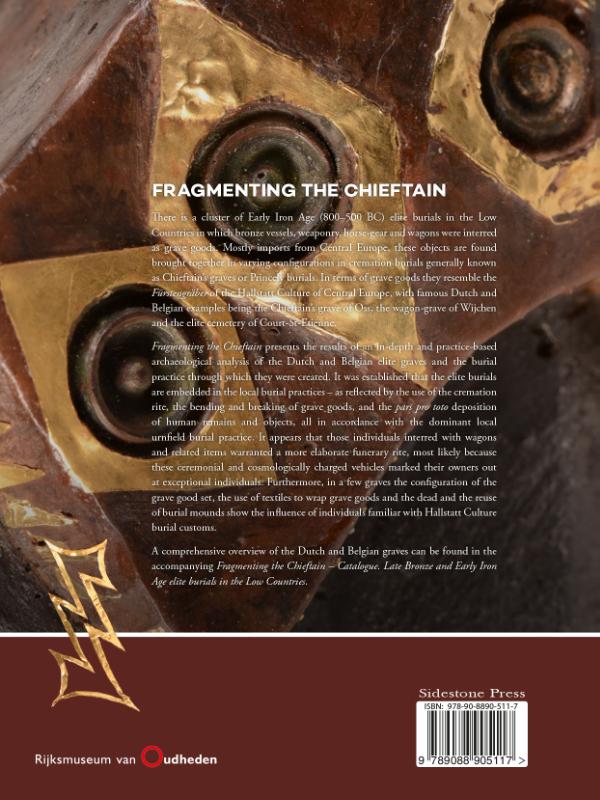
Fragmenting the Chieftain a practice-based study of Early Iron Age Hallstatt C elite burials in the Low Countries
Ook verkrijgbaar als
There is a cluster of Early Iron Age (800-500 BC) elite burials in the Low Countries in which bronze vessels, weaponry, horse-gear and wagons were interred as grave goods. Mostly imports from Central Europe, these objects are found brought together in varying configurations in cremation burials generally known as chieftains' graves or princely burials. In terms of grave goods they resemble the Fürstengräber of the Hallstatt Culture of Central Europe, with famous Dutch and Belgian examples being the Chieftain's grave of Oss, the wagon-grave of Wijchen and the elite cemetery of Court-St-Etienne. .
Fragmenting the Chieftain presents the results of an in-depth and practice-based archaeological analysis of the Dutch and Belgian elite graves and the burial practice through which they were created. It was established that the elite burials are embedded in the local burial practices - as reflected by the use of the cremation rite, the bending and breaking of grave goods, and the pars pro toto deposition of human remains and objects, all in accordance with the dominant local urnfield burial practice. It appears that those individuals interred with wagons and related items warranted a more elaborate funerary rite, most likely because these ceremonial and cosmologically charged vehicles marked their owners out as exceptional individuals. Furthermore, in a few graves the configuration of the grave good set, the use of textiles to wrap grave goods and the dead and the reuse of burial mounds show the influence of individuals familiar with Hallstatt Culture burial customs.
A comprehensive overview of the Dutch and Belgian graves can be found in the accompanying Fragmenting the Chieftain - Catalogue. Late Bronze and Early Iron Age elite burials in the Low Countries.
.
Contents:
1 Introduction
2 Theoretical framework: identifying elites and their graves
3 Dating elite burials
4 The elite burials: presenting the dataset
5 The (development of the) elite burial practice
6 How grave goods were used and interpreted
7 Conclusion
8 Final reflections and questions for the future
Summary (English and Dutch)
Acknowledgements
Bibliography
Curriculum vitae
App. A1 Abbreviations
App. A2 Summary overview of objects in Catalogue, per find category
In het kort
ISBN-13
9789088905124
Uitgever
Verschenen
10 november 2017
Serie
Bibliografisch
Uitgave
Vorm & inhoud
ProductvormHardback BB
SamenstellingLos product
Classificatie
NUR (hoofd)Archeologie 682
NUR (alle)682 Archeologie
Medewerkers
Auteur A01Sasja van der Vaart-Verschoof
Herkomst
Werk-id (NSTC)500100988
MeldingBevestigd bij publicatie 03
Bijgewerkt6 augustus 2026
Lijkt op dit boek
Durrington Walls and Woodhenge: A place for the living
Durrington Walls and Woodhenge: A place for the living
Indigenous Knowledge in Transformation
Indigenous Knowledge in Transformation
Archaeological Approaches to Inequality, Political Organisation, and Social Complexity
Archaeological Approaches to Inequality, Political Organisation, and Social Complexity
Stadterweiterungen und urbane Dynamik im Mittelalter
Stadterweiterungen und urbane Dynamik im Mittelalter
Prehistoric Shore Settlements of the Southwestern Balkans
Prehistoric Shore Settlements of the Southwestern Balkans
NSTC 500100988 · CB-relatie 9180064 · Bijgewerkt 6 augustus 2026