
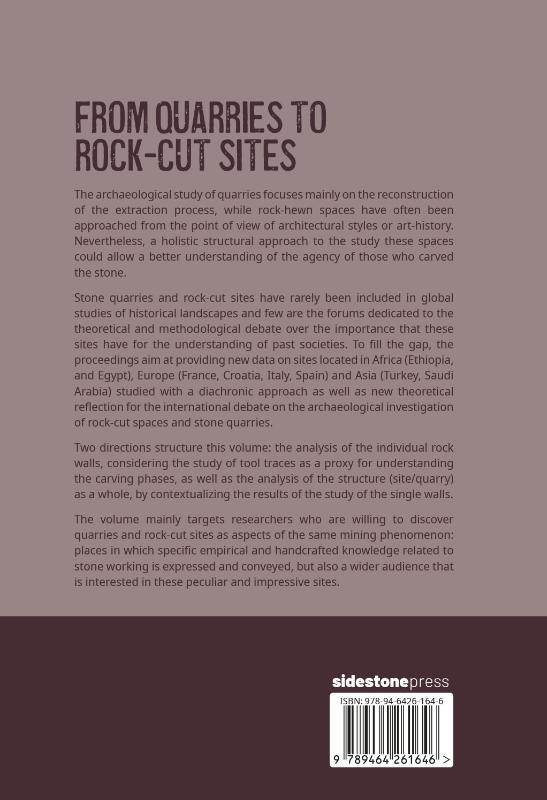
From Quarries to Rock-cut Sites Echoes of Stone Crafting
Katy Whitaker bewerker · Gabriele Gattiglia bewerker · Claudia Sciuto bewerker · Marie-Elise Porqueddu bewerker
Hardback260 pagina’sEngels
ForewordGabriele Gattiglia (University of Pisa)I. THEORETICAL AND METHODOLOGICAL CHALLENGES IN THE ARCHAEOLOGY OF QUARRIES AND ROCK-CUT SITESSavoir-faire and Technical Environment: Rethinking the Emergence of Rock-cut Tombs in the Neolithic MediterraneanMarie-Elise Porqueddu (The School of Advanced Hispanic and Iberian Studies, Casa de Velázquez)What to Expect when you’re Documenting and Excavating a Roman Quarry – Monte del Vescovo, Istria, CroatiaKatarina Šprem (Juraj Dobrila University of Pula)Theorising Ancient Quarries: How Far Have We Come?Christopher J. Lyes (School of Archaeology, University of Oxford)When Quarry Waste Explains Tool MarksDaniel Morleghem (Citeres-LAT, CNRS and University of Tours)The Hand, the Stone and the Mind: Exploring the Agency of Rocks in Quarrying TechniquesClaudia Sciuto (University of Pisa)II. CARVED SITES AND CARVED LANDSCAPESHow do Rock-cut Architectures Interact with the Landscape? The Example of Prehistoric Rock-cut Tombs in Ossi, Sardinia (Italy)Guillaume Robin (University of Edinburgh)A Study of Quartzite (Silicified Sandstone) Quarries in EgyptDaniela Galazzo (Independent researcher)First Reflections on the Structural Analysis of Rock-hewn Caves in Lalibela’s Landscape, EthiopiaManon Routhiau (Traces, CNRS and University of Toulouse Jean Jaurès – Orient & Méditerranée, CNRS)Quarrying, Carving and Shaping the Landscape. Stone Working at Dadan, Northwest Arabia, in the First Millennium BCE and BeyondThierry Grégor (University of Poitiers), Jérôme Rohmer (Orient & Méditerranée, CNRS) and Abdulrahman Alsuhaibani (King Saud University/Royal Commission for AlUla)Underground and Open-pit Quarries in Polignano a Mare (Italy): a Preliminary InvestigationGermano Germano’ (Scuola Superiore Meridionale in Naples)III. ROCK-CUT SITES AND QUARRIES: CRAFTS AND SOCIETIESThe Left-handed and the Ambidextrous: Methodological Considerations by Way of the Excavation of Rock-cut Churches Over the Long TermAnaïs Lamesa (French Institute for Anatolian Studies in Istanbul)Qualifications of Craftsmen Who Dug Souterrains in France (10th-15th centuries) – Preliminary ResultsLuc Stevens (French Society for Souterrains Studies)The Technique of Extracting Building Stone by “Stone-walling and Back-filling” in Paris: an Innovation of the Late Middle AgesJean-Pierre Gély and Marc Viré† (LAMOP, CNRS and University of Paris Panthéon-Sorbonne)The archaeological study of quarries focuses mainly on the reconstruction of the extraction process, while rock-hewn spaces have often been approached from the point of view of architectural styles or art-history. Nevertheless, a holistic structural approach to the study of these spaces could allow a better understanding of the agency of those who carved the stone. Stone quarries and rock-cut sites have rarely been included in global studies of historical landscapes and few are the forums dedicated to the theoretical and methodological debate over the importance that these sites have for the understanding of past societies. To fill the gap, the proceedings volume aims at providing new data on sites located in Africa (Ethiopia, and Egypt), Europe (France, Croatia, Italy, Spain) and Asia (Turkey, Saudi Arabia) studied with a diachronic approach, as well as new theoretical reflections for the international debate on the archaeological investigation of rock-cut spaces and stone quarries. Two directions structure this volume: the analysis of the individual rock walls, considering the study of tool traces as a proxy for understanding the carving phases, as well as the analysis of the structure (site/quarry) as a whole, by contextualizing the results of the study of the single walls.The volume mainly targets researchers who are willing to discover quarries and rock-cut sites as aspects of the same mining phenomenon: places in which specific empirical and handcrafting knowledge related to stone working is expressed and conveyed, but also a wider audience that is interested in these peculiar and impressive sites.
In het kort
ISBN-13
9789464261653
Uitgever
Verschenen
23 mei 2023
Imprint
Bibliografisch
ISBN-139789464261653
Editie1
TaalEngels eng
Pagina’s260
GeïllustreerdJa
Uitgave
UitgeverSidestone Press
ImprintSidestone Press
CB-relatie-id9180064
Verschenen23 mei 2023
StatusOnbekend 00
Vorm & inhoud
ProductvormHardback BB
SamenstellingLos product
Classificatie
NUR (hoofd)Archeologie 682
NUR (alle)682 Archeologie
Medewerkers
Bewerker B05Anaïs Lamesa
Bewerker B05Katy Whitaker
Bewerker B05Gabriele Gattiglia
Bewerker B05Claudia Sciuto
Bewerker B05Marie-Elise Porqueddu
Herkomst
Werk-id (NSTC)501531445
MeldingBevestigd bij publicatie 03
Bijgewerkt6 augustus 2026
Lijkt op dit boek
From Quarries to Rock-cut Sites
Quarries and mines in social context
Living Archaeology
Shaping Cultural Landscapes
Storage in Ancient Egypt and Nubia
Technological Styles in the Jebel Gharbi Lithic Industries of the Late Pleistocene (North-Western Libya)
Tracking the Neolithic in the Near East
Prehension and hafting traces on flint tools
Artefact Biographies from Mesolithic and Neolithic Europe and Beyond
Digital Archaeology
NSTC 501531445 · CB-relatie 9180064 · Bijgewerkt 6 augustus 2026