
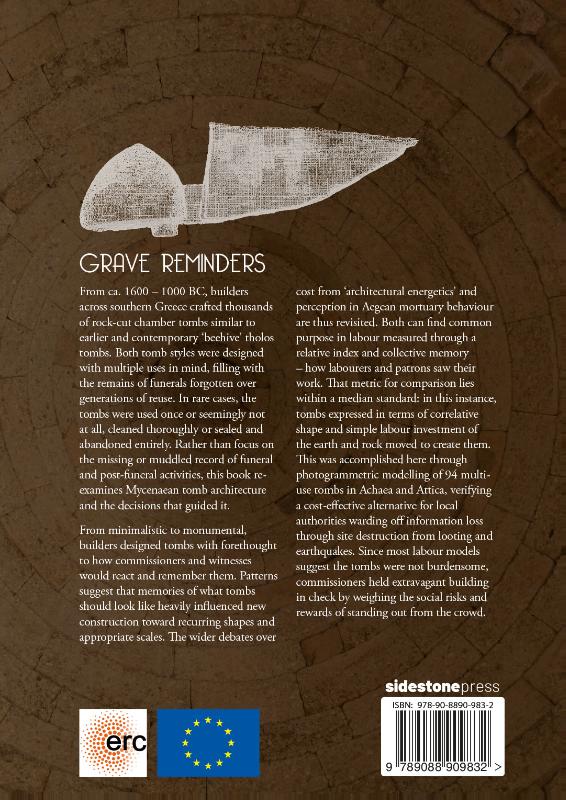
Grave Reminders Comparing Mycenaean tomb building with labour and memory
Hardback330 pagina’sEngels
Ook verkrijgbaar als
From ca. 1600 – 1000 BC, builders across southern Greece crafted thousands of rock-cut chamber tombs similar to earlier and contemporary ‘beehive’ tholos tombs. Both tomb styles were designed with multiple uses in mind, filling with the remains of funerals forgotten over generations of reuse. In rare cases, the tombs were used once or seemingly not at all, cleaned thoroughly or sealed and abandoned entirely. Rather than focus on the missing or muddled record of funeral and post-funeral activities, this book re-examines Mycenaean tomb architecture and the decisions that guided it.From minimalistic to monumental, builders designed tombs with forethought to how commissioners and witnesses would react and remember them. Patterns suggest that memories of what tombs should look like heavily influenced new construction toward recurring shapes and appropriate scales. The wider debates over cost from ‘architectural energetics’ and perception in Aegean mortuary behaviour are thus revisited. Both can find common purpose in labour measured through a relative index and collective memory – how labourers and patrons saw their work. That metric for comparison lies within a median standard: in this instance, tombs expressed in terms of correlative shape and simple labour investment of the earth and rock moved to create them. This was accomplished here through photogrammetric modelling of 94 multi-use tombs in Achaea and Attica, verifying a cost-effective alternative for local authorities warding off information loss through site destruction from looting and earthquakes. Since most labour models suggest the tombs were not burdensome, commissioners held extravagant building in check by weighing the social risks and rewards of standing out from the crowd.Contents:PrefaceAcknowledgementsList of FiguresList of TablesChapter 1. Introduction1.1. Place and purpose1.2. Case studies and reasoning1.3. Advancing objectives: comparative labour and grave reminders1.4. Forecast: from catalogue blueprints to transient experienceChapter 2. Setting2.1. Mycenaean tomb development2.2. The rock canvas2.2.1. Physiography of southern Greece2.2.2. Soil mechanics and risks2.3. Sponsor’s gamble2.3.1. Costly signalling with tombs2.3.2. Risks of investment: the expected standard2.3.3. Cost and altruism in cooperative labour2.4. SummaryChapter 3. Artists at work: perspectives and logistics in cooperative building3.1. Construction planning and alignment3.2. Further projections on time constraints3.3. Tracking progress from household to cooperative labour3.3.1. Preindustrial construction logistics§ Planning and guidance § Support § Gendered work § Scheduling § Mechanics3.3.2. Labour rates§ Procurement § Transport § Placement § Reuse3.4. Measuring success3.4.1. Modelling tombs with photogrammetry§ Alternate data collection3.4.2. Finding sameness with Euclidean distance§ AA01 standard and the Tomb Relative Index (TRex)3.5. SummaryChapter 4. A labour catalogue with multi-use tombs4.1. Menidi4.2. Portes4.3. Voudeni4.4. SummaryChapter 5. Reminders5.1. Building legacy in the early LH5.2. End-stage from LH IIIC Achaea5.3. Interpreting tomb scale and sameness5.4. Labouring toward forgetting5.5. Concluding summaryReferences CitedAppendix 1. Labour ratesAppendix 2. Other tombsAppendix 3. Digital collection of excess tomb models
In het kort
ISBN-13
9789088909849
Uitgever
Verschenen
15 december 2020
Bibliografisch
ISBN-139789088909849
Editie1
TaalEngels eng
Pagina’s330
GeïllustreerdJa
Uitgave
Vorm & inhoud
ProductvormHardback BB
SamenstellingLos product
Classificatie
NUR (hoofd)Archeologie 682
NUR (alle)682 Archeologie
Medewerkers
Auteur A01Daniel Turner
Herkomst
Werk-id (NSTC)500843999
MeldingBevestigd bij publicatie 03
Bijgewerkt6 augustus 2026
Lijkt op dit boek
Durrington Walls and Woodhenge: A place for the living
Durrington Walls and Woodhenge: A place for the living
Indigenous Knowledge in Transformation
Indigenous Knowledge in Transformation
Archaeological Approaches to Inequality, Political Organisation, and Social Complexity
Archaeological Approaches to Inequality, Political Organisation, and Social Complexity
Stadterweiterungen und urbane Dynamik im Mittelalter
Stadterweiterungen und urbane Dynamik im Mittelalter
Prehistoric Shore Settlements of the Southwestern Balkans
Prehistoric Shore Settlements of the Southwestern Balkans
NSTC 500843999 · CB-relatie 9180064 · Bijgewerkt 6 augustus 2026