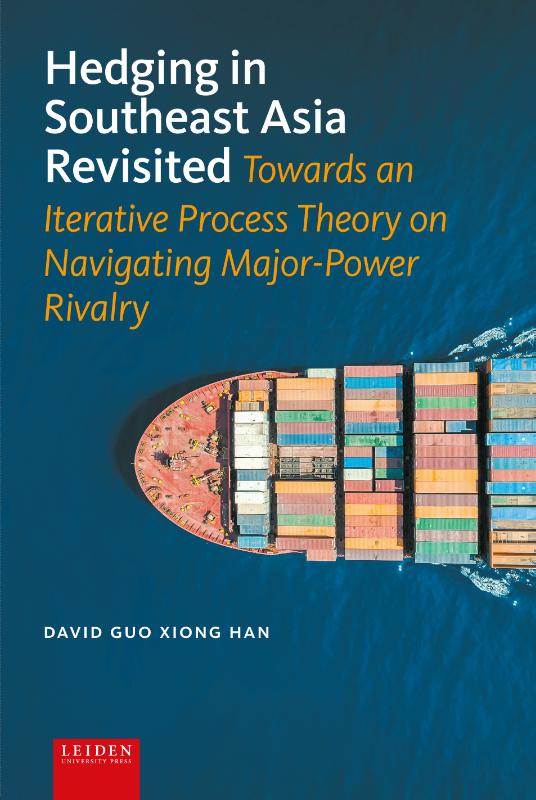
Hedging in Southeast Asia Revisited Towards an Iterative Process Theory on Navigating Major-Power Rivalry
Hardback250 pagina’sEngels
ContentsList of Figures and TablesAbbreviations1. Introduction2. Towards an Iterative Process Theory of Hedging in Foreign Policy3. Malaysia in China’s BRI: Najib’s Lack of Hedging vs Mahathir’s Hedging?4. Malaysia-US Security Relations: Najib’s Accommodative and Mahathir’s Critical Approaches to Hedging5. The Philippines’ Foray into China’s BRI: Duterte’s Volatile Yet Calculative Hedging Strategy6. The Philippines-US Alliance: Hedging the Perennial Risks of Relying on a Powerful Ally7. ConclusionReferences'Hedging in Southeast Asia Revisited' is an in-depth study offering fresh insights on hedging in international relations.'Hedging in Southeast Asia Revisited' is a book which offers a novel way of rethinking hedging in international relations. Drawing upon the cybernetic theory of decision, this book derives a new iterative process theory of hedging which explains how evolving risk perceptions amidst uncertainty can shape and change small and secondary states’ foreign policy choices in navigating major power rivalry across time. By applying this new theoretical approach to examine case studies of Malaysia’s and the Philippines’ involvement in China’s Belt and Road Initiative and security ties with the United States, this book challenges the prevailing view that hedging is a mixed-policy alignment strategy situated in the middle of between balancing and bandwagoning. Instead, this book contends that the essence of hedging lies in decision-makers’ ability to constantly monitor risks, while exercising prudence, relevancy, and adaptability in policy measures to manage risks in engagements with major powers.Hedging in Southeast Asia Revisited is a book which offers a novel way of rethinking hedging in international relations. Drawing upon the cybernetic theory of decision, this book derives a new iterative process theory of hedging which explains how evolving risk perceptions amidst uncertainty can shape and change small and secondary states’ foreign policy choices in navigating major power rivalry across time. By applying this new theoretical approach to examine case studies of Malaysia’s and the Philippines’ involvement in China’s Belt and Road Initiative and security ties with the United States, this book challenges the prevailing view that hedging is a mixed-policy alignment strategy situated in the middle of between balancing and bandwagoning. Instead, this book contends that the essence of hedging lies in decision-makers’ ability to constantly monitor risks, while exercising prudence, relevancy, and adaptability in policy measures to manage risks in engagements with major powers.
In het kort
ISBN-13
9789087285142
Uitgever
Verschenen
19 mei 2027
Imprint
Bibliografisch
ISBN-139789087285142
Editie1
TaalEngels eng
Pagina’s250
GeïllustreerdNee
Uitgave
UitgeverLeiden University Press
ImprintLeiden University Press
CB-relatie-id6345163
Verschenen19 mei 2027
StatusOnbekend 00
BeschikbaarheidContact leverancier 99
Zonder prijsPrijs volgt
Vorm & inhoud
ProductvormHardback BB
SamenstellingLos product
Classificatie
NUR (hoofd)Politicologie 754
NUR (alle)754 Politicologie
Trefwoordenhedging · iterative process, · foreign policy · risk management
Medewerkers
Auteur A01David Guo Xiong Han
Herkomst
Werk-id (NSTC)501717569
MeldingUpdate 04
Laatste CB-bericht7912
Bijgewerkt23 november 2026
Trefwoorden
Lijkt op dit boek










NSTC 501717569 · CB-relatie 6345163 · Laatste CB-bericht 7912 · Bijgewerkt 23 november 2026