
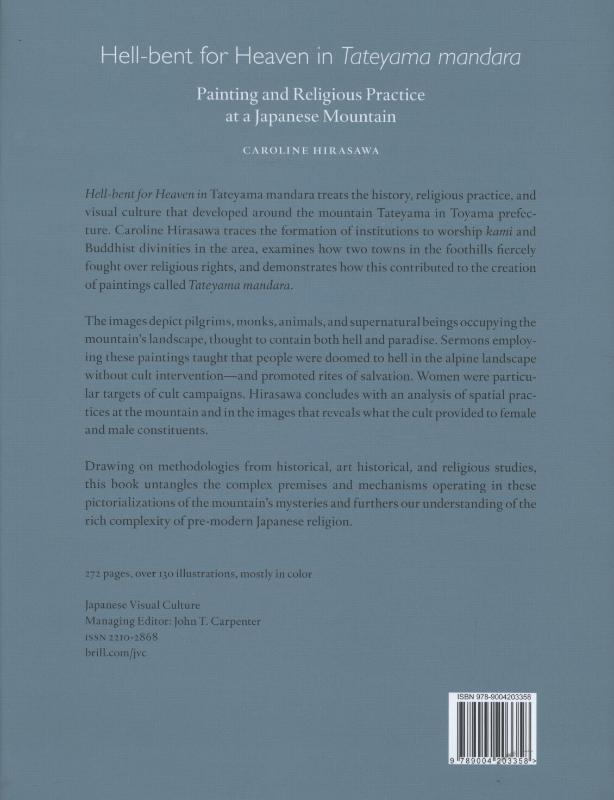
Hell-bent for heaven in Tateyama mandara painting and religious practice at a Japanese mountain
Hell-bent for Heaven in Tateyama mandara treats the history, religious practice, and visual culture that developed around the mountain Tateyama in Toyama prefecture. Caroline Hirasawa traces the formation of institutions to worship kami and Buddhist divinities in the area, examines how two towns in the foothills fiercely fought over religious rights, and demonstrates how this contributed to the creation of paintings called Tateyama mandara.The images depict pilgrims, monks, animals, and supernatural beings occupying the mountain's landscape, thought to contain both hell and paradise. Sermons employing these paintings taught that people were doomed to hell in the alpine landscape without cult intervention-and promoted rites of salvation. Women were particular targets of cult campaigns. Hirasawa concludes with an analysis of spatial practices at the mountain and in the images that reveals what the cult provided to female and male constituents.Drawing on methodologies from historical, art historical, and religious studies, this book untangles the complex premises and mechanisms operating in these pictorializations of the mountain's mysteries and furthers our understanding of the rich complexity of pre-modern Japanese religion.
In het kort
ISBN-13
9789004203358
Uitgever
Verschenen
19 december 2012
Imprint
Bibliografisch
ISBN-139789004203358
SerieJapanese Visual Culture — deel 6
Editie1
TaalEngels eng
Pagina’s272
GeïllustreerdJa
Uitgave
UitgeverBrill, NV Koninklijke
ImprintBrill Academic Pub
CB-relatie-id7300260
Verschenen19 december 2012
StatusOnbekend 00
Vorm & inhoud
ProductvormHardback BB
SamenstellingLos product
Classificatie
NUR (hoofd)Beeldende kunst 646
NUR (alle)646 Beeldende kunst
Medewerkers
Auteur A01Caroline Hirasawa
Herkomst
Werk-id (NSTC)500274996
MeldingBevestigd bij publicatie 03
Bijgewerkt6 augustus 2026
Lijkt op dit boek
Medicine master Buddha
Painting nature for the nation
Miyazawa Kenji and his illustrators
Amidaji: Emperor Antoku's Mortuary Temple and its Culture

History of Japanese Art after 1945
Divine and Demonic Imagery at Tor de'Specchi, 1400-1500
Portraits of Chogen

History of Japanese Art after 1945
Kuniyoshi

Ishikawa Sanshirō’s Geographical Imagination
NSTC 500274996 · CB-relatie 7300260 · Bijgewerkt 6 augustus 2026