
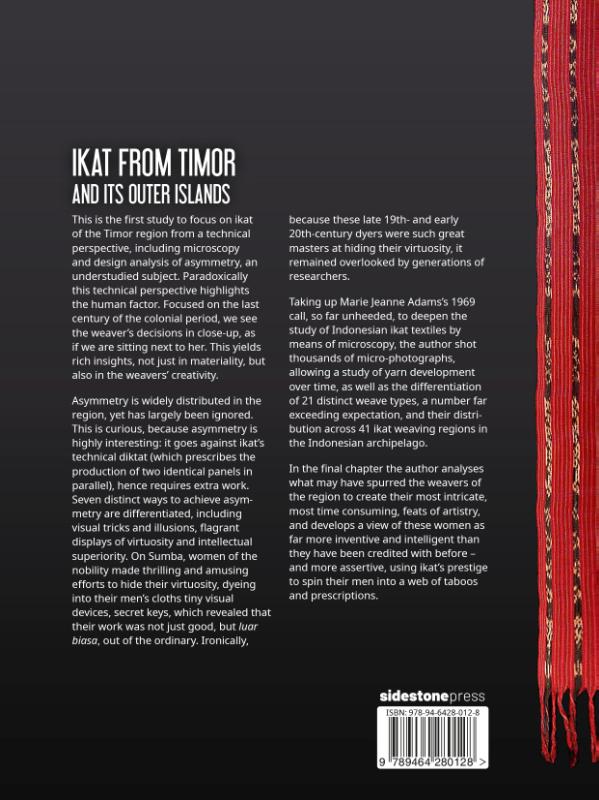
Ikat from Timor and its outer Islands Insular and Interwoven
Paperback320 pagina’sEngels
Ook verkrijgbaar als
Preface1. Angles of investigation1.1 Status quaestionis1.2 The Austronesian ikat tradition1.3 The field of study1.4 Focus on older specimens1.5 The Reference Set2. Yarn and weave types2.1 Fibres under the microscope2.2 Varieties of plying2.3 Introduction of machine-made thread2.4 Weave varieties per region2.5 Irregular weaves pose questions about motivation3. Distribution of shared motifs3.1 Emblems of identity and connection3.2 Motives for adopting ‘foreign’ motifs3.3 Whose pattern is it anyway?3.4 Motifs shared across the region under study3.4.1 Linked hexagons3.4.2 The Pictorial Strip, Rimanu3.4.3 The Human figure, stand-alone3.4.4 The Double-headed eagle3.4.5 The Triangle-with-projections3.4.6 The Eight-pointed star3.4.7 The ‘Breast beam’ motif3.4.8 The Keu motif4. Asymmetry – in defiance of ikat’s technical diktat4.1 Techniques to achieve asymmetry4.2 Sought complexity: asymmetry as proof of mastery4.3 Incidental asymmetry – intentional or accidental5. Ikat in its social context6. Conclusion: technical research highlights female talentsAbstractAppendixBibliographyAcknowledgementsPronunciation GuideColophonIndexThis is the first study to focus on ikat of the Timor region from a technical perspective, including microscopy and design analysis of asymmetry, an understudied subject. Paradoxically this technical perspective highlights the human factor. Focused on the last century of the colonial period, we see the weaver’s decisions in close-up, as if we are sitting next to her. This yields rich insights, not just in materiality, but also in the weavers’ creativity.Asymmetry is widely distributed in the region, yet has largely been ignored. This is curious, because asymmetry is highly interesting: it goes against ikat’s technical diktat (which prescribes the production of two identical panels in parallel), hence requires extra work. Seven distinct ways to achieve asymmetry are differentiated, including visual tricks and illusions, flagrant displays of virtuosity and intellectual superiority. On Sumba, women of the nobility made thrilling and amusing efforts to hide their virtuosity, dyeing into their men’s cloths tiny visual devices, secret keys, which revealed that their work was not just good, but luar biasa, out of the ordinary. Ironically, because these late 19th- and early 20th-century dyers were such great masters at hiding their virtuosity, it remained overlooked by generations of researchers.Taking up Marie Jeanne Adams’s 1969 call, so far unheeded, to deepen the study of Indonesian ikat textiles by means of microscopy, the author shot thousands of micro-photographs, allowing a study of yarn development over time, as well as the differentiation of 21 distinct weave types, a number far exceeding expectation, and their distribution across 41 ikat weaving regions in the Indonesian archipelago.In the final chapter the author analyses what may have spurred the weavers of the region to create their most intricate, most time consuming, feats of artistry, and develops a view of these women as far more inventive and intelligent than they have been credited with before – and more assertive, using ikat’s prestige to spin their men into a web of taboos and prescriptions.
In het kort
ISBN-13
9789464280128
Uitgever
Verschenen
24 november 2021
Bibliografisch
ISBN-139789464280128
Editie1
TaalEngels eng
Pagina’s320
GeïllustreerdJa
Uitgave
Vorm & inhoud
ProductvormPaperback BC
SamenstellingLos product
Classificatie
NUR (hoofd)Culturele antropologie 761
NUR (alle)761 Culturele antropologie
Medewerkers
Auteur A01Peter ten Hoopen
Herkomst
Werk-id (NSTC)501468292
MeldingBevestigd bij publicatie 03
Bijgewerkt6 augustus 2026
Lijkt op dit boek
NSTC 501468292 · CB-relatie 9180064 · Bijgewerkt 6 augustus 2026