
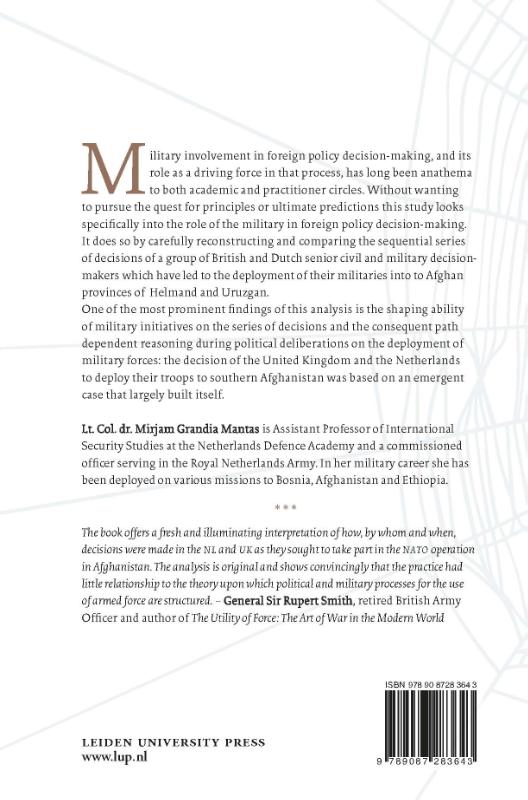
Inescapable Entrapments? The Civil-Military Decision Paths to Uruzgan and Helmand
Paperback300 pagina’sEngels
Military involvement in foreign policy decision-making, and its role as a driving force in that process, has long been anathema to both academic and practitioner circles. Without wanting to pursue the quest for principles or ultimate predictions this study looks specifically into the role of the military in foreign policy decision-making. It does so by carefully reconstructing and comparing the sequential series of decisions of a group of British and Dutch senior civil and military decision-makers which have led to the deployment of their militaries into to Afghan provinces of Helmand and Uruzgan.
One of the most prominent findings of this analysis is the shaping ability of military initiatives on the series of decisions and the consequent path dependent reasoning during political deliberations on the deployment of military forces: the decision of the United Kingdom and the Netherlands to deploy their troops to southern Afghanistan was based on an emergent case that largely built itself.
Lt. Col. Dr. Mirjam Grandia Mantas is Assistant Professor of International Security Studies at the Netherlands Defence Academy and a commissioned officer serving in the Royal Netherlands Army. In her military career she has been deployed on various missions to Bosnia, Afghanistan and Ethiopia.
"The book offers a fresh and illuminating interpretation of how, by whom and when, decisions were made in the NL and UK as they sought to take part in the NATO operation in Afghanistan. The analysis is original and shows convincingly that the practice had little relationship to the theory upon which political and military processes for the use of armed force are structured."General Sir Rupert Smith, retired British Army Officer and author of The Utility of Force: The Art of War in the Modern World
One of the most prominent findings of this analysis is the shaping ability of military initiatives on the series of decisions and the consequent path dependent reasoning during political deliberations on the deployment of military forces: the decision of the United Kingdom and the Netherlands to deploy their troops to southern Afghanistan was based on an emergent case that largely built itself.
Lt. Col. Dr. Mirjam Grandia Mantas is Assistant Professor of International Security Studies at the Netherlands Defence Academy and a commissioned officer serving in the Royal Netherlands Army. In her military career she has been deployed on various missions to Bosnia, Afghanistan and Ethiopia.
"The book offers a fresh and illuminating interpretation of how, by whom and when, decisions were made in the NL and UK as they sought to take part in the NATO operation in Afghanistan. The analysis is original and shows convincingly that the practice had little relationship to the theory upon which political and military processes for the use of armed force are structured."General Sir Rupert Smith, retired British Army Officer and author of The Utility of Force: The Art of War in the Modern World
In het kort
ISBN-13
9789087283643
Verschenen
16 april 2021
Imprint
Bibliografisch
ISBN-139789087283643
Editie1
TaalEngels eng
Pagina’s300
GeïllustreerdNee
Uitgave
ImprintLeiden University Press
CB-relatie-id6345163
Verschenen16 april 2021
StatusOnbekend 00
BeschikbaarheidContact leverancier 99
Zonder prijsPrijs volgt
Vorm & inhoud
ProductvormPaperback BC
SamenstellingLos product
Medewerkers
Auteur A01Mirjam Grandia Mantas
Herkomst
Werk-id (NSTC)501459651
MeldingBevestigd bij publicatie 03
Bijgewerkt6 augustus 2026
Lijkt op dit boek




NSTC 501459651 · CB-relatie 6345163 · Bijgewerkt 6 augustus 2026