
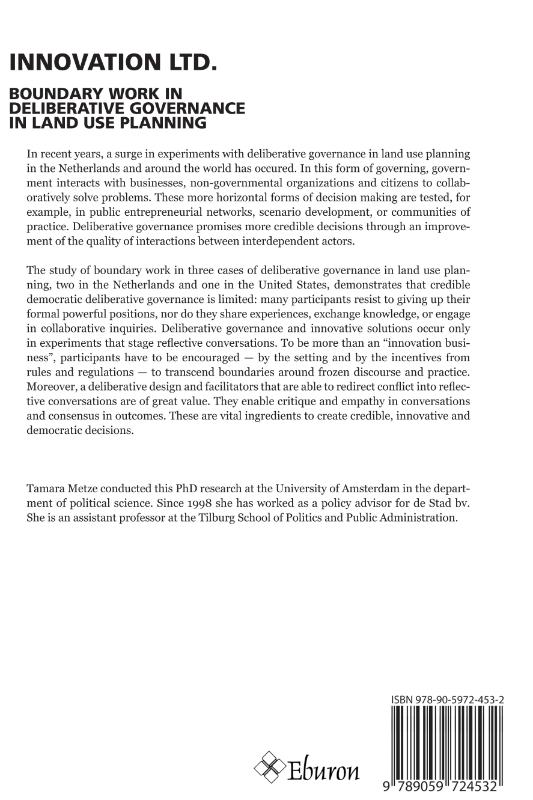
Innovation Ltd. boundary Work in Deliberative Governance in Land Use Planning
Paperback264 pagina’sNederlands
In recent years, a surge in experiments with deliberative governance in land use planning in the Netherlands and around the world has occured. In this form of governing, government interacts with businesses, non-governmental organizations and citizens to collaboratively solve problems. These more horizontal forms of decision making are tested, for example, in public entrepreneurial networks, scenario development, or communities of practice. Deliberative governance promises more credible decisions through an improvement of the quality of interactions between interdependent actors.
The study of boundary work in three cases of deliberative governance in land use planning, two in the Netherlands and one in the United States, demonstrates that credible democratic deliberative governance is limited: many participants resist to giving up their formal powerful positions, nor do they share experiences, exchange knowledge, or engage in collaborative inquiries. Deliberative governance and innovative solutions occur only in experiments that stage reflective conversations. To be more than an innovation business, participants have to be encouraged by the setting and by the incentives from rules and regulations to transcend boundaries around frozen discourse and practice. Moreover, a deliberative design and facilitators that are able to redirect conflict into reflective conversations are of great value. They enable critique and empathy in conversations and consensus in outcomes. These are vital ingredients to create credible, innovative and democratic decisions.
The study of boundary work in three cases of deliberative governance in land use planning, two in the Netherlands and one in the United States, demonstrates that credible democratic deliberative governance is limited: many participants resist to giving up their formal powerful positions, nor do they share experiences, exchange knowledge, or engage in collaborative inquiries. Deliberative governance and innovative solutions occur only in experiments that stage reflective conversations. To be more than an innovation business, participants have to be encouraged by the setting and by the incentives from rules and regulations to transcend boundaries around frozen discourse and practice. Moreover, a deliberative design and facilitators that are able to redirect conflict into reflective conversations are of great value. They enable critique and empathy in conversations and consensus in outcomes. These are vital ingredients to create credible, innovative and democratic decisions.
In het kort
ISBN-13
9789059724532
Uitgever
Verschenen
1 november 2010
Imprint
Bibliografisch
ISBN-139789059724532
Editie1
TaalNederlands dut
Pagina’s264
GeïllustreerdJa
Uitgave
UitgeverEburon Uitgeverij B.V.
ImprintEburon
CB-relatie-id7804140
Verschenen1 november 2010
StatusInactief 08
BeschikbaarheidContact leverancier 99
Zonder prijsPrijs volgt
Vorm & inhoud
ProductvormPaperback BC
SamenstellingLos product
Classificatie
NUR (hoofd)Bestuurs- en beleidskunde 805
NUR (alle)805 Bestuurs- en beleidskunde
Medewerkers
Auteur A01Tamara Metze
Herkomst
Werk-id (NSTC)500303620
MeldingBevestigd bij publicatie 03
Bijgewerkt6 augustus 2026
Lijkt op dit boek

Binnenskamers - editie provincies en waterschappen

The Performance Hack

Leidraad voor het bestuur van een woonmaatschappij

Statuut van de lokale mandataris
Goed, we nemen het mee

AI-survivalkit voor de preventieadviseur

Hoshin Kanri

CORPORATE GREED, PERSONAL SUSTAINABILITY

Burgemeester gezocht

Als het systeem het doel wordt
NSTC 500303620 · CB-relatie 7804140 · Bijgewerkt 6 augustus 2026