
Intellectual Property and Developing Countries: Balancing Rights and Obligations
Paperback731 pagina’sEngels
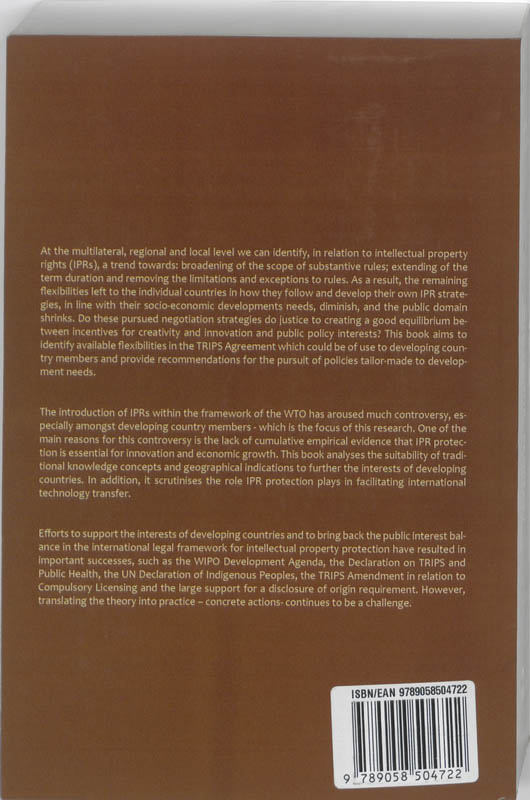
At the multilateral, regional and local level we can identify, in relation to intellectual property rights (IPRs), a trend toward: broadening of the scope of substantive rules; extending of the term duration and removing the limitations and expectations to rules. As a result, the remaining flexibilities left to the individual countries in how they follow and develop their own IPR strategies, in line with their socio-economic developments needs, diminish, and the public domain shrinks. Do these pursued negotiation strategies do justice to creating a good equilibrium between incentives for creativity and innovation and public policy interests? This book aims to identity available flexibilities in the TRIPS Agreement which could be of use to developing country members and provide recommendations for the pursuit of policies tailor-made to development needs. The introduction of IPRs within the framework of the WTO has aroused much controversy, especially amongst developing country members which is the focus of this research. One of the main reasons for this controversy is the lack of cumulative empirical evidence that IPR protection is essential for innovation and economic growth. This book analyses the suitability of traditional knowledge concepts and geographical indications to further the interests of developing countries. In addition, it scrutinises the role IPR protection plays in facilitating international technology transfer. Efforts to support the interests of developing countries and to bring back the public interest balance in the international legal framework for intellectual property protection have resulted in Public Health, the UN Declaration of Indigenous Peoples, the TRIPS Amendment in relation to Compulsory Licensing and the large support for a disclosure of origin requirement. However , translating the theory in to practice concrete actions continues to be a challenge.
In het kort
Bibliografisch
ISBN-139789058504722
Editie1
TaalEngels eng
Pagina’s731
GeïllustreerdNee
Uitgave
Vorm & inhoud
ProductvormPaperback BC
SamenstellingLos product
Classificatie
NUR (hoofd)Recht algemeen 820
NUR (alle)820 Recht algemeen
Medewerkers
Auteur A01F.J.R. Claessens
Herkomst
Werk-id (NSTC)500293804
MeldingBevestigd bij publicatie 03
Bijgewerkt6 augustus 2026
Lijkt op dit boek
Grondwet

Niet zonder ons

Manuel de l'ordre public

Informatie beheren en archiveren: selecteren en digitaal depot

Codex overheidsopdrachten

Welzijn in de bibliotheek. Gids voor zorgzame en veerkrachtige bibliotheken

Manuel de la discipline des services de police

Handboek tucht bij de politiediensten
Wegwijs overheidsopdrachten

De gecoördineerde vzw-wetgeving
NSTC 500293804 · CB-relatie 8037459 · Bijgewerkt 6 augustus 2026