
Introduction to Chemical Thermodynamics
Paperback200 pagina’sNederlands
Ook verkrijgbaar als
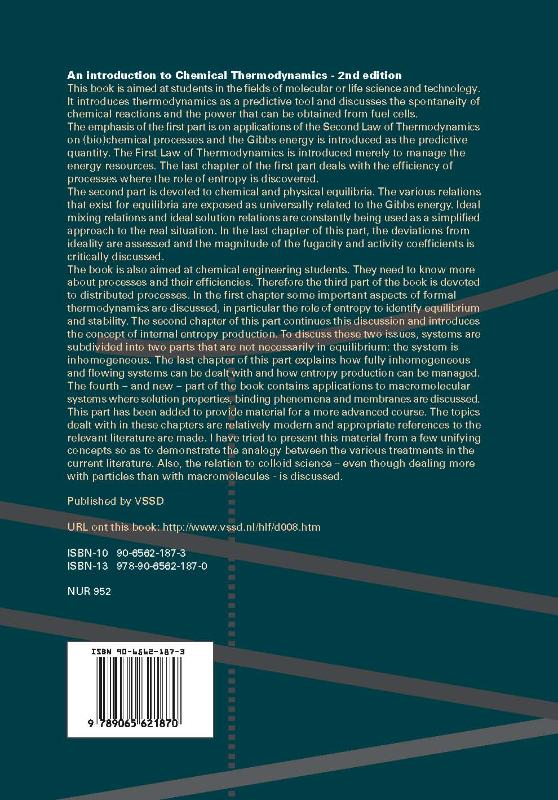
An introduction to Chemical Thermodynamics
This book is aimed at students in the fields of molecular or life science
and technology. It introduces thermodynamics as a predictive tool and
discusses the spontaneity of chemical reactions and the power that can be
obtained from fuel cells.
The emphasis of the first part is on applications of the Second Law of
Thermodynamics on (bio)chemical processes and the Gibbs energy is
introduced as the predictive quantity. The First Law of Thermodynamics is
introduced merely to manage the energy resources. The last chapter of the
first part deals with the efficiency of processes where the role of
entropy is discovered.
The second part is devoted to chemical and physical equilibria. The
various relations that exist for equilibria are exposed as universally
related to the Gibbs energy. Ideal mixing relations and ideal solution
relations are constantly being used as a simplified approach to the real
situation. In the last chapter of this part, the deviations from ideality
are assessed and the magnitude of the fugacity and activity coefficients
is critically discussed.
The book is also aimed at chemical engineering students. These need to
know more about processes and their efficiencies. Therefore the third part
of the book is devoted to distributed processes. In the first chapter some
important aspects of formal thermodynamics are discussed, in particular
the role of entropy to identify equilibrium and stability. The second
chapter of this part continues this discussion and introduces the concept
of internal entropy production. To discuss these two issues, systems are
subdivided into two parts that are not necessarily in equilibrium: the
system is inhomogeneous. The last chapter of this part explains how fully
inhomogeneous and flowing systems can be dealt with and how entropy
production can be managed.
The fourth - and new - part of the book contains applications to
macromolecular systems where solution properties, binding phenomena and
membranes are discussed. This part has been added to provide material for
a more advanced course. The topics dealt with in these chapters are
relatively modern and appropriate references to the relevant literature
are made. The author has tried to present this material from a few
unifying concepts so as to demonstrate the analogy between the various
treatments in the current literature. Also, the relation to colloid
science - even though dealing more with particles than with macromolecules
- is discussed.
Contents
Preface
Part I - Processes in Chemistry and Biochemistry
1 Overview
2 Spontaneity of processes
3 Available work
4 Energy conservation
5 Efficiency and entropy
Part II - Chemical and Physical Equilibria
6 General aspects of equilibria
7 Phase equilibria of pure substances
8 Capillary phenomena and adsorption
9 Phase equilibria of mixtures
10 Mixtures and colligative properties
11 Non-ideal mixtures
Part III - Distributed Processes
12 Fundamentals of chemical thermodynamics
13 Irreversible processes
14 Flow processes
Part IV - Macromolecular Systems
15 Macromolecular solutions
16 Macromolecular binding equilibria
17 Membranes
Index
http://www.vssd.nl/hlf/d008.htm
This book is aimed at students in the fields of molecular or life science
and technology. It introduces thermodynamics as a predictive tool and
discusses the spontaneity of chemical reactions and the power that can be
obtained from fuel cells.
The emphasis of the first part is on applications of the Second Law of
Thermodynamics on (bio)chemical processes and the Gibbs energy is
introduced as the predictive quantity. The First Law of Thermodynamics is
introduced merely to manage the energy resources. The last chapter of the
first part deals with the efficiency of processes where the role of
entropy is discovered.
The second part is devoted to chemical and physical equilibria. The
various relations that exist for equilibria are exposed as universally
related to the Gibbs energy. Ideal mixing relations and ideal solution
relations are constantly being used as a simplified approach to the real
situation. In the last chapter of this part, the deviations from ideality
are assessed and the magnitude of the fugacity and activity coefficients
is critically discussed.
The book is also aimed at chemical engineering students. These need to
know more about processes and their efficiencies. Therefore the third part
of the book is devoted to distributed processes. In the first chapter some
important aspects of formal thermodynamics are discussed, in particular
the role of entropy to identify equilibrium and stability. The second
chapter of this part continues this discussion and introduces the concept
of internal entropy production. To discuss these two issues, systems are
subdivided into two parts that are not necessarily in equilibrium: the
system is inhomogeneous. The last chapter of this part explains how fully
inhomogeneous and flowing systems can be dealt with and how entropy
production can be managed.
The fourth - and new - part of the book contains applications to
macromolecular systems where solution properties, binding phenomena and
membranes are discussed. This part has been added to provide material for
a more advanced course. The topics dealt with in these chapters are
relatively modern and appropriate references to the relevant literature
are made. The author has tried to present this material from a few
unifying concepts so as to demonstrate the analogy between the various
treatments in the current literature. Also, the relation to colloid
science - even though dealing more with particles than with macromolecules
- is discussed.
Contents
Preface
Part I - Processes in Chemistry and Biochemistry
1 Overview
2 Spontaneity of processes
3 Available work
4 Energy conservation
5 Efficiency and entropy
Part II - Chemical and Physical Equilibria
6 General aspects of equilibria
7 Phase equilibria of pure substances
8 Capillary phenomena and adsorption
9 Phase equilibria of mixtures
10 Mixtures and colligative properties
11 Non-ideal mixtures
Part III - Distributed Processes
12 Fundamentals of chemical thermodynamics
13 Irreversible processes
14 Flow processes
Part IV - Macromolecular Systems
15 Macromolecular solutions
16 Macromolecular binding equilibria
17 Membranes
Index
http://www.vssd.nl/hlf/d008.htm
In het kort
ISBN-13
9789065621870
Uitgever
Verschenen
11 september 2008
Bibliografisch
ISBN-139789065621870
Editie2
TaalNederlands dut
Pagina’s200
GeïllustreerdJa
Uitgave
UitgeverDelft Academic Press / VSSD
CB-relatie-id8095824
Verschenen11 september 2008
StatusInactief 08
BeschikbaarheidContact leverancier 99
Adviesprijs (incl. btw)€ 18,55
Vorm & inhoud
ProductvormPaperback BC
SamenstellingLos product
Classificatie
NUR (hoofd)(Bio)chemische techniek 952
NUR (alle)952 (Bio)chemische techniek
Medewerkers
Auteur A01G.J.M. Koper
Herkomst
Werk-id (NSTC)100034921
MeldingBevestigd bij publicatie 03
Bijgewerkt6 augustus 2026
Lijkt op dit boek

Introduction to International Commercial and European Law

Inleiding ICT en recht

Inleiding ICT en recht

Recht en efficiëntie

Strafprocesrecht

Inleiding in het Nederlandse recht

Belastingrecht in Hoofdlijnen

Hoofdzaken milieuheffingen

Inleiding tot het Nederlandse Internationaal Privaatrecht

Inleiding constitutioneel recht
NSTC 100034921 · CB-relatie 8095824 · Bijgewerkt 6 augustus 2026