
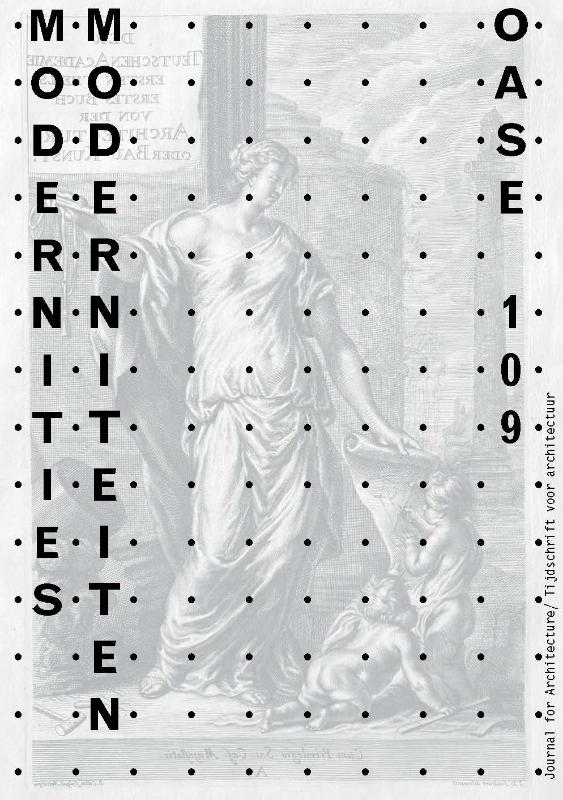
Journal for Architecture 109 Moderniteiten / Modernities
Architectuurgeschiedenis wordt vaak gelezen in termen van periodes met een eigen zeitgeist. OASE 109 onderzoekt hoe binnen een verbreding van referentiekader een ander begrip van moderniteit ontstaat.The history of architecture is often read in terms of periods that each have their own zeitgeist and movements that each have their own architectural language. What happens if we depart from this zeitgeist concept and use a cyclical history model instead? In the 1970s and 1980s, this question was usually considered from the seemingly mutually exclusive points of view of the modern, the anti-modern and the postmodern positions. The lines dividing these positions were also directly linked to certain formal-aesthetic choices, even in terms of the care of existing buildings and the preservation of monuments, in which the boundary between new and old is arbitrary by definition. Over the past two decades, contemporary European architecture developed a different frame of reference, one in which the horizon is no longer provided by the architecture of the modern movement. Historical typological principles, compositional approaches and material logic are also experienced as modern and they provide the starting point for the design. OASE 109 traces how, against the background of this broadening frame of reference, a different understanding of modernity emerged.
In het kort
ISBN-13
9789462086418
Uitgever
Verschenen
29 oktober 2021
Serie
Imprint
Bibliografisch
Uitgave
Uitgevernai010 uitgevers/publishers
Imprintnai010 uitgevers/publishers
CB-relatie-id7100743
Verschenen29 oktober 2021
StatusOnbekend 00
Vorm & inhoud
ProductvormE-book ED
VormdetailE107 PDF
SamenstellingLos product
Beveiliging e-bookDigitaal watermerk 02
Classificatie
NUR (hoofd)Bouwkunst, architectuur 648
NUR (alle)648 Bouwkunst, architectuur
Medewerkers
Herkomst
Werk-id (NSTC)500887510
MeldingBevestigd bij publicatie 03
Bijgewerkt6 augustus 2026
Lijkt op dit boek

NSTC 500887510 · CB-relatie 7100743 · Bijgewerkt 6 augustus 2026