
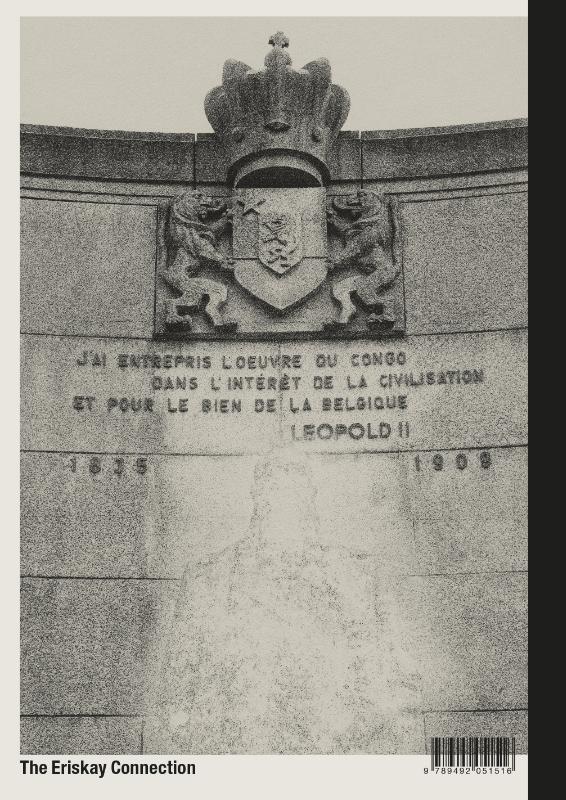
Leopold’s Legacy
Paperback152 pagina’sEngelsLeverbaar
Leopold’s Legacy is a reflection on both the visible representations of colonialism in present-day Belgium, and the hidden traces of its gruesome past.In 1885, King Leopold II of Belgium was proclaimed the sole owner of the Congo Free State. His administration was characterised by forced labour, torture and murder, and a large part of the gains from this exploitation was spent on public and private construction projects in Belgium that are often still part of it’s urban space today. In Leopold’s Legacy, Oliver Leu (DE) presents an eclectic collection of visual research. All the remnants of a once glorious past paint a wry story of decades of structural exploitation and genocide. Including an extensive essay by Bambi Ceuppens, researcher at the Royal Museum for Central Africa in Tervuren.Leopold’s Legacy is a reflection on both the visible representations of colonialism in present-day Belgium, and the hidden traces of its gruesome past. Oliver Leu (DE) presents an eclectic collection of visual research, focusing on various topics from colonial monuments and prestigious architecture to antique postcards and collaged sculptures for alternative monuments. All these remnants of a once glorious past paint a wry story of decades of structural exploitation and genocide, and demonstrate how in Europe our collective perception of these events is gradually changing.At the Berlin Conference in 1885, King Leopold II of Belgium was proclaimed the founder and sole owner of the Congo Free State, by convincing the colonial nations of Europe to commit to common trade and improving the lives of the native inhabitants. But in reality he extracted a fortune from the territory. Initially by the collection of ivory, but since the invention of the rubber wheel by Dunlop in 1888, mostly by exploiting the Congolese people to harvest and process rubber. His administration of the Congo was characterised by forced labour, torture and murder, causing the deaths of millions of Congolese people. A large part of the monetary gains from this exploitation was spent on public and private construction projects in Belgium that are often still part of our urban space.With Leopold’s Legacy, Leu paints the portrait of an ambitious ruler with delusions of grandeur, and the influence the exploitation of his private colony still has on his home country today.Including an introductory text by Professor of History, Matthew G. Stanard, and an extensive essay by Bambi Ceuppens, researcher and curator at the Royal Museum for Central Africa in Tervuren.
In het kort
ISBN-13
9789492051516
Uitgever
Verschenen
1 mei 2020
Imprint
Druk
1
Bibliografisch
ISBN-139789492051516
Editie1
Druk1
TaalEngels eng
Pagina’s152
GeïllustreerdJa
Uitgave
UitgeverThe Eriskay Connection
ImprintThe Eriskay Connection
CB-relatie-id7382518
Verschenen1 mei 2020
StatusLeverbaar 04
BeschikbaarheidBeschikbaar 20
Adviesprijs (incl. btw)€ 25,00
Vorm & inhoud
ProductvormPaperback BC
SamenstellingLos product
Classificatie
NUR (hoofd)Fotoboeken 653
NUR (alle)653 Fotoboeken
Medewerkers
Auteur A01Oliver Leu
Herkomst
Werk-id (NSTC)500322492
MeldingBevestigd bij publicatie 03
Bijgewerkt6 augustus 2026
Lijkt op dit boek
NSTC 500322492 · CB-relatie 7382518 · Bijgewerkt 6 augustus 2026