
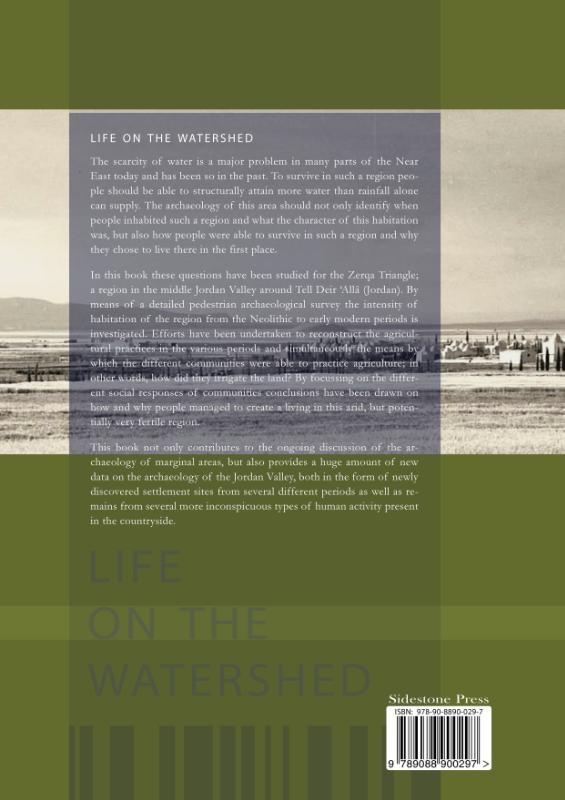
Life on the watershed reconstructing subsistence in a steppe region using archaeological survey: a diachronic perspective on habitation in the Jordan Valley
Paperback400 pagina’sEngels
Ook verkrijgbaar als
The scarcity of water is a major problem in many parts of the Near East today and has been so in the past. To survive in such a region people should be able to structurally attain more water than rainfall alone can supply. The archaeology of this area should not only identify when people inhabited such a region and what the character of this habitation was, but also how people were able to survive in such a region and why they chose to live there in the first place.
In this book these questions have been studied for the Zerqa Triangle; a region in the middle Jordan Valley around Tell Deir 'Alla (Jordan). By means of a detailed pedestrian archaeological survey the intensity of habitation of the region from the Neolithic to early modern periods is investigated. Efforts have been undertaken to reconstruct the agricultural practices in the various periods and simultaneously the means by which the different communities were able to practice agriculture; in other words, how did they irrigate the land? By focussing on the different social responses of communities conclusions have been drawn on how and why people managed to create a living in this arid, but potentially very fertile region.
This book not only contributes to the ongoing discussion of the archaeology of marginal areas, but also provides a huge amount of new data on the archaeology of the Jordan Valley, both in the form of newly discovered settlement sites from several different periods as well as remains from several more inconspicuous types of human activity present in the countryside.
In this book these questions have been studied for the Zerqa Triangle; a region in the middle Jordan Valley around Tell Deir 'Alla (Jordan). By means of a detailed pedestrian archaeological survey the intensity of habitation of the region from the Neolithic to early modern periods is investigated. Efforts have been undertaken to reconstruct the agricultural practices in the various periods and simultaneously the means by which the different communities were able to practice agriculture; in other words, how did they irrigate the land? By focussing on the different social responses of communities conclusions have been drawn on how and why people managed to create a living in this arid, but potentially very fertile region.
This book not only contributes to the ongoing discussion of the archaeology of marginal areas, but also provides a huge amount of new data on the archaeology of the Jordan Valley, both in the form of newly discovered settlement sites from several different periods as well as remains from several more inconspicuous types of human activity present in the countryside.
In het kort
Bibliografisch
ISBN-139789088900297
Editie1
TaalEngels eng
Pagina’s400
GeïllustreerdJa
Uitgave
Vorm & inhoud
ProductvormPaperback BC
SamenstellingLos product
Classificatie
NUR (hoofd)Archeologie 682
NUR (alle)682 Archeologie
Medewerkers
Auteur A01E. Kaptijn
Herkomst
Werk-id (NSTC)500483389
MeldingBevestigd bij publicatie 03
Bijgewerkt6 augustus 2026
Lijkt op dit boek
Durrington Walls and Woodhenge: A place for the living
Durrington Walls and Woodhenge: A place for the living
Indigenous Knowledge in Transformation
Indigenous Knowledge in Transformation
Archaeological Approaches to Inequality, Political Organisation, and Social Complexity
Archaeological Approaches to Inequality, Political Organisation, and Social Complexity
Stadterweiterungen und urbane Dynamik im Mittelalter
Stadterweiterungen und urbane Dynamik im Mittelalter
Prehistoric Shore Settlements of the Southwestern Balkans
Prehistoric Shore Settlements of the Southwestern Balkans
NSTC 500483389 · CB-relatie 9180064 · Bijgewerkt 6 augustus 2026