
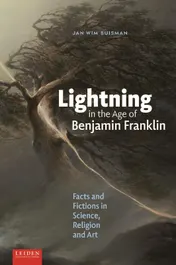
Lightning in the Age of Benjamin Franklin Facts and Fictions in Science, Religion, and Art
Hardback384 pagina’sEngels
Ook verkrijgbaar als
Introduction: Lightning after Franklin1. A New Invention2. The Introduction of the Lightning Rod in the Netherlands3. Eighteenth-Century Physical Theories on Thunderstorms4. Official Religion5. Marginal and Marginalised Religious Reactions6. Intermezzo: Electrical Nature? The Animated Nature of Theosophy7. Thunderstorms and Electricity in Poetry, Music, and Painting8. By Way of Conclusion, Notes, Bibliography, Illustration credits, Index of NamesThis book shows how the Enlightenment and Romanticism have forever changed our scientific, religious, and artistic image of natural violence.From time immemorial, thunder and lightning were seen as a wrathful Deity’s instruments of punishment. But then, in 1752, came Benjamin Franklin’s paradigm-shifting invention of the lightning rod, and the way we view God and nature was changed forever.In Lightning in the Age of Benjamin Franklin. Facts and Fictions in Science, Religion, and Art Jan Wim Buisman shows how, in the second half of the eighteenth century, our scientific, religious, and artistic conceptions of one of nature’s most violent phenomena were transformed. Thunderstorms began to be experienced less as a threat and more as a source of fascinating delight, and God became less of an angry demiurge and more of a benevolent father. At the same time, university-trained scholars, inquiring amateurs, and sharp-witted showmen embarked on experiments with the multifarious potential of electricity in medicine and elsewhere. With the storm no longer a spectacle to be feared, poets, painters, and composers started to treat it as a subject in its own right. Never before was the beauty of thunder and lightning so frequently and fulsomely represented in Western culture as during the transition from the Enlightenment to theRomantic era."The transition from a premodern fear of nature to Romanticism’s love affair with the natural sublime has been explored from many angles. But in this absorbing and erudite book, Jan Wim Buisman reveals that lightning and electricity were central to this transformation. From the premodern practice of bell-ringing to ward off lightning, to the Enlightenment’s playful use of static electricity to generate an “electric kiss,” Buisman charts the evolution of Europeans’ relationship to one of nature’s fundamental forces. He shows how scientific advances such as the lightning rod actually made the Romantic fascination with nature possible. This electrifying book is essential reading for anyone interested in nature, religion, and intellectual history."—Peter J. Thuesen, author of Tornado God: American Religion and Violent Weather
In het kort
ISBN-13
9789087283872
Verschenen
15 mei 2023
Imprint
Bibliografisch
ISBN-139789087283872
Editie1
TaalEngels eng
Pagina’s384
GeïllustreerdJa
Uitgave
ImprintLeiden University Press
CB-relatie-id6345163
Verschenen15 mei 2023
StatusOnbekend 00
BeschikbaarheidContact leverancier 99
Zonder prijsPrijs volgt
Vorm & inhoud
ProductvormHardback BB
SamenstellingLos product
Classificatie
NUR (hoofd)Cultuur- en mentaliteitsgeschiedenis 694
NUR (alle)694 Cultuur- en mentaliteitsgeschiedenis
Trefwoordenreligion · enlightenment · nature · benjamin franklin · providence · thunder · romanticism
Medewerkers
Auteur A01Jan Wim Buisman
Herkomst
Werk-id (NSTC)501538010
MeldingBevestigd bij publicatie 03
Bijgewerkt6 augustus 2026
Trefwoorden
Lijkt op dit boek









NSTC 501538010 · CB-relatie 6345163 · Bijgewerkt 6 augustus 2026