
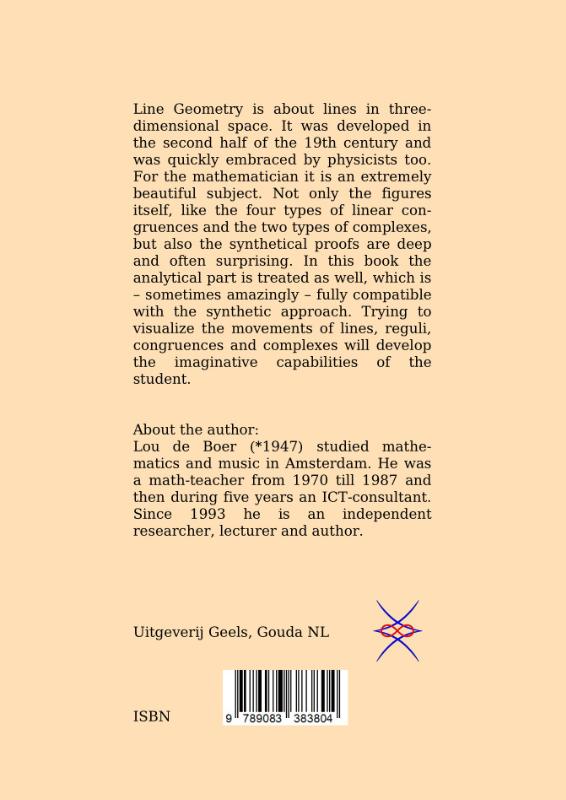
Line Geometry Part 1
Paperback177 pagina’sEngels
Introduction 1 Recapitulation1.1 The general projective space1.2 The numeric projective space 1.3 The projective 3-space over R1.4 Degree of Freedom, DoF1.5 Separation 1.6 General position and (in-) dependency 1.7 Projective maps 1.8 Conics1.9 Coordinates1.10 Mutual position of elements 1.11 Exercises 1.12 The touch operator1.13 Quadrics 1.14 Projectivities of the line1.15 Geometric algebra2 The parabolic strip2.1 Definition and properties2.2 A matrix for the parabolic strip2.3 Orientation 3 The regulus3.1 Definition3.2 Projectivities3.3 Orientation4 Linear dependency of lines4.1 Synthetic4.2 Analytic4.3 Outlook 5 The linear congruence5.1 Definitions and properties 5.2 Dependency 4, synthetic 5.3 Biaxial collineations5.4 Biaxials, synthetic5.5 Biaxials, analytic5.6 Elations 5.7 Dependency 4, analytic 5.8 Orientation of linear congruences 5.9 Summary .6 The linear complex 6.1 Skew pentagons 6.2 Special linear complexes 6.3 An image of a general linear complex 6.4 The null-polarity and its complex 6.5 The theorem of Sylvester 6.6 The theorem of Chasles 6.7 Dependency 5, synthetic 6.8 Constructions 6.9 Complexes, analytically 6.10 Dependency, conclusion 6.11 General position of lines 6.12 Orientation of linear complexes A Complex and null-polarityA.1 The invariant lines of a null-polarity A.2 The pencils of a linear complex A.3 More about Ω B A model of the complex List of symbolsReferencesIndexLine geometry, as its name indicates, studies systems of straight lines in 3-dimensional space. Like with Euclidean Geometry, Line geometry gets a better understanding whenstudied in the extended space, viz. in the real projective space of dimension 3.The subject was born, one could say, in 1868, when Julius Plücker finished the firstvolume of his Neue Geometrie des Raumes. It florished in the period around the turnof the 19th century into the 20th and was very much embraced by physicists. Thoughit never really disappeared, after WWI it was rather neglected until George Adamswrote several studies in the years 1934-1939. In the 1970s Peter Gschwind wroteabout the Linear Complex and in 1981 Renatus Ziegler gave his first account on linegeometry. Two interesting books by Stoß followed and in 2012 Ziegler published anextended (English) version of his 1981-book. Half of this last book is on general pro-jective geometry, and Ziegler deliberately restricted to the synthetic treatment of hissubjects – as did Stoß. The analytic approach, however, is an important counterpart to the synthetic one, and it is a real joy to discover the differences in proofs between the two approaches.By the way, above them reigns algebra. In this book geometric objects are treated asalgebraic ones, with the fundamental relation of containment (≺) or incidence, andthe basic operators meet (∧) and join (∨). In chapter 1 this is summarized, as are themost important issues of elementary projective geometry. In the next two chaptersthe parabolic strip and the regulus are treated, after which proper line geometry starts with the concept of linear dependency of lines, synthetically as well as analytically.Chapter 5 is about linear congruences, chapter 6 about linear complexes. Only thenit is possible to finish the treatment of dependency of lines.
In het kort
ISBN-13
9789083383804
Uitgever
Verschenen
18 november 2023
Imprint
Bibliografisch
ISBN-139789083383804
Editie1
TaalEngels eng
Pagina’s177
GeïllustreerdJa
Uitgave
UitgeverUitgeverij Geels
ImprintUitgeverij Geels
CB-relatie-id6661665
Verschenen18 november 2023
StatusAangekondigd 02
BeschikbaarheidContact leverancier 99
Adviesprijs (incl. btw)€ 27,50
Vorm & inhoud
ProductvormPaperback BC
SamenstellingLos product
Classificatie
NUR (hoofd)Fundamentele wiskunde 921
Trefwoordendependency · elliptic congruence · field of lines · hyperboloid · linear complex · plücker-coordinates · bundle · collineation · duality · field of points · geometric algebra · involution · linear congruence · null-polarity · projective space · ruled plane · touch operator · hyperplane · parabolic strip · pencil · ruled point · synthetic dependency
Medewerkers
Herkomst
Werk-id (NSTC)501567288
MeldingBevestigd bij publicatie 03
Bijgewerkt6 augustus 2026
Trefwoorden
Lijkt op dit boek
Mathematics of the Great Pyramid
Goniometrische veranderingen
Lineaire algebra
Mathematics of Leonardo da Vinci cabinet. And the Mona Lisa.
Geometric New Earth projection
Relativity
Mathematics of the number 369 and the power of universal resistance
Mathematics of the number 369
The Pure Cube
Secret of the Great Pyramid
NSTC 501567288 · CB-relatie 6661665 · Bijgewerkt 6 augustus 2026