
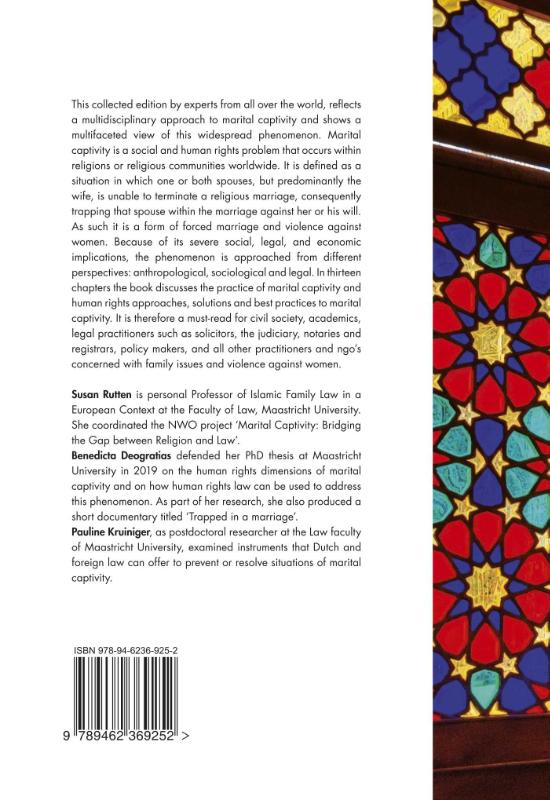
Marital Captivity Divorce, Religion and Human Rights
Hardback406 pagina’sEngels
Ook verkrijgbaar als
This collected edition by experts from all over the world, reflects a multidisciplinary approach to marital captivity and shows a multifaceted view of this widespread phenomenon. Marital captivity is a social and human rights problem that occurs within religions or religious communities worldwide. It is defined as a situation in which one or both spouses, but predominantly the wife, is unable to terminate a religious marriage, consequently trapping that spouse within the marriage against her or his will. As such it is a form of forced marriage and violence against women. Because of its severe social, legal, and economic implications, the phenomenon is approached from different perspectives: anthropological, sociological and legal. In thirteen chapters the book discusses the practice of marital captivity and human rights approaches, solutions and best practices to marital captivity. It is therefore a must-read for civil society, academics, legal practitioners such as solicitors, the judiciary, notaries and registrars, policy makers, and all other practitioners and ngo’s concerned with family issues and violence against women.
In het kort
ISBN-13
9789462369252
Uitgever
Verschenen
17 juli 2019
Bibliografisch
ISBN-139789462369252
Editie1
TaalEngels eng
Pagina’s406
GeïllustreerdNee
Uitgave
UitgeverKoninklijke Boom uitgevers PW
CB-relatie-id7500275
Verschenen17 juli 2019
StatusOnbekend 00
BeschikbaarheidContact leverancier 99
Adviesprijs (incl. btw)€ 95,00
Vorm & inhoud
ProductvormHardback BB
SamenstellingLos product
Classificatie
NUR (hoofd)Internationaal (publiek)recht 828
NUR (alle)828 Internationaal (publiek)recht
Medewerkers
Herkomst
Werk-id (NSTC)500233580
MeldingBevestigd bij publicatie 03
Bijgewerkt6 augustus 2026
Lijkt op dit boek
Islamic divorces in Europe
Breaking Eurocentric Frames on Arranged Marriage
The human rights of migrant women in International and European Law
Recent Developments in Turkish Family Law
Women and Minority Rights Law in Africa: Reimagining Equality and Addressing Discrimination
Religious Radicalism
Religion in the public square
Migration and Religious Freedom
Understanding kinship care of children in Africa
Religion, Law and Education
NSTC 500233580 · CB-relatie 7500275 · Bijgewerkt 6 augustus 2026